
Imagine standing in a showroom, staring at a high-quality vinyl floor sample you love, while your partner is already tallying up the costs and shaking their head. It’s a common scene that can quickly turn a dream home project into a source of domestic tension. You likely feel the weight of making a permanent, expensive mistake, or perhaps you’re worried about the 5% to 7% rise in construction costs projected for 2026. Learning how to get buy-in from spouse on renovation choices is not about winning an argument; it’s about building a shared future where both partners feel heard and secure.
We understand that financial anxiety and design deadlocks are real hurdles. This guide provides a professional framework to align your vision, manage your budget, and master the art of compromise without straining your relationship. You’ll learn how to prioritize lifestyle ROI and use durable materials to bridge the gap between beauty and cost. We will walk you through practical strategies for harmonious planning, from setting a 20% contingency buffer to selecting expert carpentry and tiling services that both of you will take pride in for years to come.
Key Takeaways
- Shift your focus from individual design preferences to shared lifestyle goals to eliminate the decision fatigue often found in Singaporean renovations.
- Discover exactly how to get buy-in from spouse on renovation choices by presenting three curated options at varying price points for every major decision.
- Explore the role of “Bridge Materials” like premium vinyl flooring, which offers the perfect balance between high-end aesthetics and practical budget management.
- Learn to frame design choices around solving specific daily frustrations, such as selecting low-maintenance tiling and cement works to save time on cleaning.
- Use professional site assessments and showroom visits as objective tools to resolve deadlocks and turn planning into a collaborative experience.
The Renovation Struggle: Why Singaporean Couples Clash Over Home Design
Renovating a home in Singapore is rarely a linear path. It’s often a high-stakes negotiation that begins long before the first wall is hacked. Many couples face “Renovation Burnout” after the multi-year wait for a BTO flat. By the time the keys are in hand, the excitement is often replaced by exhaustion. This sets the stage for friction when you’re suddenly tasked with choosing over 200 design elements, from light switches to skirting boards. This phenomenon, known as decision fatigue, makes even small choices feel like monumental hurdles.
In most relationships, a classic dynamic emerges: the “Aesthetic Partner” versus the “Practical Partner.” One spouse prioritizes the visual impact seen in magazines, while the other focuses on durability, maintenance, and the bottom line. Learning how to get buy-in from spouse on renovation choices starts with acknowledging that these differing perspectives are valid. Disagreement is a normal, healthy part of the flooring Singapore journey. It’s not a sign of a failing project, but rather a reflection of two people caring deeply about their future environment.
The BTO and Resale Pressure Cooker
Singapore’s strict HDB renovation windows add an extra layer of stress. You have only three months to complete works for a new BTO block and a mere one month for existing resale blocks once the permit is granted. This ticking clock, combined with projected construction cost increases of 5% to 7% in 2026, creates a pressure cooker environment. “Instagram-envy” often complicates matters. When one spouse expects a showroom-perfect home based on social media trends, the other may reject these ideas as unrealistic or financially risky. Understanding the economic principles of intra-household bargaining can help you navigate these power dynamics more effectively.
Identifying Your ‘Deal-Breakers’ Early
To reduce choice overload, you must distinguish between “Must-Haves” and “Nice-to-Haves” early in the planning phase. Establishing these boundaries prevents arguments from escalating during the actual renovation. It’s also helpful to give each partner “ownership” of a specific room or design category. If one spouse manages the kitchen carpentry, the other might take the lead on the living room layout. To avoid the “I told you so” trap, document every decision in a shared digital folder. This ensures transparency and provides a clear reference point when memories of a discussion differ. By following these steps, you’ll find that how to get buy-in from spouse on renovation choices becomes a structured process rather than a series of emotional battles.
- Define clear budgets: Agree on a hard cap before visiting showrooms.
- Limit daily decisions: Don’t try to pick tiles, paint, and lights all in one afternoon.
- Focus on lifestyle: Discuss how you’ll use the space, not just how it looks.
Building a Shared Vision: Aligning Aesthetics and Budget
Aligning your vision starts with a fundamental shift. Stop trying to agree on a “Shared Design Style.” Instead, establish a “Shared Lifestyle Goal.” If one spouse wants a dark, moody aesthetic and the other prefers bright, airy spaces, you’ll reach a stalemate. However, you likely both agree on wanting a home that’s “easy to maintain” or “perfect for hosting family.” This lifestyle-first approach is a cornerstone of how to get buy-in from spouse on renovation choices. It replaces subjective taste with objective utility and shared values.
Creating a “Joint Mood Board” is your next tactical step. Don’t focus on the differences. Look for the commonalities. Use digital tools to pin images, then identify the overlapping textures, colors, or layouts. Often, you’ll find that while the labels differ, the underlying preferences for comfort or functionality are the same. For complex projects that require more than just aesthetic alignment, consulting the top renovation companies in Singapore can provide a neutral, professional perspective to bridge these gaps and settle design disputes.
If you find it difficult to reconcile these visions alone, seeking a professional full home renovation consultation can help translate your conflicting ideas into a cohesive, workable plan.
The ‘Why’ vs. ‘What’ Conversation
Shift the dialogue from specific items to the emotional outcome. Ask “Why do you like this?” instead of “What is that?” If a spouse insists on an expensive feature, ask what their biggest worry is about the alternative. You might discover they’re worried about durability or safety rather than just the look. Reframing these choices as “Relationship ROI” ensures that every dollar spent contributes to long-term harmony. It’s about building a space that supports your daily life together—whether that involves relaxing at home or heading out to visit SgGolfCoach for some professional coaching—rather than just creating a gallery for guests.
Financial Transparency and Joint Budgeting
Money is the most common friction point. With construction costs in Singapore projected to rise by up to 7% in 2026, financial clarity is non-negotiable. Establish a “Hard Cap” budget. If a choice pushes you over this limit, implement a mandatory 24-hour cooling-off period before committing. We recommend a 15% contingency fund specifically for unforeseen structural issues or material price spikes. This “Budget Buffer” acts as an insurance policy for your peace of mind. Using joint accounts for renovation milestones ensures both partners feel equally invested in the outcome. Prioritize durable materials like high-grade vinyl or custom carpentry that offer long-term value over cheap, temporary fixes that lead to future repair costs.
The Strategy of Compromise: Choosing Materials That Please Both Spouses
Compromise doesn’t have to mean settling for second best. In the context of a 2026 renovation, the most successful couples utilize “Bridge Materials.” These are specific products that look high-end to satisfy the aesthetic-focused spouse but perform like workhorses to please the practical-minded partner. Understanding how to get buy-in from spouse on renovation choices often comes down to finding these middle-ground solutions that eliminate the “either/or” conflict.
One of the most effective peacemakers in a modern home is vinyl flooring Singapore. It bridges the gap between luxury and logic perfectly. One partner might dream of the warmth of natural timber or the prestige of marble, while the other worries about the high cost and delicate maintenance those materials require. Modern resilient flooring solves this by offering over 200 designs that flawlessly mimic expensive wood or stone. You get the visual “wow” factor without the financial or domestic stress.
Why Vinyl is the Ultimate ‘Buy-In’ Material
For the design-focused spouse, today’s premium vinyl features high-definition textures and realistic embossing that are nearly indistinguishable from natural materials. It creates the sophisticated atmosphere you want for your 2026 home. Meanwhile, the practical partner gains peace of mind through industry-standard durability. High-quality vinyl is waterproof and scratch-resistant, making it a reliable choice for the long term. It offers a high-end look without the “marble” price tag, allowing you to reallocate those savings to other areas like custom carpentry or high-tech appliances.
Comparing Flooring Options for Couples
When you’re stuck in a design deadlock, looking at objective data can help clear the air. Use this comparison to see how different materials stack up against your shared lifestyle goals.
| Feature | Vinyl Flooring | Parquet (Wood) | Ceramic Tiles |
|---|---|---|---|
| Maintenance | Very Low (Waterproof) | High (Vulnerable to moisture) | Medium (Grout cleaning) |
| Aesthetic Appeal | High (200+ designs) | Very High (Natural) | Moderate to High |
| Price Point | Affordable | Expensive | Moderate |
| Durability | Scratch-resistant | Prone to dents | Chip-prone |
Modern resilient flooring is the most durable and life-proof choice for busy Singaporean families with pets or young children. It provides a safe, slip-resistant surface that stays beautiful even under heavy foot traffic. By choosing a material that checks every box for both safety and style, you’ll find that how to get buy-in from spouse on renovation choices becomes a much smoother conversation centered on quality and value.
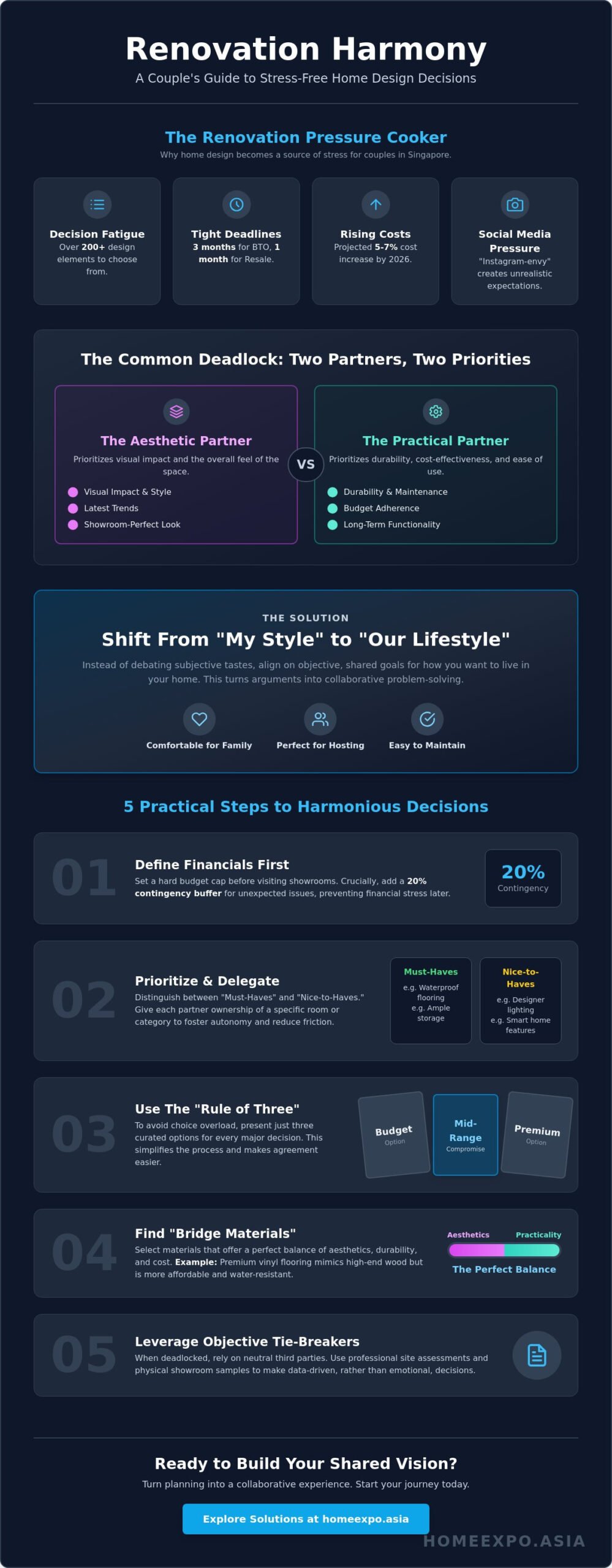
5 Practical Steps to Get Buy-In on High-Ticket Items
Securing approval for major investments like custom carpentry or premium tiling requires more than just enthusiasm. It demands a structured approach that respects your partner’s concerns while highlighting the long-term value of the project. If you’re struggling with how to get buy-in from spouse on renovation choices, follow these five proven steps to move the conversation forward.
- Step 1: Present three curated options. Never present just one idea. Offer a “good, better, best” selection at different price points. This allows your spouse to feel in control of the budget without being overwhelmed by infinite possibilities.
- Step 2: Connect to their specific pain points. If your partner hates the effort of scrubbing grout, focus on how seamless surfaces or low-maintenance materials like vinyl eliminate that daily frustration.
- Step 3: Use physical samples. Abstract ideas lead to anxiety. Bringing a physical sample into your current home makes the choice tangible and reduces the fear of making an expensive, permanent mistake.
- Step 4: Consult a neutral expert. Sometimes, your spouse needs to hear the technical benefits from a professional. An expert site assessment provides objective data on durability and installation requirements that settles arguments.
The Power of Physical Samples
Moving from a digital image to a physical sample is a psychological game-changer. Seeing a herringbone flooring sample in your actual living room allows you to conduct a “home lighting test.” Colors change significantly under different lighting conditions. By placing samples in your space, you both gain confidence that the chosen shade won’t look different after installation. This tactile experience shifts the partner’s focus from the price tag to the undeniable quality and feel of the material. By mastering these steps, you’ll quickly discover how to get buy-in from spouse on renovation choices becomes a collaborative effort rather than a tug-of-war.
Trading ‘Wins’ to Maintain Balance
To keep the process fair, implement the “Veto Power” rule. Each spouse gets exactly two vetos for the entire project. This ensures that truly hated ideas are off the table, but it also encourages partners to save their vetos for things that really matter. Focus your energy on “High-Impact” areas like the living room, where you spend the most time together. For “Private” areas like a personal study or a walk-in wardrobe, encourage your spouse to take the lead. This creates a sense of ownership and reduces the feeling of being managed through the renovation. To ensure your choices are technically sound and stay within your 2026 budget, you can book a professional site assessment to get objective data that settles design deadlocks once and for all.
Leveraging Professional Expertise to Resolve Deadlocks
When communication reaches a standstill, professional mediation is the most effective way forward. Bringing in an experienced consultant shifts the dynamic from a personal argument to a data-driven discussion. This is a critical step in how to get buy-in from spouse on renovation choices. A professional site assessment provides the objective evidence needed to settle disputes about moisture levels, subfloor conditions, and material compatibility. Instead of relying on subjective opinions, you can rely on technical standards and historical performance data.
Think of your supplier as a technical partner rather than just a vendor. They provide essential guidance on complex HDB renovation requirements. For instance, they can clarify the differences between hacking and overlaying or explain why certain tiling and cement works require specific HDB permits. Standard HDB approvals typically take 2-5 working days. Having an expert handle these details reduces the mental load on both spouses. It ensures that your project remains compliant with the Directory of Renovation Contractor (DRC) standards, providing a layer of security that simple DIY planning cannot offer.
The ‘Neutral Third Party’ Advantage
Experts provide a clear perspective on the “Total Cost of Ownership.” A budget-wary spouse might only see the initial price tag. A professional can explain how a slightly higher upfront investment in quality vinyl flooring or custom carpentry services prevents expensive repairs later. They also clarify technical jargon. Understanding the difference between structural hacking and decorative modifications helps reduce confusion and anxiety. Let the professional handle the “bad news” about what isn’t feasible. It’s much easier to hear that a specific design won’t work from an architect or engineer than from a spouse.
- Objective Data: Use moisture tests and floor level checks to justify material choices.
- Regulatory Clarity: Get straight answers on HDB permits and Building and Construction Authority (BCA) requirements.
- Risk Mitigation: Focus on safety certifications and industry standards to build trust.
Finalizing Your Choice with Confidence
The final hurdle is often the fear of “Buyer’s Remorse.” You can eliminate this anxiety through comprehensive warranties and guaranteed after-sales support. Knowing that your investment is protected by official documentation provides peace of mind to both partners. Professional installation also ensures that the “Instagram look” you’ve planned is actually achieved in reality. Don’t let the planning phase become a source of stress. Use the showroom experience as a low-pressure “date” to explore possibilities together. It’s an opportunity to touch the materials and visualize your future home in a supportive environment. By leveraging expert advice, you’ll find that how to get buy-in from spouse on renovation choices becomes a methodical process rather than an emotional one. Visit the Home Expo Asia showroom to see our 200+ designs together and take the final step toward your dream home with total confidence.
Take the Next Step Toward Your Harmonious Home
You now have a structured framework to turn renovation stress into a collaborative success. By shifting your focus toward shared lifestyle goals and utilizing high-performance materials, you ensure both aesthetic dreams and practical needs are met. Learning how to get buy-in from spouse on renovation choices is ultimately about building trust through transparency and professional guidance. Don’t let decision fatigue or financial anxiety stall your progress. Instead, use objective data and expert assessments to move forward with absolute confidence.
We’re here to help you bridge the gap between vision and reality. With over 200+ vinyl flooring designs and a team of experts ready to handle HDB and commercial site assessments, we provide the security you need for a stress-free transformation. Our professional installation comes with comprehensive warranties to ensure your peace of mind long after the work is done. Your dream home is within reach, and it’s a project you’ll both be proud to call your own.
Book a Free Site Assessment & Get an Accurate Quote
Frequently Asked Questions
How do I handle a spouse who says ‘no’ to everything?
Stop presenting single ideas and start uncovering the “why” behind their rejection. Often, a constant “no” stems from a fear of hidden costs or high maintenance. By addressing these root concerns with data and specific material benefits, you’ll learn how to get buy-in from spouse on renovation choices through empathy rather than argument. Shift the focus to how a choice solves a problem they care about.
What are the best low-maintenance flooring options for busy Singaporean couples?
Vinyl flooring is the superior choice for busy households due to its waterproof and scratch-resistant properties. Unlike traditional materials that require periodic polishing or specialized cleaners, vinyl only needs regular sweeping and occasional mopping. It saves hours of housework every month. This makes it a favorite for couples who value their weekend downtime and want a home that stays beautiful with minimal effort.
How can we renovate our home if we have completely different styles?
Focus on “lifestyle outcomes” rather than specific design labels like “Industrial” or “Scandi.” If your styles clash, find common ground in functional goals, such as wanting a space that feels “cozy” or “organized.” Create a shared mood board that focuses on overlapping textures and lighting. This collaborative approach helps you build a home that reflects both personalities without feeling disjointed or cluttered.
Is vinyl flooring a good investment for a resale HDB?
Vinyl is an excellent investment for resale flats because it can be installed quickly without intensive hacking. It refreshes the look of an older unit instantly and provides a durable surface that withstands the unique wear and tear of a second-hand property. It’s a cost-effective way to increase the visual appeal of the home while avoiding the high costs of complete floor demolition.
How do we decide which renovation items to splurge on and which to save on?
Splurge on high-contact items like flooring, custom carpentry, and hardware that you use every day. These elements define the quality of the home and take the most physical abuse. Save on decorative items like loose furniture, lighting fixtures, and window treatments. These are easily replaced as trends change, allowing you to update your look in the future without a full renovation.
What happens if we can’t agree on a renovation budget?
Implement a mandatory 24-hour cooling-off period for any items that exceed your initial estimates. Use a 15% contingency buffer to handle the cost increases projected for 2026. If you still can’t agree, consult a professional for a site assessment. A neutral, data-backed perspective on what’s truly necessary for the project’s structural integrity often settles financial disputes quickly.
Can we overlay vinyl over existing tiles to save money and time?
You can certainly overlay vinyl over existing tiles if the subfloor is level and in good condition. This method saves significant time and money by avoiding HDB hacking permits and debris disposal fees. It’s a popular choice for couples looking to shorten their renovation timeline. It allows you to move in faster while still achieving a premium, modern look for your floors.
How do I convince my spouse that professional installation is worth the cost?
Explain that professional installation includes comprehensive warranties and ensures the material performs as intended. DIY attempts often lead to bubbling, gapping, or moisture issues that void material guarantees. Highlighting the long-term security and risk-mitigation of a professional service is a vital part of how to get buy-in from spouse on renovation choices. It’s an investment in peace of mind.