Did you know that hacking your toilet floor tiles before the three-year mark could lead to a voided warranty and a massive fine from HDB? It’s a common trap for new BTO owners who are eager to customize their space. Even for those in older resale flats, the process of HDB toilet floor tiles replacement feels like a high-stakes gamble. You’re likely worried about accidentally causing a ceiling leak for the neighbor downstairs or getting hit with unexpected costs during the hacking and waterproofing phase. We understand that your home is your sanctuary, and the last thing you want is a renovation project that turns into a legal or structural headache.
You deserve a modern, leak-free bathroom that meets every safety standard. This guide simplifies the entire process by teaching you how to master HDB regulations, compare costs, and ensure 100% compliance with waterproofing requirements. We’ll explore the technical differences between tile overlaying and full hacking, explain the mandatory 150mm waterproofing upturn rule, and show you how to find a reliable contractor who handles all the official paperwork. By the end of this article, you’ll have the confidence to transform your toilet into a durable, stylish space without any of the typical renovation anxiety.
Key Takeaways
- Identify the legal restrictions on hacking new BTO toilets and how to navigate the 3-year rule without risking your warranty.
- Learn the critical waterproofing standards required for HDB toilet floor tiles replacement to prevent costly leaks and neighbor disputes.
- Evaluate the cost-to-benefit ratio of hacking versus overlaying to select the most efficient renovation method for your lifestyle.
- Explore the best material options, including homogeneous tiles and waterproof vinyl, to achieve a modern look that stands the test of time.
- Understand the importance of engaging HDB-licensed contractors to manage permits and ensure your renovation is 100% compliant.
Signs You Need HDB Toilet Floor Tiles Replacement
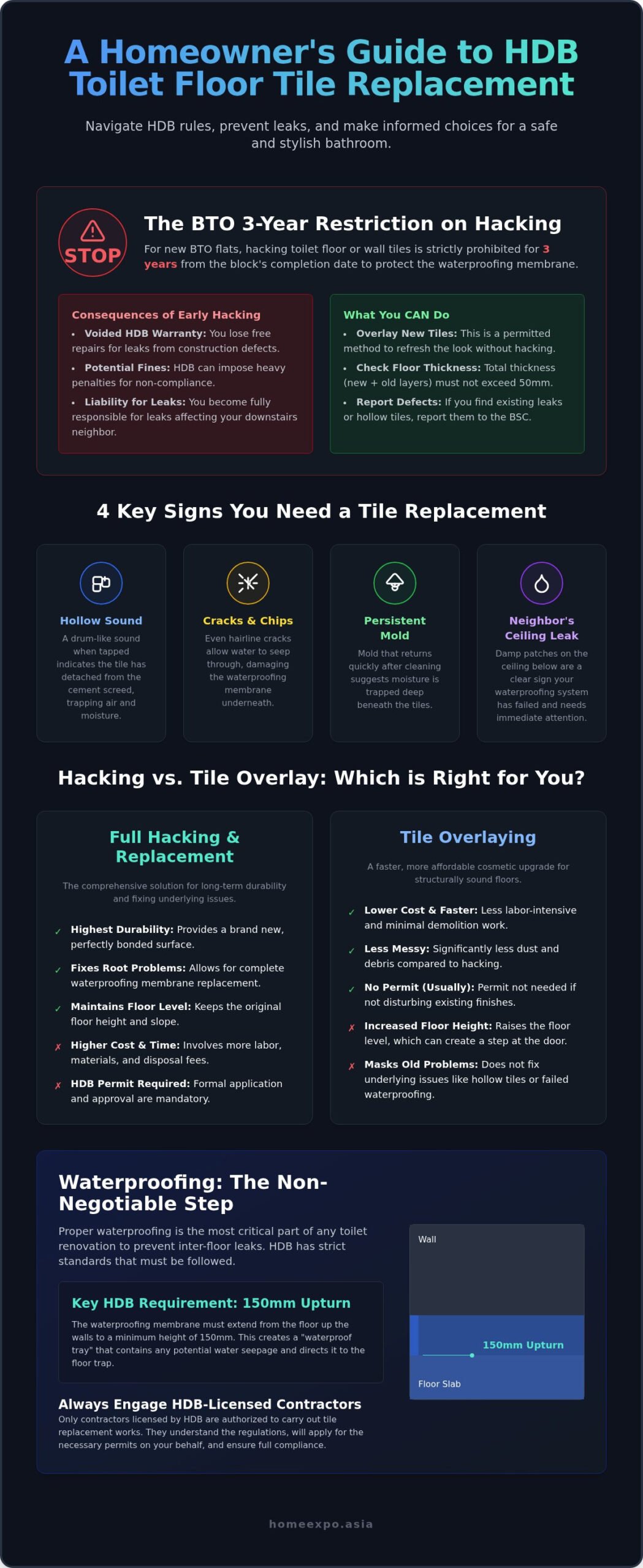
Your bathroom floor tiles endure daily exposure to high humidity and constant temperature shifts. Over time, these environmental stressors can degrade the bond between the tile and the cement screed. One of the most reliable ways to check for underlying issues is the “tapping” test. Use a coin or a small rod to gently tap across your floor surface. If you hear a hollow, drum-like sound, it indicates an air pocket where the adhesive has failed. Ignoring these hollow spots often leads to a necessary HDB toilet floor tiles replacement to prevent further structural damage.
Visible damage like cracks or chips shouldn’t be dismissed as purely aesthetic flaws. Even hairline fractures allow water to seep into the cement screed. Once moisture bypasses the Ceramic and porcelain tiles, it begins to saturate the underlying layers and eventually rots the waterproofing membrane. Similarly, if you notice persistent mold in your grout that returns immediately after deep cleaning, the moisture is likely trapped deep underneath the tiles. In Singapore’s tropical climate, this trapped water can expand and contract, causing tiles to buckle, dislodge, or “pop” unexpectedly.
The Danger of Neglecting Hollow Tiles
Hollow tiles are more than just a minor nuisance; they represent a significant safety hazard. These air pockets trap stagnant water, creating a hidden breeding ground for bacteria and unpleasant odors that cleaning cannot reach. Because the tile isn’t fully supported by the screed, it becomes extremely brittle. A dropped bottle or even a firm step can cause the tile to shatter underfoot. In a wet environment like a toilet, sharp edges from a broken tile pose a severe injury risk. Eventually, the lack of a secure bond causes tiles to lift entirely during sudden temperature shifts, making the floor uneven and dangerous.
Waterproofing Failures and Ceiling Leaks
If your neighbor downstairs reports damp patches or dripping on their toilet ceiling, your waterproofing system has likely failed. This is a critical stage where a professional HDB toilet floor tiles replacement becomes the most effective remedy. Under the HDB “Good Neighbor” policy, both the upper and lower floor owners share the responsibility for investigating and repairing inter-floor leaks. However, replacing the tiles and the underlying membrane is the only permanent solution to stop water ingress. Professional intervention ensures the new installation complies with current HDB waterproofing standards, providing long-term security for your home and maintaining good relations with your neighbors. For those who value high-standard results, Silver Tile & Stone, LLC serves as an excellent example of professional bathroom tiling and craftsmanship that lasts.
HDB regulations are strict for a specific reason. They protect the structural integrity of your flat and your neighbors’ homes. If you’ve just collected your keys for a new BTO, you’ll encounter the mandatory 3-year restriction. HDB prohibits hacking toilet floor and wall finishes for three years from the block’s completion date. This rule exists because the waterproofing membrane needs time to settle. Tampering with it too early often leads to leaks that affect the unit below. While you can’t hack, you’re allowed to overlay new tiles using adhesives. This is a great way to refresh the look without breaking rules. When Choosing the Right Materials for an overlay, ensure the total floor thickness doesn’t exceed 50mm.
Exceptions are rare. HDB generally only allows early replacement for defect rectification, such as fixing existing leaks or hollow tiles found during the initial inspection. For older resale flats, you’ll need a formal renovation permit before starting any HDB toilet floor tiles replacement that involves hacking. Minor repairs or tile overlays don’t usually require a permit, provided you don’t disturb the existing finishes. If your renovation involves structural changes, like shifting a toilet bowl or adding heavy partitions, HDB might require a Professional Engineer (PE) to certify the works.
Understanding the BTO Waterproofing Warranty
Hacking your tiles within the first three years doesn’t just risk a fine. It completely voids your HDB waterproofing warranty. HDB provides this coverage to ensure that any early leaks caused by construction defects are fixed at no cost to you. If you notice dampness or water stains during this period, contact your Building Service Centre (BSC) immediately. They’ll investigate and perform necessary repairs. Attempting a DIY fix or hiring an unauthorized contractor to hack the floor during this window means you’ll bear the full cost of any future leak repairs.
Permit Checklist for HDB Toilet Works
Securing a permit is a methodical process. You’ll need your floor plans, the HDB permit application, and a contractor registered with the Directory of Renovation Contractors (DRC). In 2026, HDB permits for existing blocks typically require works to be completed within one month of issuance. For newly completed blocks, you have a three-month window. Keep in mind that noisy work like hacking is restricted to 9:00 a.m. to 6:00 p.m. on weekdays and Saturdays. Noisy renovations are strictly prohibited on Sundays and public holidays to maintain a peaceful environment for all residents. If you’re feeling overwhelmed by the paperwork, our team at Home Expo Asia can help guide you through the compliance steps.
Hacking vs. Tile Overlay: Which Method Is Best for You?
Deciding between hacking and overlaying is the most critical technical choice in your HDB toilet floor tiles replacement project. Hacking is a heavy duty process. It involves stripping the floor down to the bare concrete slab, removing both the old tiles and the worn out waterproofing membrane. While this creates more noise and debris, it’s the only way to guarantee a fresh start. On the other hand, tile overlaying involves bonding new tiles directly onto the existing ones using a high strength adhesive. It’s a faster, cleaner, and more budget friendly alternative for homeowners who want a modern look without the chaos of a full demolition.
HDB compliance plays a major role in this decision. As established in the previous section, if your BTO flat is less than three years old, overlaying is your only legal option. HDB strictly prohibits hacking during this period to protect the integrity of the original waterproofing. For older flats, the choice often depends on the condition of your current floor. While overlaying saves time, it adds weight and height to your bathroom floor. HDB regulations state that the total thickness of the floor finishes and screed must not exceed 50mm. Our team ensures every project stays within these safety margins to maintain structural integrity.
When to Choose Full Hacking
You should prioritize full hacking if your toilet is currently experiencing leaks or if you live in an older resale flat. Since the average lifespan of a waterproofing membrane is about 10 to 15 years, hacking allows you to install a new, high quality barrier. This provides a 10 year peace of mind against inter-floor leaks. Hacking also gives you the opportunity to level a sloping floor from scratch. This is essential for proper drainage toward the floor trap. If your existing tiles are already “popping” or hollow, hacking is mandatory. Applying an overlay on a failing base will only lead to the new tiles cracking or becoming loose within months. To ensure a professional result, you can check out JM & SONS General Contractor Pte Ltd for your home’s renovation needs.
While convenient, the overlay method has specific limitations that many homeowners overlook. One major issue is toilet door clearance. Adding a second layer of tiles raises the floor level. This often means you’ll need to trim the bottom of your bathroom door or replace it entirely to ensure it can still swing open. There’s also the “hollow” risk. If the original tiles aren’t perfectly bonded, the new layer won’t be stable either. Finally, consider the weight. Adding significant mass to the floor slab must be done carefully. We always assess the existing tile condition first to ensure an overlay is a safe and durable solution for your HDB toilet floor tiles replacement.
Choosing the Right Materials: Homogeneous Tiles vs. Waterproof Vinyl
Selecting the right surface is the most impactful part of your HDB toilet floor tiles replacement project. Your choice affects more than just the look. It determines how easy the floor is to clean and how safe it is when wet. In 2026, safety is the top priority for Singaporean homeowners. We recommend looking for materials with a high anti-slip rating, specifically R10 or R11. These ratings indicate the degree of friction provided by the tile. R10 tiles are suitable for general bathroom use, while R11 tiles provide an extra level of security for shower areas where soap and water create slick surfaces. While ceramic tiles are a budget friendly option, they often lack the long term durability required for high moisture environments.
Homogeneous tiles remain the industry gold standard for HDB bathrooms. Unlike ceramic tiles, which have a design printed only on the surface glaze, homogeneous tiles are full bodied. This means the color and pattern go all the way through the material. If you accidentally chip a tile, the damage is barely visible because the color underneath is identical. For those looking for a modern alternative, high quality waterproof vinyl is gaining traction as a popular overlay choice. It provides a warmer feel underfoot and is much softer than stone. However, you must distinguish between your toilet’s wet and dry zones to ensure your materials perform as expected.
Homogeneous Tiles: Durability and Maintenance
Homogeneous tiles are exceptionally dense and water resistant. This makes them perfect for the heavy usage of a family toilet. To enhance their performance, we suggest using epoxy grout instead of traditional cement grout. Epoxy grout is non-porous. It resists stains and prevents mold growth, which is a common pain point in Singapore’s humidity. In terms of 2026 design trends, we’re seeing a shift toward specific styles:
- Large format tiles: These minimize grout lines, creating a sleek, seamless look that’s easier to scrub.
- Textured stone finishes: These provide natural beauty with superior R11 slip resistance for elderly safety.
- Geometric mosaics: These are ideal for creating a vibrant feature floor in smaller HDB toilets.
Vinyl Flooring in the Toilet: Is it Possible?
Many homeowners ask if they can use vinyl flooring singapore in their bathrooms. The answer is yes, but it requires a strategic approach. It’s best used in the “Dry Zone,” which is the area around the vanity and toilet bowl. Vinyl is naturally slip resistant and much warmer than stone, making your morning routine more comfortable. In the “Wet Zone” or shower area, traditional tiling remains the safer choice due to constant water pooling. We specialize in creating seamless transitions between these zones, ensuring your floor looks unified while remaining functional. If you’re ready to explore over 200 designs for your next HDB toilet floor tiles replacement, book a free site assessment today to get a personalized quote.
The Professional Replacement Process with Home Expo Asia
At Home Expo Asia, we’ve refined our workflow to make your HDB toilet floor tiles replacement as smooth and stress-free as possible. It begins with a comprehensive free site assessment. Our experts visit your home to inspect the actual floor condition, checking for those hollow sounds or hidden moisture traps we discussed in previous sections. This onsite evaluation is crucial for an accurate project scope. Following the visit, we provide a customized, transparent quotation. You won’t find hidden costs or vague estimates here. We detail every specific cost for hacking, cement works, and the high-quality tiling materials you’ve selected for your renovation.
Our installation team features highly skilled tilers and trusted carpenters in Singapore. This diverse expertise is essential for a complete renovation. For instance, if you choose an overlay, our carpenters can professionally trim your doors to accommodate the new floor height. We prioritize safety and reliability in every step. After the project is complete, we provide a comprehensive warranty and professional maintenance tips. This ensures your investment remains in peak condition for years to come while giving you total peace of mind.
Step 1: Consultation and Material Selection
Browsing through our collection of over 200 designs is the first step toward your dream bathroom. We guide you through the latest 2026 flooring Singapore trends, helping you balance style with the anti-slip requirements needed for wet areas. To create a truly unified look, many homeowners now match their floor tiles with modern wall paneling Singapore options. This creates a seamless visual flow that makes even small HDB toilets feel more spacious and luxurious. Our consultants ensure that your material choices aren’t just beautiful, but also fully compliant with HDB’s weight and thickness regulations.
Step 2: Waterproofing and Quality Control
Our waterproofing protocol is designed for maximum risk mitigation. We use a specialized 2-layer process to create an impenetrable barrier against leaks. Once the membrane is set, we perform a mandatory flood test. This involves ponding the toilet floor with water to verify that it’s 100% leak-proof before we even consider the job finished. Our final inspection is methodical. We check every grout line for perfection and use precision tools to ensure the floor is leveled correctly. This guarantees that water always flows toward the drainage trap, preventing stagnant pools and mold growth. We don’t just meet industry standards; we strive to exceed them for every homeowner we serve.
Secure Your Home’s Future with a Modern, Compliant Bathroom
Upgrading your toilet is more than a cosmetic fix; it’s a critical step in maintaining your flat’s structural integrity. By understanding the HDB 3-year restriction and identifying signs of bonding failure early, you prevent minor issues from becoming expensive neighbor disputes. Whether you choose the efficiency of an overlay or the long-term security of a full hack, your decision should prioritize waterproofing excellence and high-quality materials. Investing in a professional HDB toilet floor tiles replacement ensures your home remains leak-free and stylish for years to come.
Our team provides the expertise you need to navigate complex regulations with confidence. With over 200 high-quality designs and a certified professional installation team, we guarantee a result that combines beauty with 100% regulatory compliance. We believe in total honesty, which is why we offer transparent, no-hidden-cost pricing for every project. Don’t wait for a leak to disrupt your life. Get Your Free HDB Toilet Site Assessment Today and take the first step toward a safer, more beautiful home. Your perfect bathroom is just a consultation away.
Frequently Asked Questions
How much does HDB toilet floor tiles replacement cost in 2026?
Factors like the choice between hacking and overlaying, material selection, and labor intensity determine the final price. While full hacking involves stripping the floor to the slab and re-waterproofing, overlaying is a faster, more budget-friendly alternative. It’s best to request a personalized quote that accounts for your specific toilet dimensions and choice of tiles. Professional contractors will provide a transparent breakdown of costs for tiling and cement works before starting your project.
Do I need a permit to change my toilet floor tiles in a resale flat?
Yes, you must obtain an HDB renovation permit if you plan to hack your existing toilet floor tiles. This ensures that the structural integrity and waterproofing of the block are maintained. However, if you choose the overlay method using adhesives, a permit is generally not required as long as the existing finishes remain undisturbed. Always engage an HDB-licensed contractor to handle the permit application process to ensure your renovation is fully compliant.
How long does it take to replace toilet floor tiles in an HDB?
The actual installation for an HDB toilet floor tiles replacement typically takes between three to five working days. This timeline includes hacking the old surface, applying a new waterproofing membrane, and laying the fresh tiles. Keep in mind that HDB regulations require all approved renovation works in existing blocks to be completed within one month from the permit issuance date. This timeframe allows for necessary drying and flood testing to ensure a leak-free result.
Can I overlay vinyl flooring in my HDB toilet?
You can certainly use vinyl flooring as an overlay in the dry zone of your HDB toilet. This includes the area around the vanity and the toilet bowl where water doesn’t pool. High-quality vinyl is slip-resistant and feels warmer underfoot than stone. However, it’s not suitable for the wet zone or shower area. We recommend a hybrid approach where you use durable homogeneous tiles for the shower and vinyl for a stylish, comfortable dry area.
What is the HDB 3-year restriction for toilet renovation?
The HDB 3-year restriction prohibits homeowners from hacking or replacing original toilet floor and wall finishes in newly completed blocks. This rule is designed to protect the integrity of the waterproofing membrane provided by HDB. If you want to change the look of your BTO toilet during this period, you are permitted to overlay new tiles using adhesives. After the three-year window expires, you are free to perform a full hacking renovation with a permit.
Will replacing my tiles fix the ceiling leak in my neighbor’s house?
Replacing your tiles through a full hacking process is the most effective way to fix an inter-floor ceiling leak. This method involves removing the old tiles and applying a fresh, 2-layer waterproofing membrane to stop water ingress. Simply overlaying new tiles won’t solve an existing leak because the underlying damage remains. Under HDB’s “Good Neighbor” policy, both you and your neighbor share the responsibility to resolve these structural issues promptly to prevent further damage.
What is the best anti-slip tile for an HDB toilet?
Homogeneous tiles with an R10 or R11 anti-slip rating are the best choice for HDB toilets. These ratings indicate the level of slip resistance, which is vital for preventing accidents in wet environments. R10 tiles are excellent for general bathroom floors, while R11 tiles provide superior grip for shower zones. These full-bodied tiles are exceptionally durable and maintain their slip-resistant properties even as they wear down over years of heavy daily use in your home.
Can I stay in my flat during the toilet floor replacement?
While you can technically stay in your flat, it’s often quite inconvenient during the hacking phase. The process creates significant noise and dust, and you’ll lose access to the toilet for several days while the cement and waterproofing layers dry. If your flat has only one bathroom, we suggest making alternative arrangements for a few days. For those with two toilets, you can stay comfortably by renovating one bathroom at a time.