
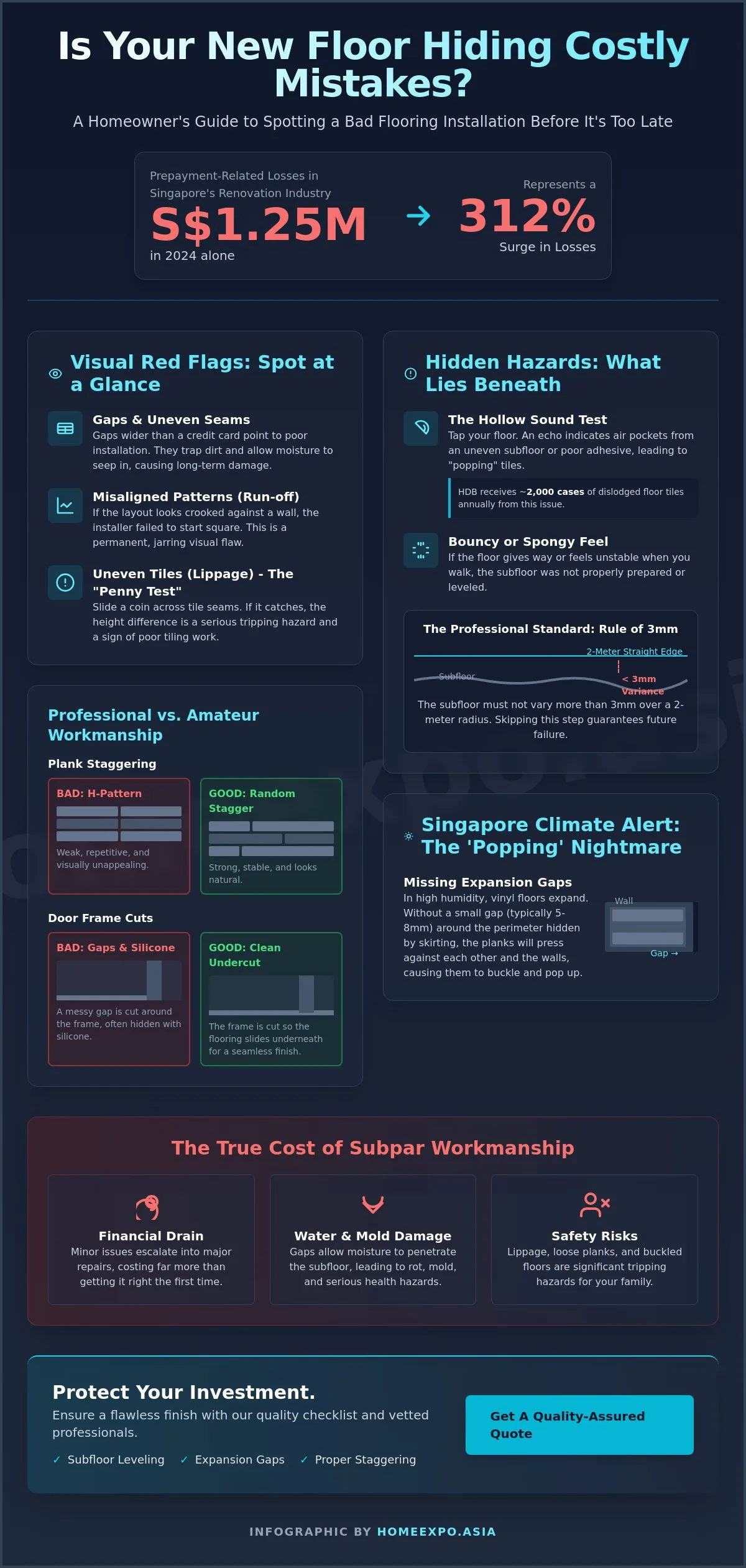
Did you know that prepayment-related losses in Singapore’s renovation industry surged by 312% to S$1.25 million in 2024? While losing money upfront is a nightmare, living with a botched renovation can be even more stressful and costly. You’ve likely spent thousands on your new home, and the last thing you want is to discover the signs of a bad flooring installation job just months after moving in. Whether it’s a hollow sound under your tiles or a mysterious gap in your vinyl, these issues often point to deeper problems with workmanship or subfloor preparation.
We understand the fear of being cheated or misled by technical jargon. You deserve a home that’s built to last, which is why we’ve created this guide to give you total peace of mind. You’ll learn how to spot critical red flags early, from improper expansion gaps to HDB regulation violations, and protect your renovation investment from future failure. We’ll provide a clear checklist to verify quality and actionable steps to rectify errors before they become permanent headaches.
Key Takeaways
- Identify immediate visual defects like uneven heights or inconsistent gaps that compromise both the aesthetic and safety of your new space.
- Learn to recognize the signs of a bad flooring installation job through hollow sounds or bouncing planks, which often indicate poor subfloor preparation.
- Understand the critical role of expansion gaps in preventing vinyl floors from warping or “popping” in Singapore’s high-humidity climate.
- Avoid long-term financial risks by addressing installation errors before they lead to permanent water damage or structural failure.
- Discover the professional site assessment protocols and quality standards required to ensure a durable, high-performance flooring finish.
Visual Red Flags: Spotting a Bad Flooring Installation at First Glance
When you walk into your newly renovated home, your eyes should glide across the surface without catching on any imperfections. A high-quality installation feels seamless and intentional. However, if you find yourself fixated on small inconsistencies, you’re likely seeing the early signs of a bad flooring installation job. These visual cues aren’t just about aesthetics; they often signal deeper structural failures that could compromise the safety and longevity of your investment.
Gaps and Uneven Seams
Precision is the hallmark of a professional installer. If you notice gaps between your vinyl planks or tiles that are wider than the thickness of a credit card, it’s a major red flag. This usually means the click-lock system wasn’t engaged properly or the subfloor wasn’t level. For vinyl flooring, these gaps allow moisture to seep underneath, which can lead to mold or swelling in Singapore’s humid climate. A professional installation should look tight and uniform across the entire room.
Pay close attention to how the planks are laid out. A quality job requires specific attention to:
- Improper Staggering: Planks should be staggered in a balanced pattern. If seams line up in a straight line or a repetitive “H-pattern,” the floor lacks structural stability and is more likely to shift over time.
- Door Frame Cuts: Amateurs often leave large, unsightly gaps around door frames or use messy silicone to hide poor cuts. A pro will undercut the frame so the flooring slides underneath for a clean, professional finish.
- Adhesive Bleeding: If you see sticky residue or “bleeding” at the seams of your vinyl, it indicates a messy application that will attract dirt and eventually weaken the bond.
Misaligned Patterns and Layout Errors
A floor should run parallel to your main walls to create a sense of order. If the layout looks “crooked” as it moves across the room, the installer failed to start the job perfectly square. This is known as “run-off,” and it becomes painfully obvious when the flooring meets a straight wall or a transition strip. Use the “eye-line” test: stand at the entrance of the room and look toward the furthest wall. The lines should draw your eye forward, not at an angle.
For homeowners who opted for tiling and cement works, height variations between adjacent tiles, known as “lippage,” are a serious safety hazard. You can perform the “Penny Test” by sliding a coin across the seam. If the coin catches on the edge of the next tile, the installation doesn’t meet professional standards. These “lipped” tiles aren’t just ugly; they are tripping points that can cause accidents. These visual flaws are often the first indicators that your contractor skipped essential steps, leading to the “popping” tiles that plague many Singaporean homes.
Hidden Hazards: Why Subfloor Preparation is the Root of Failure
While visual flaws are frustrating, the most dangerous issues often lie beneath the surface. A beautiful floor is only as good as the foundation it sits on. In Singapore, many homeowners focus on the color of their vinyl but forget that the subfloor determines if that vinyl will last ten years or ten months. If your floor feels “bouncy” or makes a clicking noise when you walk, you’re experiencing one of the most overlooked signs of a bad flooring installation job.
The “Hollow Sound” mystery is a classic warning. When you tap on a tile or walk across vinyl and hear an echo, it means there’s an air pocket underneath. This happens when the adhesive didn’t bond or the subfloor wasn’t level. Over time, these pockets cause tiles to dislodge. In fact, HDB has historically received about 2,000 cases of dislodged floor tiles per year. These failures usually trace back to improper subfloor prep or poor cement mixing.
Professional standards require a “Rule of 3mm.” This means the subfloor shouldn’t vary in height by more than 3mm over a 2-meter radius. If your contractor skips the leveling stage, you’ll eventually see “telegraphing.” This is when every bump and dip in the concrete slab shows through your thin vinyl planks. It ruins the aesthetic and creates weak points where the floor can crack.
The Critical Role of Cement Screeding
A professionally leveled cement screed is the only way to ensure your floor stays flat. In Singapore, HDB regulations are strict: the total thickness of your floor finishes and screed must not exceed 50mm from the bare concrete slab. If you’re doing an overlay, the new layer must be 13mm or thinner. An inexperienced contractor might ignore these limits, putting unnecessary weight on the structure or creating trip hazards at your doorway. If your screed feels sandy or “dusty” when you touch it, it wasn’t cured correctly and won’t hold an adhesive bond.
Moisture and Humidity Traps
Singapore’s 80% average humidity is a silent killer for flooring. Skipping a moisture test is a death sentence for vinyl. If moisture is trapped between the slab and the floor, it leads to “cupping,” where the edges of the planks lift up. Even worse, it creates a breeding ground for mold. A high-quality installation always includes a vapour barrier to block this rising dampness. If you want to avoid these technical nightmares, it’s best to work with a reliable flooring installation service that understands our tropical climate and HDB requirements.
Vinyl and SPC Specific Errors: Avoiding the ‘Popping’ Nightmare
Many Singaporeans believe that a “popping” sound is just a new floor “settling” into place. This is a common myth used to dismiss poor workmanship. If you hear a distinct click or pop when you step on your floor, you’re hearing the mechanical failure of the locking system. It’s one of the most definitive signs of a bad flooring installation job. These sounds usually mean the planks are rubbing against each other because the subfloor is uneven or the joints were damaged during the laying process.
A floating floor system, like the vinyl flooring used in modern HDB flats, isn’t glued down. It needs to move as a single unit. When heavy furniture, such as a massive built-in wardrobe or a heavy kitchen island, is placed directly on top of the planks without proper planning, it “pins” the floor. This prevents natural movement and forces the joints to separate in other parts of the room. A professional installer will account for these weight loads before they start the project. For homeowners seeking inspiration on how to integrate such features correctly, Inspired Home Design provides examples of how custom cabinetry and kitchen islands should be professionally installed to ensure long-term durability.
Expansion Gap Failures
Floors are living things. They expand and contract with Singapore’s intense temperature swings and high humidity. A critical requirement for a lasting installation is the expansion gap. This is a 5mm to 10mm space left around the entire perimeter of the room, usually hidden under the skirting board. Without this room to breathe, the floor has nowhere to go when it expands. The result is “tenting,” where the planks push against each other and rise up in the middle of the room. You can check this yourself by removing a small section of the skirting; if the vinyl is touching the wall, it’s a failure.
Click-Lock Integrity
The integrity of your floor depends on the delicate “tongue and groove” joints. Amateur contractors often make the mistake of using a standard hammer to force planks together. This brute force chips the locking mechanism, leading to “short-side” joint failures. While the floor might look fine on day one, these weakened joints will eventually separate, creating micro-gaps that trap dirt and water. Professionals always use a dedicated tapping block and a rubber mallet to distribute force evenly, ensuring the click-system remains intact. If you see planks “bouncing” when you walk, it’s often a sign that these joints have already snapped or were never fully engaged.
Long-Term Consequences: Why Subpar Workmanship Costs More
Choosing the cheapest quote might feel like a win during the initial renovation phase, but the long-term costs of poor workmanship are staggering. When you overlook the signs of a bad flooring installation job, you aren’t just living with minor visual flaws. You’re essentially managing a ticking financial time bomb. In Singapore’s high-stakes property market, the quality of your floor directly impacts your home’s valuation. Savvy buyers and professional valuers quickly spot “lipped” tiles or separating vinyl joints. These defects suggest that the entire renovation was handled with a lack of care, often leading to lower offers or demands for significant price “offsets” to cover future repair costs.
Structural Deterioration
A floor that wasn’t installed correctly will eventually begin to destroy itself from the inside out. When there’s excessive movement underfoot, the core of your vinyl planks is under constant stress. This leads to the “Dust Pump” effect. Every time you walk across a loose or hollow section, the floor acts like a bellows, forcing trapped subfloor grit and cement dust up through the seams and into your living space. This doesn’t just ruin your indoor air quality; the abrasive grit acts like sandpaper, wearing down the locking mechanisms until the planks fully separate. A floor designed to last 15 years can easily fail in under 12 months due to these foundational errors.
Financial and Legal Headaches
The cost of “hacking” and re-installing a failed floor is significantly higher than doing it right the first time. You have to account for the removal of the old material, disposal fees, and the potential damage to your skirting boards or built-in carpentry. If you find yourself in a dispute with a contractor over workmanship, you’ll need professional documentation to back your claim. We recommend keeping a detailed carpenter singapore or flooring expert’s report that outlines the specific technical failures. Given that CASE reported a 312% surge in prepayment-related losses in 2024, protecting your investment with official documentation is more important than ever. Don’t leave your home’s foundation to chance; invest in a professional flooring installation service to ensure your peace of mind.
The Home Expo Asia Standard: How to Ensure a Flawless Installation
You don’t have to settle for a home filled with the signs of a bad flooring installation job. While the previous sections highlighted the technical failures common in the industry, achieving a perfect finish is entirely possible with the right protocol. At Home Expo Asia, we believe that quality is a result of meticulous planning rather than luck. We provide a professional flooring installation service that prioritizes long-term durability and safety, ensuring your renovation remains a source of pride rather than a financial burden.
Our approach begins long before the first plank is laid. We insist on a mandatory 48-hour material acclimatisation period for all our vinyl products. By allowing the materials to adjust to your home’s specific temperature and humidity levels, we eliminate the risk of the “tenting” and “buckling” issues discussed earlier. This simple but vital step ensures the dimensions of the floor remain stable after the project is complete. We also use professional-grade underlayment that provides superior sound dampening and a moisture-resistant barrier, protecting your home from the silent threat of rising dampness.
Our Professional Installation Checklist
Transparency is the cornerstone of our service. We use a rigorous 5-point site assessment protocol to verify that your subfloor meets the highest industry standards. Our team follows a methodical process to guarantee excellence:
- Step 1: Digital moisture verification. We use precision sensors to ensure your concrete slab is dry enough to prevent future mould growth and adhesive failure.
- Step 2: Laser-levelling. Our installers identify high and low spots across the room to ensure the subfloor meets the “Rule of 3mm,” preventing hollow sounds and lippage.
- Step 3: Precision cutting. We utilize dust-reduced machinery to create clean, tight edges around door frames and built-in carpentry, ensuring a seamless aesthetic.
Why Experience Matters in Singapore
With a proven track record of vinyl flooring singapore excellence across 200+ designs, we understand the unique challenges of local properties. From complex HDB layouts to high-end condo renovations, our team focuses on risk mitigation and technical precision. We back our workmanship with transparent warranties and responsive after-sales support, giving you the security you deserve. Our goal is to build trust through quantifiable results and social proof, making us a reliable partner for your full home renovation. Don’t settle for subpar work that will cost you more in the long run. Get a risk-free quote for professional installation today and experience the difference that expert craftsmanship makes.
Secure Your Home’s Foundation and Future Value
Identifying the early signs of a bad flooring installation job is the best way to protect your renovation investment. You’ve learned that aesthetic flaws like uneven seams often point to deeper issues. Poor subfloor preparation or ignored HDB regulations can cause long-term structural damage. These technical failures don’t just look unprofessional. They create safety hazards and lead to costly repairs that could’ve been avoided with expert care. Your home is a significant asset. Its flooring should be a source of lasting comfort, not a recurring headache.
As specialists in Singapore HDB and condo renovations, we bring technical precision to every project. We offer a massive gallery of over 200 vinyl designs and back our workmanship with a comprehensive after-sales warranty. We believe in getting it right the first time. This ensures you enjoy your space with total peace of mind. Don’t leave your floor to chance when you can rely on proven expertise and industry-leading standards.
Book a Free Site Assessment with Home Expo Asia’s Flooring Experts today. Your perfect home deserves a foundation built on quality, reliability, and professional excellence.
Frequently Asked Questions
Is it normal for a new vinyl floor to make clicking or popping sounds?
No, clicking or popping sounds are not normal and shouldn’t be ignored. These noises indicate that the planks are moving against each other because the subfloor isn’t flat or the click-lock system was damaged during installation. While some contractors claim it’s just “settling,” it’s actually a sign of mechanical stress that will eventually lead to joint separation.
How much of a gap is acceptable between my flooring and the wall?
An expansion gap of 5mm to 10mm is the industry standard for a floating floor in Singapore. This space is necessary because materials expand and contract with our high humidity levels. This gap is usually hidden under your skirting boards. If the floor is installed too tight against the wall, it will eventually buckle or “tent” in the middle of the room.
Can a bad flooring installation be fixed without replacing the whole floor?
Minor issues like a single scratched plank can often be replaced individually if you have spare materials. However, if the problems stem from poor subfloor preparation or a failure to level the ground correctly, a full replacement is usually required. Patching a foundational issue only delays the inevitable failure of the entire floor system.
What should I do if I find a ‘hollow’ spot under my new tiles?
You should notify your contractor immediately if you detect a hollow sound when tapping your tiles. This “drummy” noise means the tile hasn’t bonded correctly to the adhesive or cement screed. In Singapore, HDB receives roughly 2,000 reports of dislodged tiles annually. Hollow spots are the primary warning sign before a tile fully “pops” or cracks.
How do I know if my contractor skipped the subfloor levelling step?
You can check this by placing a 2-meter straight edge or a long spirit level on the floor surface. If you see light passing through gaps larger than 3mm under the level, the contractor likely skipped the levelling stage. You’ll also notice “telegraphing,” where the texture of the rough concrete slab starts showing through your thin vinyl planks.
Will a bad installation void my flooring material warranty?
Yes, a bad installation will almost certainly void your material warranty. Manufacturers provide guarantees based on the assumption that their products are installed according to specific technical guidelines. If an inspector finds that subfloor moisture tests were skipped or expansion gaps weren’t left, the manufacturer will likely reject your claim for replacement materials.
What are the most common signs of poor SPC flooring installation?
The most frequent signs of a bad flooring installation job involve “tenting,” where planks rise up, and “gapping,” where joints pull apart. You might also notice the floor feels bouncy or unstable when you walk on it. These issues are almost always caused by restricted movement or an uneven base that wasn’t properly prepared.
How can I prove to my contractor that the installation is botched?
The best way to prove a botched job is to reference specific industry standards and HDB regulations. Use a ruler to document gaps larger than a credit card or height variations between tiles. Taking clear photos and requesting a professional site assessment from a reputable flooring installation service will provide the technical evidence needed for a formal dispute.