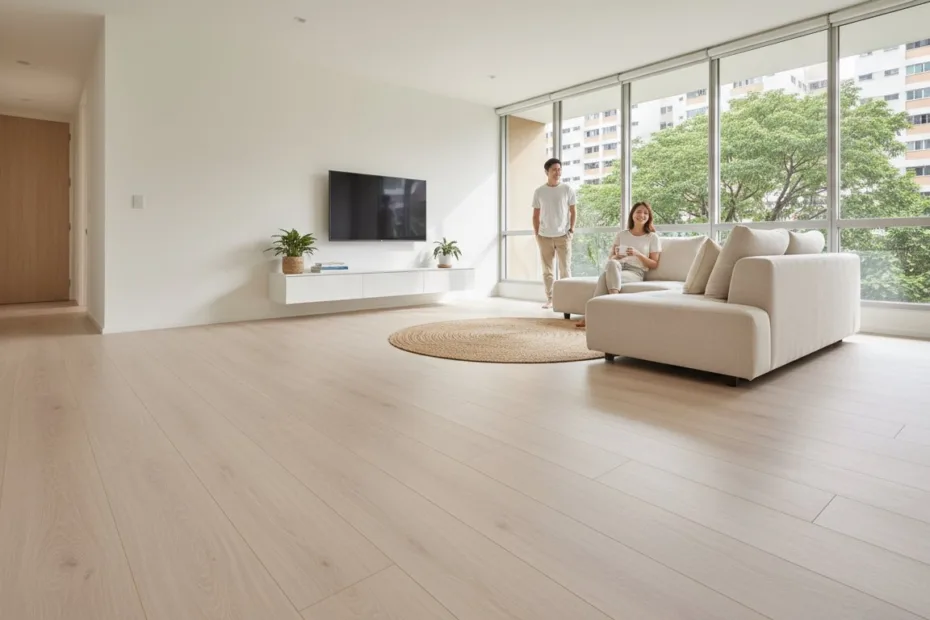
Most homeowners believe that small rooms require small floor tiles to maintain proportion, but the opposite is actually true. Choosing oversized planks is the professional secret to tricking the eye into seeing more square footage. If you are struggling with a cramped HDB layout, learning how to make a small room look bigger with flooring is the fastest way to open up your home without moving a single wall. It’s all about reducing visual noise and creating a seamless flow that guides the eye across the entire footprint of your space.
We understand the frustration of feeling boxed in by dark, busy floors or visible seams that segment your living area into tiny squares. You deserve a home that feels bright, airy, and expertly designed. This 2026 guide will help you master the professional secrets that transform cramped flats into expansive rooms using strategic layouts and modern vinyl solutions. We’ll preview the most effective light-toned finishes and explain how to navigate HDB regulations like the 50mm thickness limit to ensure your renovation is both beautiful and compliant. By the end, you’ll have the confidence to create a high-quality space that adds lasting value to your property.
Key Takeaways
- Learn why treating your floor as the “Fifth Wall” is the most effective way to influence the perceived boundaries of any space.
- Discover how to use the “Longest Line” theory by laying planks diagonally to create an immediate sense of depth and movement.
- Master the professional techniques for how to make a small room look bigger with flooring by choosing specific light-reflecting textures and cool-toned finishes.
- Understand the “Seamless Home” strategy that uses unbroken transitions to prevent your floor plan from looking segmented or cluttered.
- Find out how a professional site assessment helps you select the perfect layout from a wide range of high-quality, durable vinyl designs.
The Psychology of Space: Why Flooring is Your Biggest Lever
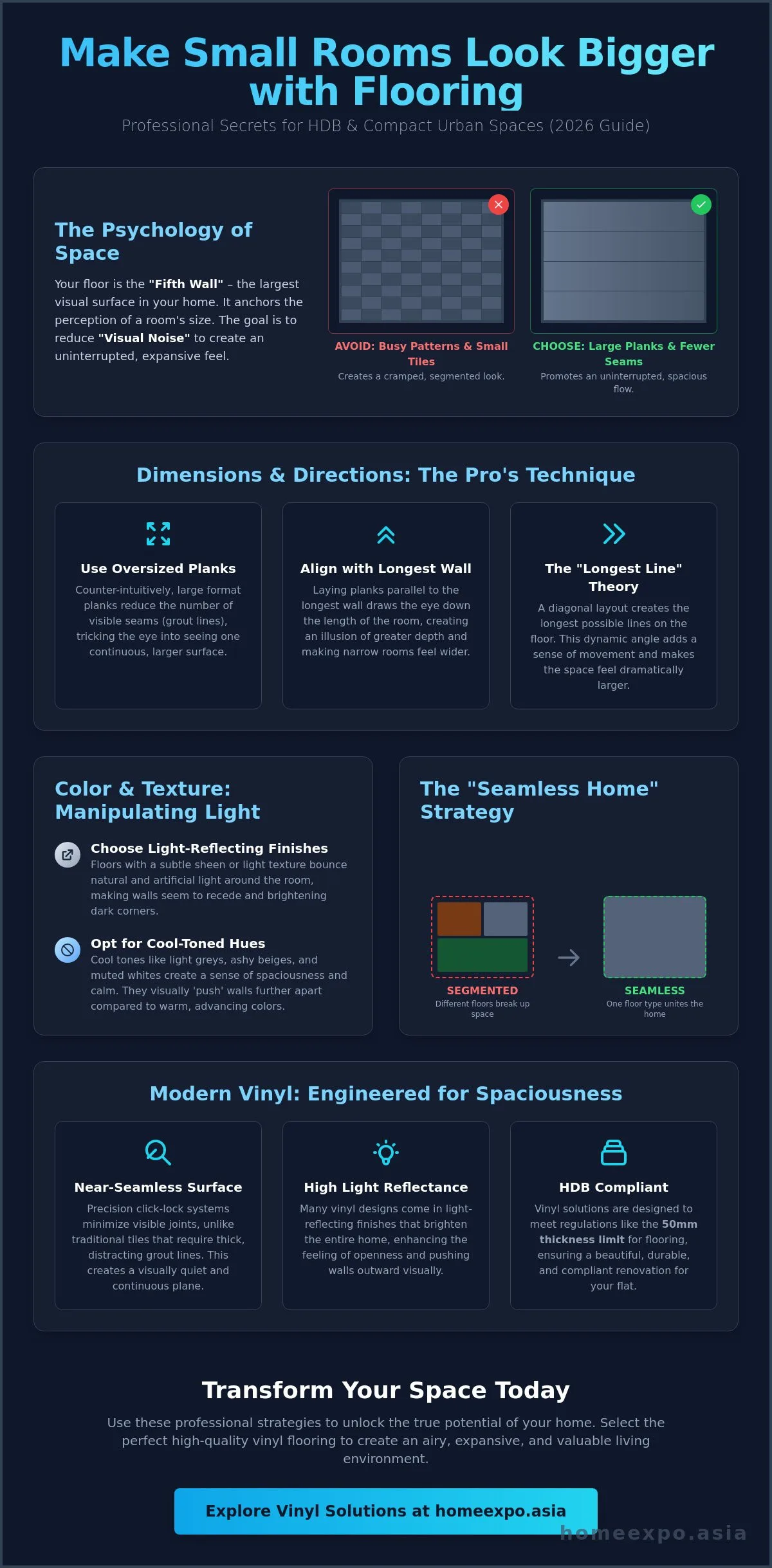
The floor is your home’s largest horizontal surface. It acts as the primary visual anchor for every other element in a room. When you step into a space, your brain subconsciously scans the ground to determine the room’s boundaries and scale. This is the foundation of the psychology of space. If the floor is cluttered with busy patterns or dark colors, the room feels significantly smaller than its actual dimensions. Professional designers often refer to the floor as the “Fifth Wall” because it has just as much influence on the atmosphere as your vertical surfaces. By choosing the right material, you can guide the eye’s movement and create a sense of infinite space.
Visual noise is the primary enemy of small rooms. It occurs when there are too many competing elements on a single surface. In flooring, this often manifests as heavy graining, high-contrast colors, or frequent seams between tiles. These elements force the eye to stop and start, making the room feel segmented and cramped. In 2026, urban design trends for Singapore apartments emphasize an “uninterrupted flow.” This strategy involves using consistent materials that stretch across multiple rooms to remove visual barriers. When you learn how to make a small room look bigger with flooring, you aren’t just changing a surface; you’re fundamentally altering how you experience your home.
The Science of Optical Illusions in Interior Design
Your brain calculates room size based on the amount of visible floor area it can see at a single glance. If you can see more of the floor without interruption, the room feels larger. Light reflectance also plays a major role in this calculation. Floors that reflect natural light back up toward the ceiling help push the walls outward visually. When you reduce the number of visible lines or seams, you create a calmer environment. A floor with fewer joints looks like one continuous plane. This tricks the mind into perceiving a more expansive footprint than what is actually there.
The Role of Vinyl in Modern Spatial Design
Modern vinyl solutions are specifically engineered to address these spatial challenges. Large format vinyl planks are now a standard choice for HDB renovations because they minimize the number of joints on the floor. Unlike traditional ceramic tiles that require thick grout lines, vinyl uses precision click-lock systems. This creates a nearly seamless surface that is easy to maintain and visually quiet. Consider these benefits for small spaces:
- Reduced Seams: Fewer lines mean less visual clutter and a smoother appearance.
- Reflective Finishes: Many designs help bounce light around the room to brighten dark corners.
- Consistent Texture: Choosing a high-quality vinyl flooring with a subtle grain ensures the room feels voluminous rather than busy.
These professional-grade materials provide the durability you need for a busy household while maintaining the airy aesthetic of a luxury home. By focusing on quality and reliability, you can achieve a professional-looking renovation that adds genuine value to your property.
Dimensions & Directions: Technical Secrets of Visual Expansion
Technical layout decisions are just as critical as the material you choose. Mastering flooring design to make rooms feel bigger requires understanding how lines influence human perspective. Many homeowners assume that a compact space needs smaller planks to stay in proportion. This is a common misconception that often leads to a cluttered, busy floor. By using wider planks and strategic installation angles, you can effectively push the boundaries of a room outward without changing its physical footprint.
The goal is to minimize visual interruptions. When a floor is segmented into hundreds of tiny squares or narrow strips, the eye perceives a series of small parts rather than one large whole. Understanding how to make a small room look bigger with flooring involves choosing layouts that elongate the space. Aligning your planks parallel to the longest wall is a standard professional technique. It draws the eye toward the farthest point of the room, creating an elongated effect that makes narrow spaces feel significantly deeper.
Choosing the Right Plank Size for Small Rooms
Wide planks, specifically those with a width of 180mm or more, work surprisingly well in compact HDB rooms. These larger dimensions mean fewer seams across the floor. Fewer seams result in less visual noise, which helps the brain perceive the area as more open and airy. While you might worry about the scale, a wider plank actually simplifies the environment. To avoid the “bowling alley” effect in narrow hallways, ensure the planks run the length of the corridor. This simple adjustment provides a sense of direction and purpose to the space. If you aren’t sure which width suits your home, you can request a professional site assessment to see physical samples in your actual lighting.
The Power of Diagonal and Patterned Layouts
Installing your flooring at a 45-degree angle is a sophisticated way to break a room’s square boundaries. This diagonal orientation tricks the eye into following the longest line in the room, which is the path from one corner to the opposite one. It creates a sense of movement that straight lines cannot achieve. If you prefer more character, herringbone flooring is an excellent alternative. The V-shape pattern adds a touch of luxury and guides the eye diagonally across the room. Keep in mind that diagonal and herringbone installations typically require a higher waste factor. You should budget for approximately 10% to 15% extra material compared to a standard straight-lay installation to account for the additional cuts needed at the walls.
- Wide Plank Rule: Use 7-inch+ (180mm) widths to reduce visual clutter.
- Diagonal Laying: Use the “Longest Line” theory to maximize perceived depth.
- Parallel Installation: Align with the longest wall to elongate narrow rooms.
- Patterned Movement: Use herringbone to add depth without making the floor look “choppy.”
Color & Texture: Beyond the ‘Light vs. Dark’ Debate
Standard design advice usually suggests that only light colors can open up a room. While light tones are highly effective, this is only half the story. Understanding how to make a small room look bigger with flooring requires a deeper look at undertones and light interaction. Light-colored floors like bleached oak, ash, or maple are popular for a reason. They have a high capacity for light bounce, which pushes the visual boundaries of the walls outward. This creates an immediate feeling of airiness that is perfect for compact HDB flats.
However, dark floors shouldn’t be ruled out. The secret lies in choosing cool-toned dark colors like charcoal or slate rather than warm, reddish browns. Cool colors are perceived by the human eye as receding. This means a cool-toned dark floor can actually create a sense of depth and “infinite” space. It’s a professional technique used to make the floor appear further away than it actually is. To enhance this effect, try matching your floor color to your wall baseboards. Eliminating the high-contrast line where the floor meets the wall creates a seamless transition that makes the room’s footprint feel much larger.
The Impact of Light Reflectance Value (LRV)
Light Reflectance Value, or LRV, is a scale used by professionals to measure how much light a surface reflects. In windowless areas or rooms with limited natural light, choosing a vinyl floor with a high LRV is a reliable way to brighten the space. High LRV surfaces bounce light back into the room rather than absorbing it. Many homeowners pair high-LRV flooring with wall paneling to create a cohesive, bright environment. This combination helps control light bounce and adds sophisticated vertical interest without making the room feel cluttered or “busy” during the night.
Texture and Finish Selection
The finish of your floor significantly impacts the room’s perceived volume. While high-gloss floors are often thought to make rooms look bigger, they can sometimes backfire. Glossy surfaces act like mirrors, reflecting furniture legs and ceiling lights with high contrast. This creates visual noise that can make a small room feel crowded. We typically recommend a low-sheen matte vinyl finish for a clean, modern look. Matte surfaces provide a soft, consistent plane that feels expansive and calm. Stick to smooth or lightly embossed textures. Deep, heavy textures create tiny shadows across the floor, which can make the surface look darker and the room feel more enclosed.
The ‘Seamless Home’ Strategy for Singapore Layouts
Visual continuity is the ultimate weapon for anyone wondering how to make a small room look bigger with flooring. In many Singaporean homes, the floor is chopped up by T-moldings or transition strips at every doorway. These strips act as visual speed bumps that tell your brain the room has ended. By removing these thresholds and running a single material from the entrance to the balcony, you create an unbroken visual plane. This makes the entire home feel like one large, expansive area rather than a series of disconnected boxes. It’s a simple change that delivers a professional-looking result.
Managing transitions between new flooring and existing tiles requires professional precision. For HDB owners, it’s vital to stay within the 50mm thickness limit for floor finishes and screed. Overlaying vinyl is a popular choice because it stays well within these regulations while avoiding the noise and dust of hacking. If you’re dealing with wet areas, remember that HDB prohibits replacing floor tiles in bathrooms for three years from the block’s completion date. However, you can still achieve a seamless look by overlaying new finishes with high-quality adhesives to match your dry areas without compromising the waterproofing membrane.
Optimising HDB and Condo Floor Plans
An open-concept floor plan is most effective when the flooring remains consistent across different zones. In a standard BTO layout, using the same vinyl planks in the living room and the kitchen creates a unified look that hides the divide. This same principle applies to the master bedroom. By extending the living room floor into the bedroom without a transition strip, you make the sleeping area feel like a high-end suite. This “Single Floor” footprint is the most reliable way to maximize the perceived square footage of a compact urban apartment.
Installation Techniques for a Seamless Look
A truly expansive floor requires a perfectly flat surface. This is why professional subfloor preparation is non-negotiable. Whether you are using a cement screed or overlaying existing tiles, the base must be level to prevent the vinyl from “bouncing” or showing gaps. Overlaying is often the best strategy for Singapore homes because it maintains the existing floor height while providing a fresh, modern aesthetic. Our experienced team ensures that every installation meets strict quality standards, giving you peace of mind and a durable finish. Book a professional flooring consultation today to plan your seamless home transformation.
- Remove Thresholds: Eliminate T-moldings between rooms to create a continuous visual flow.
- Consistent Material: Use the same vinyl design from the foyer to the farthest wall.
- Overlaying Benefits: Save time and stay within HDB thickness limits by choosing overlaying over hacking.
- Wet Area Solutions: Use adhesive-based overlays in bathrooms to maintain waterproofing and visual unity.
Transforming Your Space with Home Expo Asia’s Vinyl Solutions
Executing the design strategies discussed in this guide requires high-quality materials and precision craftsmanship. Home Expo Asia offers a curated collection of over 200 vinyl flooring designs specifically selected for Singaporean homes. Whether you are looking for the light, Scandinavian-inspired tones of bleached oak or the receding depth of cool charcoal, our range provides the perfect palette. Choosing the right material is the first step in mastering how to make a small room look bigger with flooring. Our solutions focus on wide plank formats and seamless click-lock systems that eliminate visual clutter and open up your living space.
We provide a professional site assessment to help you determine the most effective layout for your specific floor plan. Our experts evaluate light sources, room dimensions, and existing subfloor conditions to recommend a layout that maximizes your home’s perceived volume. We prioritize high-durability and waterproof options that stand up to Singapore’s humid climate. Our expert installation teams are trained to deliver a gap-free finish, ensuring that your “Single Floor” footprint remains unbroken from the foyer to the balcony. This commitment to detail results in a professional-looking renovation that adds genuine value to your property.
Why Home Expo Asia is the Trusted Choice in Singapore
As a leading Singapore-based flooring installation company, we have built a reputation based on reliability and transparent service. We don’t just sell products; we provide peace of mind through official documentation and comprehensive warranties. Our materials meet rigorous industry standards, including certifications like Green Label Singapore and FloorScore for low VOC emissions. This focus on safety and quality ensures a healthy environment for your family. We take pride in our extensive social proof, with hundreds of successful renovations and positive testimonials from homeowners across the island. You can trust our historical experience to guide you through a stress-free transformation.
- Extensive Selection: Over 200 premium designs to match any interior theme.
- Expert Guidance: Professional site measurements to ensure perfect alignment and minimal waste.
- Certified Quality: Materials tested by reputable third-party bodies for durability and safety.
- Risk Mitigation: Strong warranties that cover both our high-quality materials and professional workmanship.
Get Started on Your Spatial Transformation
Taking the first step toward a more expansive home is simple. You can book a free site measurement and consultation with our team to explore your options. During this session, we’ll explain the installation process in detail and help you choose the best orientation for your planks. We believe in financial clarity, so you’ll receive a straightforward quote with no hidden fees. Visit our Balestier showroom to experience our textures in person and receive expert advice tailored to your HDB or condo layout. Don’t let a cramped room limit your lifestyle. Contact us today to see how the right flooring can redefine your space.
Ready to Expand Your Home’s Potential?
Transforming a compact HDB or condo starts from the ground up. By prioritizing wide planks and removing restrictive transition strips, you effectively eliminate the visual clutter that makes rooms feel segmented and small. Mastering how to make a small room look bigger with flooring is a strategic investment in both your property’s value and your daily comfort. It’s about creating a functional, airy environment where your family can truly breathe without feeling boxed in by outdated or busy design choices.
Home Expo Asia is here to guide you through every technical decision. We offer over 200 premium designs specifically tailored for the unique layouts of Singaporean homes. Our expert installation teams specialize in HDB and condo renovations, ensuring a gap-free finish that stands the test of time. For your total peace of mind, every project includes our comprehensive 2026 product warranty, reflecting our commitment to quality and safety standards. You don’t have to navigate these choices alone when professional expertise is just a click away.
Book Your Free Site Assessment with Singapore’s Vinyl Experts Today!
Take the first step toward a brighter, more expansive living space. Your dream of a modern, professional-looking home is closer than you think, and we are ready to help you achieve it.
Frequently Asked Questions
Can wide planks really work in a very small room?
Wide planks work exceptionally well in tiny rooms because they minimize the number of seams on the floor. Fewer lines create a calmer, less cluttered surface that tricks the eye into seeing more space. We recommend planks with a width of at least 180mm for standard HDB bedrooms. This choice simplifies the environment and allows the brain to focus on the overall room size rather than individual floor segments.
Should I lay my flooring vertically or horizontally to make a room look bigger?
You should always lay your flooring parallel to the longest wall to elongate the room’s appearance. This direction draws the eye toward the farthest point, creating a sense of depth and length. If you lay planks across a narrow room, you risk making it feel even more cramped. Choosing the right direction is a fundamental step in learning how to make a small room look bigger with flooring.
Is it better to have light or dark floors for a small space?
Light floors like bleached oak are generally safer because they reflect more light to brighten the space. However, cool-toned dark floors like charcoal can also work by creating a receding effect that adds depth. Avoid warm, dark reds or browns in small rooms, as these tend to close in the walls. The key is to match your floor to your baseboards to create an unbroken transition.
How do I make my small apartment feel like one large space?
Use a single flooring material throughout your entire home to create a “Seamless Home” strategy. Removing transition strips and T-moldings between the living room, kitchen, and bedrooms prevents the floor plan from looking segmented. This unbroken visual plane makes a small apartment feel like one large, continuous area. It’s a professional technique that maximizes the perceived square footage of urban layouts.
Does the finish of the vinyl (matte vs. gloss) affect the room’s size?
Low-sheen matte vinyl is almost always superior for small rooms compared to high-gloss finishes. Glossy surfaces reflect furniture legs and lights with high contrast, creating distracting visual noise that can shrink a space. A matte finish provides a soft, consistent look that feels expansive and modern. It keeps the surface simple and allows the eye to travel across the floor without interruption.
What is the best flooring pattern for a narrow hallway?
The best pattern for a narrow hallway is to lay the planks parallel to the length of the corridor. This orientation guides the eye forward and makes the passage feel longer rather than wider. Avoid laying planks across the width of the hallway, as this creates a ladder effect that emphasizes the narrowness. For a touch of luxury, consider a diagonal installation to break the square boundaries.
Can I install new vinyl over my existing HDB tiles to save space?
You can certainly install new vinyl over existing HDB tiles to save time and maintenance costs. Overlaying is a popular strategy because it stays well within the HDB 50mm thickness limit for floor finishes. This method avoids the noisy and dusty process of hacking away old tiles. Our team ensures the subfloor is perfectly flat before installation to guarantee a smooth, professional result that adds value to your home.
How do I choose the right floor color to match my small room’s furniture?
Choose a floor color that is at least two shades lighter or darker than your largest furniture pieces to create subtle contrast. If your furniture and floors match too closely, the room can look flat and uninteresting. Light-toned vinyl is often the best choice for small rooms because it provides a neutral backdrop that makes furniture appear to float, further enhancing the airy feel of the space.