Your dream kitchen shouldn’t become a source of financial stress or structural failure. In Singapore’s humid climate, the difference between a kitchen that lasts a decade and one that rots in three years often comes down to the quality of your kitchen carpentry singapore and the durability of your subfloor. Most homeowners rightly worry about hidden costs, renovation delays, and the confusion of HDB versus Condo regulations. It’s a significant investment, and you deserve to feel secure in every decision you make.
This guide empowers you to master your kitchen transformation with professional insights on 2026 design trends and cost-effective material selection. We’ll provide transparent pricing expectations and explain how to avoid common pitfalls like moisture damage or tile issues. By the end of this article, you’ll have a clear plan to achieve a functional, stylish kitchen that increases your property value while staying strictly within your budget. We’ll also break down the latest HDB rules to ensure your renovation is fully compliant and stress-free.
Key Takeaways
- Follow the 2026 HDB and Condo regulations carefully to avoid delays and ensure your renovation meets current fire safety standards.
- Optimize your space by choosing the ideal layout, such as Galley or L-shaped, to maximize efficiency in your BTO or resale floor plan.
- Secure your investment by selecting durable, moisture-resistant materials and high-quality kitchen carpentry singapore that stands up to the city’s humid climate.
- Plan your finances accurately with a clear breakdown of 2026 costs for hacking, masonry, and plumbing, including tips for managing your contingency fund.
- Achieve a designer look at direct-contractor prices by choosing from over 200 vinyl designs and customized carpentry solutions.
Planning Your Kitchen Renovation in Singapore: 2026 Trends and Rules
Renovating a kitchen in Singapore is a complex task that balances aesthetics with strict technical compliance. Whether you own a Build-To-Order (BTO) flat or a private condominium, the requirements differ significantly. In 2026, the focus has shifted toward sustainable materials that withstand our tropical humidity. High-quality kitchen carpentry singapore is now designed with moisture-resistant cores to prevent the common issue of rotting cabinets. It’s a critical investment for your home’s longevity. Safety is non-negotiable in these high-traffic areas.
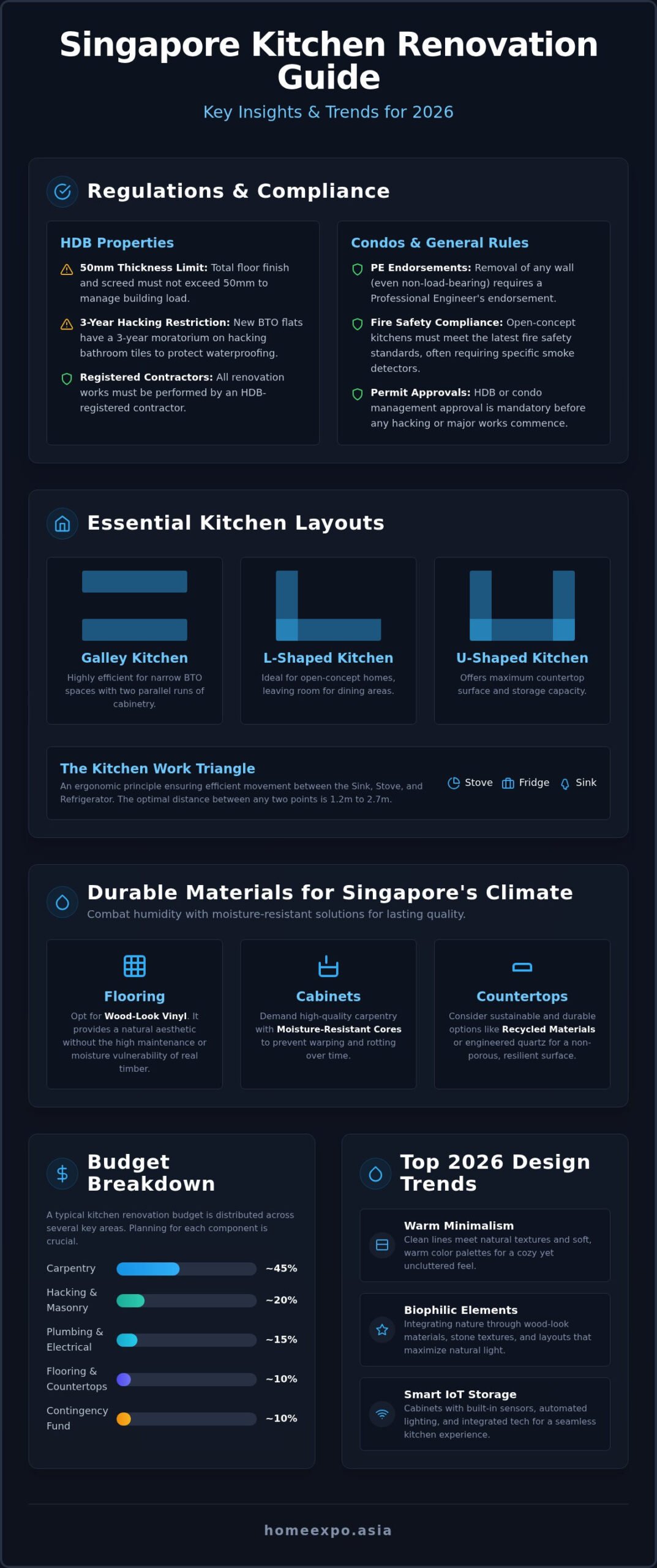
A successful project integrates four core pillars: durable flooring, custom carpentry, certified plumbing, and safe electrical wiring. You must engage an HDB-registered contractor for any public housing works. This ensures that the structural integrity of your block is maintained. For instance, HDB rules updated in July 2026 mandate that the total thickness of floor finishes and screed must not exceed 50mm. Sticking to these limits prevents unnecessary weight on the building structure. It’s a smart move to verify these technical specs before you sign any contract.
Navigating HDB and Condo Renovation Regulations
Specific permits are required for major works like hacking walls or floors. For new BTO owners, there’s a three-year restriction on hacking bathroom floor and wall tiles to protect the waterproofing membrane. While you can typically hack kitchen tiles earlier, you must obtain HDB approval first. If you plan an open-concept conversion in 2026, you’ll need to comply with the latest fire safety requirements. This often involves specific smoke detector placements or home fire alarm devices. Any removal of non-load-bearing walls requires Professional Engineer (PE) endorsements to confirm the work won’t affect the building’s stability.
Top Kitchen Design Trends for Singapore Homes in 2026
The 2026 design landscape is dominated by warm minimalism and biophilic elements. Homeowners are increasingly choosing wood-look vinyl flooring to bring natural textures into the space without the maintenance of real timber. Understanding the history and design of kitchens reveals how we’ve moved toward integrated IoT storage solutions. These smart kitchens feature cabinets with built-in sensors and energy-efficient lighting. Sustainable luxury is also a priority. We’re seeing a rise in recycled material countertops and layouts that maximize natural airflow. Professional kitchen carpentry singapore specialists now emphasize flooring-first planning to ensure your cabinets sit on a stable, moisture-proof foundation.
Essential Layouts and Space Planning for Modern Kitchens
Efficiency in a Singaporean home starts with the Kitchen Work Triangle. This design principle focuses on the distance between your sink, stove, and refrigerator. Keeping these three points between 1.2 and 2.7 meters apart ensures you can move safely and quickly while cooking. It’s a fundamental rule that prevents congestion, especially in the compact floor plans common in BTO units. When you plan your kitchen carpentry singapore, you must prioritize this flow to ensure your daily chores don’t feel like a workout.
Choosing the right layout depends heavily on your specific floor plan. Galley kitchens are highly efficient for narrow BTO spaces, providing two parallel runs of cabinetry. L-shaped layouts are excellent for open-concept homes, as they provide a natural corner for storage and leave plenty of room for a dining table. If you have a larger resale flat, a U-shaped kitchen offers the most countertop surface and storage capacity. You should also consider the ergonomics of the primary cook. Counter heights should be customized to prevent back strain, typically ranging between 85cm and 90cm depending on the user’s height.
Integrating the laundry yard is another unique challenge for HDB owners. Many modern designs now use consistent cabinetry to hide washing machines and cleaning supplies, creating a unified look. It’s often helpful to speak with a professional about a free site assessment to see how these elements can fit seamlessly into your specific layout.
Optimizing Small HDB Kitchen Storage
Maximizing every square inch is vital in high-rise living. You should utilize vertical space by installing full-height kitchen carpentry singapore that reaches the ceiling. This eliminates dust traps and provides storage for items you don’t use daily. Pull-out larders and corner carousels are essential tools for accessing deep cabinets. Integrated appliance housing also helps maintain a clean, streamlined look by hiding bulky refrigerators or ovens behind matching cabinet doors.
The Open-Concept Kitchen Debate
Open-concept kitchens are a staple of 2026 kitchen design trends, offering a sense of spaciousness and better light. However, they can allow cooking fumes to drift into the living area. Many homeowners now opt for glass partitions as a middle ground. These maintain the visual connection while containing smells. To unify the space, using a consistent vinyl flooring singapore across both the kitchen and living room creates a seamless transition that makes your home feel significantly larger.
Selecting Durable Materials: Flooring, Cabinets, and Countertops
Material selection is the #1 factor in determining the longevity of your kitchen. In Singapore’s high-humidity environment, choosing the wrong surface leads to warping, mold, and costly repairs within just a few years. While traditional homogeneous tiles were the previous standard, 2026 has seen a major shift towards integrated material solutions that offer both beauty and extreme resilience. Every component must be selected with a “flooring-first” durability mindset to ensure a stable foundation for your cabinetry.
Countertop choices have also evolved. Quartz remains a top choice because it’s non-porous and highly scratch-resistant. Sintered stone is gaining significant traction for its ability to withstand direct heat and UV exposure without staining. Solid surfaces are still available for budget-conscious projects, though they require more care to avoid scratches. Regardless of the surface, the internal structure is what truly matters. Moisture-resistant cabinet carcasses are essential to prevent the wood from swelling in our tropical climate.
Why Vinyl Flooring is the 2026 Standard for Kitchens
Many homeowners ask if vinyl is truly waterproof. High-quality vinyl is designed specifically for heavy kitchen use. It features a completely waterproof core that won’t swell even if a pipe leaks. It also provides essential anti-slip properties, which are vital in wet areas to ensure family safety. One of the biggest advantages is the ability to overlay vinyl over existing tiles. This allows you to avoid the mess and high costs of hacking. For a deeper look at your options, check out this flooring singapore guide.
Direct Carpentry and Cabinet Material Selection
The foundation of your kitchen carpentry singapore is the carcass material. We always recommend plywood over chipboard for kitchen environments. Plywood’s layered structure offers superior moisture resistance and screw-holding strength. It won’t sag or rot as easily as compressed wood particles. You should also select high-pressure laminates that are anti-fingerprint and heat-resistant to maintain a pristine look. Don’t overlook the hardware. Investing in high-quality hinges and soft-close mechanisms prevents cabinet doors from slamming and extends the life of the entire unit. Finding a trusted carpenter singapore is the final step to ensuring expert installation of these premium materials.
Budgeting and Cost Breakdown for Kitchen Renovation Singapore
Financial clarity is the foundation of a stress-free renovation. For a standard 4-room HDB kitchen in 2026, most homeowners should prepare a budget between S$14,000 and S$24,000. If you’re renovating a resale flat, expect to pay 15% to 25% more than BTO rates due to extensive demolition and structural rectification. Working with a direct contractor provides a significant financial advantage. By eliminating middleman markups from interior design firms, you ensure more of your budget is invested in high-quality kitchen carpentry singapore and durable finishes.
Your budget should be divided into four primary categories: hacking, masonry, plumbing, and carpentry. Hacking and masonry are essential for creating a level foundation, especially if you’re installing a cement mortar base for cabinets. Plumbing covers sink installation and pipe works, while carpentry typically represents the largest investment. To maximize value, you should prioritize spending on internal hardware like heavy-duty hinges and pull-out systems. You can save on costs by choosing standard laminates or simpler cabinet handles, which are easier to upgrade later without affecting the kitchen’s structural integrity.
Estimated Costs for HDB vs. Condo Kitchens
Condo renovations typically start at S$20,000 and can easily exceed S$40,000. These higher costs are driven by strict Management Corporation Strata Title (MCST) guidelines, which include limited working hours and mandatory floor protection for common areas. In 2026, industry rates for top or bottom hung kitchen cabinets start from S$120 per foot run. Full-height storage units with casement doors generally begin at S$240 per foot run. Flooring costs vary by material, but overlaying vinyl remains a popular, cost-effective choice for both HDB and private properties to avoid the high fees associated with full floor hacking.
Hidden Renovation Costs to Watch Out For
Always maintain a 10% contingency fund for the unexpected. HDB regulations require specific debris disposal and haulage fees that are often billed separately from the main work. You must also account for professional fees related to electrical point relocation and gas pipe alterations, which require licensed technicians. If you plan to live in your home during the 3-5 week renovation period, don’t forget to budget for temporary kitchen setups or additional dining expenses. For a transparent breakdown of your project, get a personalized quote from our direct carpentry experts.
Executing Your Renovation with Home Expo Asia
Choosing the right partner for your kitchen transformation is the most critical decision you’ll make. Home Expo Asia stands out as a reliable specialist in both durable vinyl flooring and bespoke kitchen carpentry singapore. We offer over 200 vinyl designs, providing a breadth of choice that far exceeds typical carpentry firms. Our goal is to provide a personalized look that reflects your style while maintaining the highest industry standards for safety and quality. We don’t just build kitchens; we create functional spaces that add real value to your home.
Our process is designed to be straightforward and stress-free. It begins with a free site assessment where our experts evaluate your space and provide professional recommendations. From material selection to final installation, we handle every detail with precision. You’ll receive comprehensive warranties on our work, ensuring your peace of mind long after the renovation is complete. Our after-sales support is a testament to our commitment to long-term reliability and customer satisfaction.
The Benefits of Our Direct Contractor Model
Many homeowners are often caught between hiring an interior designer or a direct contractor. The direct contractor model is superior for those seeking price transparency and technical accuracy. By eliminating the middleman, we pass the cost savings directly to you. You won’t have to deal with the 20% to 30% markups often associated with design firms. Instead, you get a clear, honest breakdown of every dollar spent on your project.
- Direct Communication: You speak directly with the craftsmen and installers who are building your kitchen. This significantly reduces the risk of communication errors.
- Faster Turnaround: Without the back-and-forth of a middleman, we can complete your flooring and cabinetry installation more efficiently.
- Technical Expertise: Our team understands the structural requirements of HDB and Condo units, ensuring your renovation is compliant from day one.
Our Quality Assurance and Warranty
We don’t just install; we ensure your kitchen is built to last. Our vinyl flooring undergoes rigorous testing for moisture and heat resistance, making it perfect for the high-traffic demands of a Singaporean kitchen. Our professional installation standards are designed to prevent common issues like popping tiles or uneven surfaces. We believe in our workmanship, which is why we offer a robust risk-mitigation promise to every customer. We’re here to build a kitchen that stays beautiful and functional for years to come. It’s about giving you the security you deserve in your investment.
Get a risk-free quote for your kitchen renovation today and experience the difference of working with a reliable expert in kitchen carpentry singapore.
Ready to Build Your 2026 Dream Kitchen?
Achieving a successful kitchen transformation in Singapore requires balancing modern aesthetics with strict technical compliance. By prioritizing durable materials and understanding the latest HDB regulations, you ensure your investment stands the test of time. High-quality kitchen carpentry singapore combined with waterproof vinyl flooring creates a resilient foundation that resists our local humidity. Working with a direct contractor allows you to maximize your budget without compromising on the professional standards your home deserves.
You now have the knowledge to navigate 2026 costs and layouts with total clarity. Whether you’re managing a new BTO flat or a resale condo, the right planning prevents hidden fees and structural issues later. Transform your kitchen with Home Expo Asia’s direct contractor services. We offer direct carpentry pricing, over 200 vinyl designs, and a free site assessment to bring your vision to life. Your ideal kitchen is within reach; let’s make it a reality together with quality you can trust for years to come.
Frequently Asked Questions
How much does a basic kitchen renovation cost in Singapore in 2026?
A basic kitchen renovation for a 4-room HDB flat typically ranges between S$14,000 and S$24,000 in 2026. Smaller BTO kitchens may cost as little as S$8,000, while 5-room or Executive units can exceed S$32,000. These estimates include hacking, masonry, plumbing, and essential kitchen carpentry singapore. Resale flats generally cost 15% to 25% more because they require demolition of old structures and potential rectification of existing plumbing and electrical points.
Do I need an HDB permit for kitchen renovation if I am only changing cabinets?
You don’t need a permit if you’re simply replacing cabinets without hacking walls or floor tiles. However, you must ensure the total thickness of the cement mortar base and tile finishes doesn’t exceed 50mm. If your project involves hacking existing floors or removing non-load-bearing walls for an open-concept look, you must engage an HDB-registered contractor to apply for the necessary permits before any work begins on your property.
Is vinyl flooring really suitable for a heavy-duty Singaporean kitchen?
High-quality vinyl is exceptionally suitable for heavy-duty kitchens because it features a 100% waterproof core and superior anti-slip properties. It provides a seamless, easy-to-maintain surface that doesn’t trap grease in grout lines like traditional tiles. It’s designed to withstand high foot traffic and accidental spills without warping or rotting. At Home Expo Asia, we offer over 200 vinyl designs that combine this extreme durability with the natural aesthetic of wood or stone textures.
How long does a typical kitchen renovation take from start to finish?
A standard kitchen renovation in Singapore usually takes between 3 and 5 weeks from the start of hacking to final installation. This timeline accounts for masonry curing, precise measurements for custom kitchen carpentry singapore, and the installation of countertops and appliances. Resale units might take slightly longer if unforeseen structural or plumbing issues are discovered during demolition. Coordinating with a direct contractor helps streamline this process by reducing communication delays between different trades.
Can I overlay my existing kitchen tiles with vinyl to save money?
Yes, you can overlay existing kitchen tiles with vinyl to significantly reduce renovation costs and avoid the mess of hacking. This method is a popular choice for homeowners looking for a fast, cost-effective update. As long as your existing tiles are structurally sound and level, vinyl can be installed directly over them. This approach also bypasses the need for certain hacking permits and prevents potential damage to the underlying waterproofing membrane in older flats.
What is the most durable countertop material for a high-heat kitchen?
Sintered stone is the most durable countertop material for high-heat kitchens in 2026. It can withstand direct contact with hot pans and is virtually impervious to scratches, stains, and UV rays. While quartz remains a highly popular and scratch-resistant option, sintered stone offers superior thermal stability for active cooks. For those on a tighter budget, high-pressure laminates provide a heat-resistant surface, though they require more care with sharp objects compared to natural stone surfaces.
Should I hire an Interior Designer or a Direct Contractor for my kitchen?
Hiring a direct contractor like Home Expo Asia is ideal if you want to eliminate middleman markups and have direct communication with the craftsmen. Interior designers often add a 20% to 30% service fee for project management and conceptualization. By working directly with us, you get transparent pricing on flooring and cabinetry while ensuring technical accuracy. This model is perfect for homeowners who have a clear vision and prioritize high-quality workmanship and cost efficiency.
What are the fire safety rules for open-concept kitchens in HDB flats?
Fire safety rules for open-concept kitchens require the installation of Home Fire Alarm Devices (HFAD) and specific smoke detectors. If your kitchen is located along a fire escape route, you must ensure any replacement entrance doors meet fire-rated standards. While you can remove non-load-bearing walls to create an open space, you must obtain a permit and potentially a Professional Engineer endorsement. These regulations ensure that your modern layout remains safe and compliant with 2026 building standards.