Did you know that termites cause an estimated S$400 million in damages to Singapore properties every single year? It’s a staggering figure that highlights why so many homeowners live in constant fear of these “silent destroyers” ruining their expensive wooden floors. You’ve likely felt that same anxiety, wondering if your beautiful parquet is secretly being hollowed out. Many people assume that waterproof materials are naturally pest-resistant, but true protection requires specialized termite proof flooring solutions that remove the food source entirely.
We understand that your home is your most significant investment. You deserve a beautiful floor that provides total peace of mind for the next 10 to 20 years without the constant threat of costly treatments or replacements. In this guide, we’ll explore the science behind termite-resistant materials and show you how to choose flooring that pests physically cannot eat. You will learn about the benefits of cellulose-free vinyl flooring and how professional installation techniques create a permanent barrier against infestations.
Key Takeaways
- Understand why Singapore’s humid climate makes your home a natural target for both subterranean and drywood termite infestations.
- Learn the science behind termite proof flooring solutions and why cellulose-free vinyl is physically impossible for pests to digest.
- Identify the high-risk materials, such as laminate with fiberboard cores and traditional parquet, that often attract “silent destroyers.”
- Master a critical pre-installation checklist to ensure your subfloor is properly sealed and cleared of old timber debris before new flooring is laid.
- Discover how expert installation services provide a long-term barrier that protects your home renovation for the next 10 to 20 years.
Understanding the Termite Threat in Singapore Homes
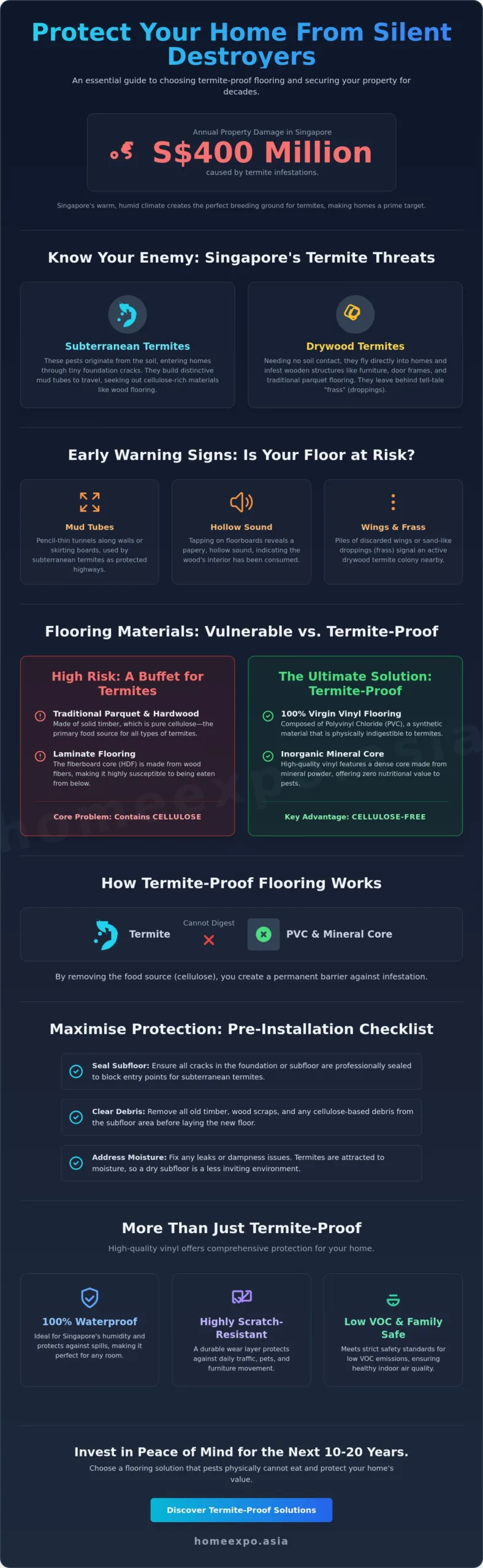
Singapore’s year-round humidity and high temperatures create a perfect incubator for pests. For many local homeowners, a termite infestation isn’t just a remote possibility; it’s often a “when” rather than an “if” scenario. Termites cause an estimated S$400 million in damages to properties across Singapore every year. This staggering cost stems from the fact that these insects are “silent destroyers” that work behind the scenes for months or even years before being detected. By the time you see the damage, the repair bill has already grown.
In our local context, we primarily deal with two distinct threats. Subterranean termites originate from the soil and enter through tiny foundation cracks. Drywood termites don’t require soil contact and can infest your furniture or floorboards directly. Traditional materials like solid timber parquet and laminate flooring act as an all-you-can-eat buffet. They contain cellulose, which is the primary food source for these pests. When they eat through your floor, the cost isn’t just a simple floorboard replacement. You might face massive structural repairs to your subfloor or built-in cabinetry. Choosing termite proof flooring solutions early in your renovation is the most effective way to avoid these financial headaches.
Common Signs of Infestation in Your Current Floor
Early detection can save you thousands in restoration costs. Watch for these specific red flags in your home:
- Mud Tubes: These thin, brown tunnels often appear along skirting boards or wall edges. They serve as protected highways for subterranean termites.
- The Hollow Sound Test: Tap your floorboards or parquet. If it sounds thin, papery, or hollow, the interior has likely been consumed.
- Discarded Wings and Frass: Finding piles of tiny wings or “sand-like” droppings (frass) near window sills indicates a drywood termite colony is active nearby.
Why Moisture is the Silent Accomplice
Termites thrive on moisture. High humidity and hidden water seepage in older Singapore apartments attract them to your subfloor area. When moisture gets trapped under old tiles or wood, it creates a damp environment where termites flourish. This is why “popping tiles” are more than just an aesthetic nuisance; they signal potential subfloor vulnerabilities. Professional installers often recommend integrated termite barriers during the renovation process to seal off entry points. By opting for termite proof flooring solutions like high-quality vinyl, you remove both the food source and the moisture traps that invite disaster.
Why Vinyl is the Ultimate Termite-Proof Flooring Solution
While many products claim to be “termite-resistant,” there’s a significant difference between deterring a pest and being physically inedible to one. True termite proof flooring solutions rely on a simple scientific fact: termites cannot digest Polyvinyl Chloride (PVC). Unlike traditional hardwood or laminate, vinyl contains absolutely no cellulose. Because cellulose is the primary organic compound termites crave, removing it from your floor’s composition effectively removes your home from their menu. It’s a permanent solution that addresses the root cause of infestations.
High-quality vinyl options often feature inorganic core materials that provide zero nutritional value to pests. These cores are typically made from a blend of natural mineral powder and stabilizers, creating a dense, synthetic barrier that subterranean termites cannot penetrate or consume. To effectively Identify and Control Termites, experts suggest eliminating these organic pathways entirely. By installing an inorganic floor, you aren’t just hoping they won’t find your timber; you’re ensuring there is no food source for them to find in the first place.
The Advantage of 100% Virgin Vinyl
Quality matters for long-term protection. We recommend 100% virgin vinyl over recycled variants. Virgin vinyl is more stable and lacks the organic impurities sometimes found in lower-grade recycled materials. Beyond pest resistance, these high-end materials are 100% waterproof and highly scratch-resistant. They meet strict Singapore safety standards for indoor air quality, ensuring low VOC emissions for your family. If you’re planning a full renovation, choosing high-quality vinyl flooring is the first step toward a pest-free home.
Aesthetic Without the Risk: Wood-Look Vinyl
Homeowners often worry that switching to synthetic materials means sacrificing the warmth of natural timber. This isn’t the case in 2026. Modern manufacturing creates realistic textures that replicate the deep grains of oak and walnut perfectly. You get the beautiful aesthetic of a wood floor without the constant anxiety of a “silent destroyer” eating it from the inside out. There is no risk of mismatched replacement planks or “termite patches” because the material remains consistent and durable for decades. It’s the perfect balance of luxury and security for any Singaporean property owner looking for termite proof flooring solutions.
Comparing Flooring Materials: From Vulnerable to Termite-Proof
Choosing the right material for your Singapore home involves more than just picking a color. You must consider the biological reality of our tropical climate. Solid timber and traditional parquet are often seen as the gold standard for luxury, but they represent the highest risk for termite attraction. These materials are composed entirely of organic matter, providing a direct food source for pests. While some homeowners believe that engineered wood is a safer middle ground, it remains vulnerable. Even if the top veneer is durable, the internal layers still contain cellulose, allowing termites to hollow out the planks from the inside without showing immediate surface damage.
When you look at termite proof flooring solutions available in 2026, high-quality vinyl stands out as the only category that truly removes the risk. Vinyl is an inorganic material that termites simply cannot digest. By opting for a synthetic composition, you eliminate the “all-you-can-eat buffet” that organic wood provides. This choice gives you the same warm aesthetic as timber but with the professional security of a material that is physically immune to pest consumption. It’s a long-term investment in your home’s structural integrity.
The Problem with Laminate and HDF Cores
Laminate flooring is often marketed as a durable alternative to wood, yet it hides a significant weakness. The core of most laminate planks is made of High-Density Fiberboard (HDF), which consists of compressed wood fibers. These fibers are highly attractive to termites. If moisture seeps into the subfloor, the HDF core swells, creating tiny gaps that act as entry points for pests. For ground-floor units in Singapore, installing laminate is often a ticking time bomb. Once termites find the HDF core, they can destroy an entire room’s flooring in a matter of weeks.
Vinyl vs. Homogeneous Tiles
Many homeowners consider homogeneous tiles for their pest-resistance. While tiles are certainly termite-proof, they often lack the comfort and warmth that modern families desire. Tiles can feel cold underfoot and involve grout lines that require constant scrubbing to prevent mold. Vinyl offers a superior balance for HDB renovations because it provides a seamless, waterproof surface that is much softer to walk on. It’s easier to maintain and faster to install. For a deeper look at how these materials compare in the current market, check out our Flooring Singapore: The Ultimate Guide. Choosing termite proof flooring solutions shouldn’t mean compromising on the “homely” feel of your living space.
Pre-Installation Checklist: Maximising Your Termite Protection
A thorough subfloor inspection is your next line of defense. We look for tiny cracks in the cement screed, as subterranean termites only need a very small gap to enter your home. If your subfloor is uneven or damaged, it creates “highways” for pests to move undetected. In some cases, especially for landed properties or ground-floor HDB units, we recommend engaging an NEA-licensed pest control professional to perform a soil treatment before installation begins. This layered approach ensures that your new floor sits on a sterile, secure base that offers no entry points for the “silent destroyers.”
The Role of Cement Screeding
A smooth, professional cement screed does more than just level your floor. It seals the subfloor from ground-level pests and prevents moisture traps. Cracks in old screed are the primary entry points for subterranean termites in Singapore apartments. By ensuring a solid, gap-free foundation, you remove the pathways these pests use to reach your living space. A high-quality base is essential for the long-term performance of your floor. For more details on the technical requirements of a perfect installation, see our Vinyl Flooring Singapore Guide.
Selecting Termite-Proof Accessories
Your floor is only as strong as its weakest link. Many homeowners choose high-quality vinyl but then install MDF (Medium Density Fiberboard) skirting. MDF is highly susceptible to termite attacks because it is made of compressed wood fibers. Instead, opt for PVC or aluminium skirting. These materials are 100% pest-proof and waterproof. Ensure that your transition strips and profiles are also synthetic. A “tight seal” during installation is critical to prevent voids where moisture can collect and attract unwanted visitors. Every joint must be perfectly fitted to maintain the integrity of the barrier.
Don’t leave your home’s safety to chance. Our team provides expert flooring installation service that includes a comprehensive subfloor assessment to ensure your renovation remains pest-free for decades. We focus on every detail, from the removal of old debris to the final sealing of your skirting boards, to give you complete peace of mind.
Why Home Expo Asia is Your Partner in Pest-Free Flooring
Home Expo Asia stands as a reliable expert in the Singapore flooring industry. We don’t just sell floors; we provide long-term security against the S$400 million annual threat of termite damage. Our commitment to 100% termite proof flooring solutions means we only offer high-quality, cellulose-free vinyl that pests physically cannot digest. You get a floor that looks like natural oak or walnut but carries none of the risks associated with organic timber. It’s a permanent solution for homeowners who want to enjoy their living space without the constant fear of “silent destroyers.”
Our expert installation teams are specifically trained to identify subfloor vulnerabilities before any work begins. We check for the tiny cracks and moisture traps that serve as entry points for subterranean pests. With over 200 designs available, your dream home doesn’t have to be a compromise between style and safety. We offer transparent pricing and comprehensive warranties to ensure you have complete peace of mind for the next 10 to 20 years. Every project is handled with the professional care your investment deserves.
Proven Track Record in Singapore
We back our broad promises with quantifiable proof points. With thousands of successful installations across HDB flats, condominiums, and landed properties, our reputation is built on external validation and customer satisfaction. We maintain a strict “no hidden costs” policy. You receive financial clarity from the start, with all official documentation provided. This transparency is why so many Singaporeans trust us for their full home renovation and flooring needs.
Quality is never an afterthought at Home Expo Asia. Our vinyl products meet rigorous industry standards and carry reputable certifications from bodies like SETSCO, Green Label Singapore, and CE. These labels verify that your flooring is safe, durable, and environmentally friendly. We prioritize these technical standards to provide the risk-mitigation promise our customers deserve. By showcasing extensive external validation, we ensure you’re choosing a partner genuinely appreciated by the community.
Get Your Risk-Free Site Assessment
Every home has unique needs. Our process begins with a thorough evaluation of your current flooring and subfloor condition. We identify potential pest risks and provide personalized recommendations that fit your specific budget and home type. Whether you’re doing a complete overhaul or a targeted upgrade, we guide you through every step. Our flooring installation service is designed to be customer-centric and responsive, highlighting our commitment to long-term support.
Ready to protect your investment with a floor that termites physically cannot eat? Book your free site measurement today and take the first step toward a beautiful, pest-free home. Our team is ready to help you create a secure environment that lasts for decades.
Build a Pest-Free Future for Your Home
Protecting your Singapore property from the “silent destroyers” requires more than just luck. It demands a strategic shift toward materials that pests simply cannot consume. By choosing cellulose-free vinyl, you remove the primary food source that attracts termites to your living space. Combined with a professional subfloor inspection and a meticulous installation process, you create a permanent barrier that keeps your investment safe for decades. These termite proof flooring solutions aren’t just about aesthetics; they’re about long-term financial security and peace of mind.
As a top-rated vinyl flooring supplier in Singapore, we offer over 200+ designs to match your vision perfectly. Our certified professional installation comes with a full warranty, ensuring your renovation is backed by industry-leading standards. Don’t wait for the first sign of damage to take action. Secure your home with 100% termite-proof vinyl flooring from Home Expo Asia today! We’re ready to help you build a beautiful, worry-free sanctuary for your family.
Frequently Asked Questions
Can termites eat through vinyl flooring?
Termites cannot eat through vinyl flooring because it’s made from Polyvinyl Chloride (PVC), which contains no cellulose. Since termites specifically seek out cellulose for nutrition, vinyl offers absolutely no food value to them. It acts as a durable, synthetic barrier that pests will simply ignore as they search for organic wood sources elsewhere. This makes it a primary choice for homeowners seeking a permanent solution to pest problems.
Will installing vinyl over my old tiles attract termites?
Installing vinyl over old tiles won’t attract termites as long as the subfloor is dry and free of organic debris. However, if your existing tiles have cracks or hollow areas, moisture can collect underneath and create a damp environment that attracts pests. We always perform a thorough subfloor inspection before installation. This ensures that your new floor is laid on a clean, secure base that doesn’t harbor hidden vulnerabilities.
Is SPC flooring better than luxury vinyl for termite protection?
Both materials provide excellent protection because they are 100% cellulose-free and inorganic. While stone-plastic composites are a popular category in the market, high-quality vinyl remains one of the most effective termite proof flooring solutions available today. The most critical factor is the total absence of wood fibers. Termites are physically unable to digest these synthetic materials, regardless of the specific core density or composition you choose.
Does termite-proof flooring require special maintenance?
Termite-proof vinyl doesn’t require any specialized chemical treatments or waxes to maintain its resistance. Its pest-proof nature is a permanent part of its material composition, so it won’t wear off over time. You only need to follow standard cleaning routines like regular sweeping and occasional mopping with a pH-neutral cleaner. This makes it a highly practical, low-maintenance option for busy Singaporean households looking for long-term security.
What should I do if I find termites under my existing floor?
If you discover termites, you should immediately contact an NEA-licensed pest control professional to treat the active colony. Don’t attempt to remove the floorboards or spray household insecticides yourself, as this often causes the colony to spread to other parts of your home. Once the infestation is professionally cleared and certified, you can safely proceed with an installation service to replace the damaged wood with inorganic, pest-proof materials.
How long does termite-proof vinyl flooring typically last?
High-quality vinyl flooring typically lasts between 10 to 20 years when installed by professionals. Because it’s 100% waterproof and immune to pest damage, it doesn’t suffer from the internal hollowing or rot that often destroys traditional timber. This impressive longevity makes it one of the most cost-effective termite proof flooring solutions for modern renovations. It’s a reliable investment that protects your home’s aesthetic and structural integrity for decades.
Are the adhesives used in vinyl installation termite-resistant?
Modern flooring adhesives are synthetic and don’t contain the organic proteins or starches that would attract termites. Our teams use industry-standard, low-VOC adhesives that are designed to create a powerful bond while remaining completely unattractive to pests. This ensures that every layer of your new floor is secure. By using inorganic adhesives, we eliminate the risk of pests tunneling through the glue layer to reach other parts of your home.
Is termite-proof flooring more expensive than traditional wood?
Vinyl flooring is generally more affordable than solid timber parquet or high-end engineered wood. While it provides a similar luxury aesthetic, it saves you significant money over time by eliminating the need for expensive pest treatments and floor replacements. You get the warmth and beauty of wood without the high maintenance costs or the financial risk of a termite infestation. It’s a smart choice for value-conscious homeowners who prioritize safety.