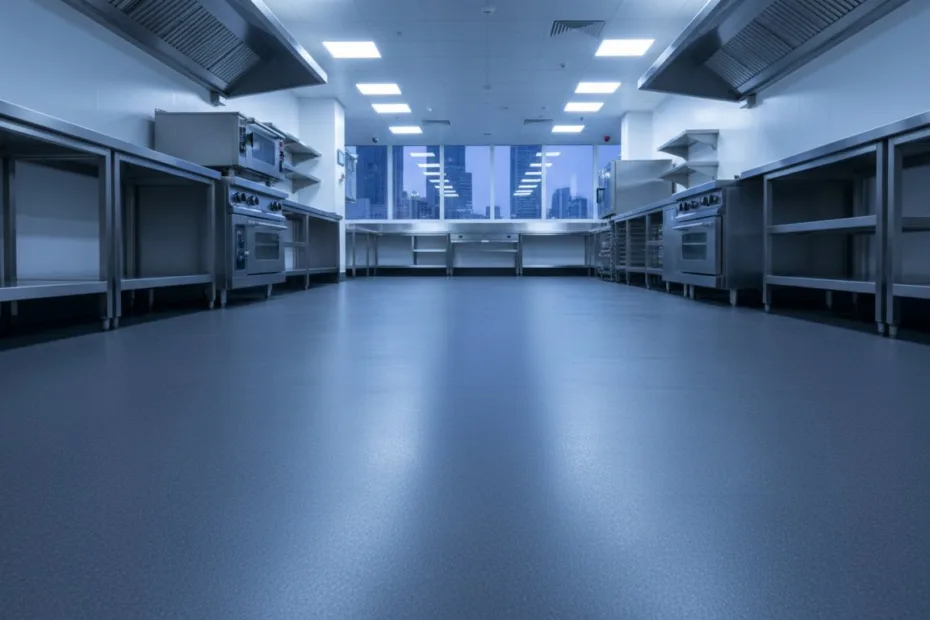
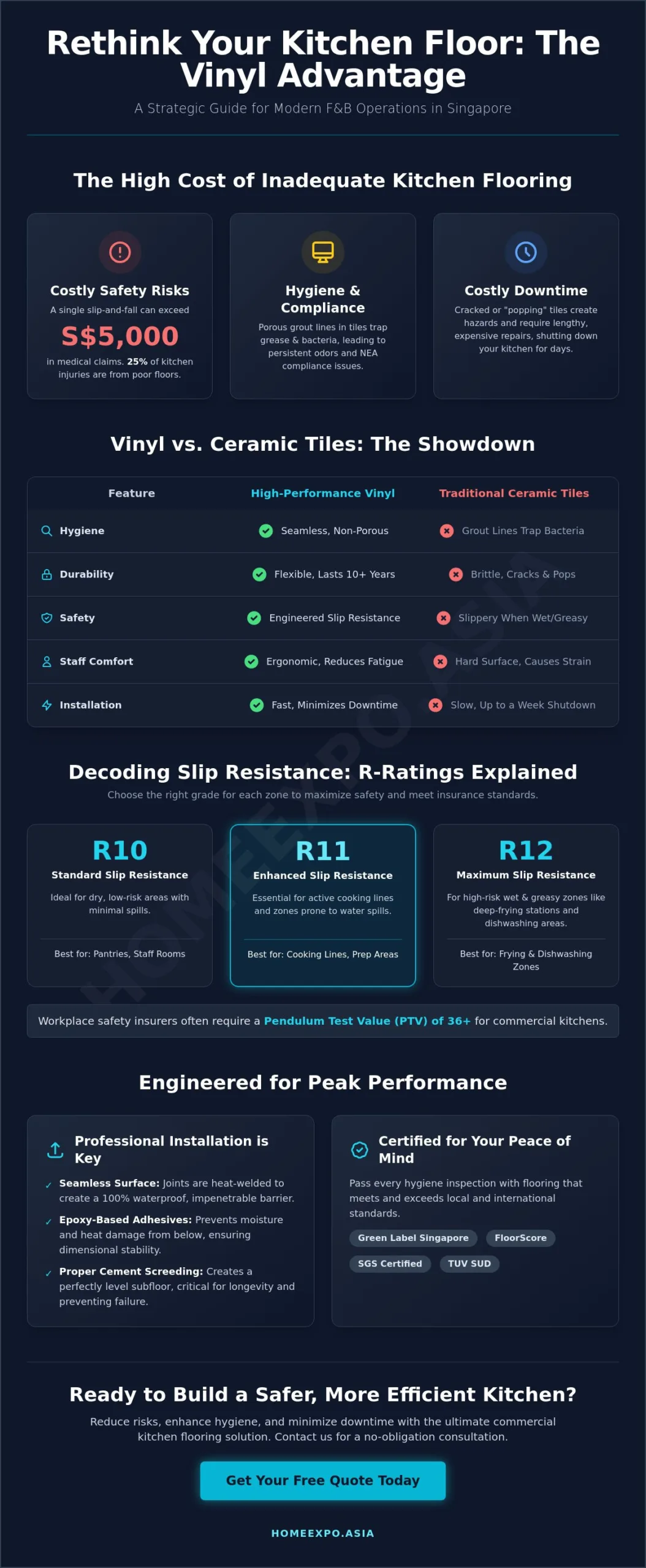
Did you know that a single slip-and-fall accident in a high-pressure kitchen environment can lead to workplace disruption and costs exceeding S$5,000 in medical claims? According to 2023 industry safety data, nearly 25% of kitchen injuries are caused by poor floor maintenance and slippery surfaces. We understand that keeping your kitchen staff safe while maintaining a spotless facility is a constant challenge. You’ve likely struggled with greasy grout lines that trap bacteria or ceramic tiles that crack under the weight of heavy equipment. It’s frustrating when traditional flooring fails to meet the rigorous demands of a 24/7 food service operation.
Our guide helps you find the perfect vinyl flooring for commercial kitchen spaces that combines safety with extreme durability. You’ll discover how to select materials that carry essential certifications like Green Label Singapore and FloorScore to ensure your business passes every NEA hygiene inspection with ease. We will walk you through the benefits of seamless installation, the importance of slip-resistance ratings, and how modern vinyl can outlast traditional tiles by up to 10 years.
Key Takeaways
- Learn why high-performance vinyl flooring for commercial kitchen is the strategic, seamless alternative to traditional tiles for modern F&B environments.
- Identify the specific R-Rating and Pendulum Test values required to meet Singapore’s workplace safety insurance and strict hygiene standards.
- Compare the structural benefits of vinyl sheets versus LVT to choose the right format for heavy-duty cooking zones and high-traffic dining areas.
- Discover how professional installation using epoxy-based adhesives and proper cement screeding prevents long-term heat and moisture damage.
- Establish a daily maintenance routine to keep your facility NEA-ready while ensuring your floor resists damage from industrial-strength degreasers.
Why Vinyl Flooring is the Strategic Choice for Singapore Commercial Kitchens
Commercial-grade vinyl is a heavy-duty, multi-layered resilient flooring engineered for extreme environments. It’s not the thin material found in residential homes. This high-performance product features a dense wear layer and a reinforced core designed to withstand the rigors of a professional kitchen. Modern F&B owners are rapidly moving away from traditional ceramic tiles. They’re choosing vinyl flooring for commercial kitchen setups because it offers a seamless, non-porous surface that meets the highest hygiene standards.
The ergonomic benefits of vinyl are a game-changer for staff retention. Hard stone or concrete floors lead to joint pain and exhaustion during long shifts. Vinyl provides a slight “give,” which reduces staff fatigue and improves productivity. Choosing certified materials is a risk-free strategy for business longevity. Our flooring solutions are a testament to exceptional quality, ensuring your kitchen remains operational without the fear of sudden floor failure.
- ✓ Quality is our #1 priority for every installation.
- ✓ Safe and eco-friendly materials for your peace of mind.
- ✓ Certified by international bodies like SGS and TUV SUD.
- ✓ Professional service backed by decades of experience.
The Demands of F&B Environments in Singapore
Singapore’s tropical climate creates a unique set of challenges for kitchen infrastructure. With average humidity levels often hitting 84% and kitchen temperatures regularly exceeding 30°C near stoves, materials must be dimensionally stable. High-footfall areas and heavy equipment zones, such as walk-in refrigerators and industrial ovens, put immense pressure on the floor. The Sheet vinyl flooring composition ensures the material remains impermeable to water and grease, preventing subfloor damage. You need a supplier with deep local experience in Singapore renovations to navigate these environmental factors effectively.
Vinyl vs. Ceramic Tiles: A Performance Comparison
The “popping tile” issue is a notorious problem in Singapore. Rapid temperature changes in kitchens cause tiles to expand and crack, creating tripping hazards and breeding grounds for bacteria. Vinyl avoids this entirely because it’s flexible and doesn’t rely on brittle adhesives. Hygiene is another major differentiator. Grout lines in ceramic floors trap food particles and moisture, leading to persistent odors and NEA compliance issues. Vinyl is seamless, making it easy to clean and maintain.
From a business perspective, the cost-benefit analysis favors vinyl. Installation is significantly faster than tiling. While a full tile replacement might shut your kitchen down for a week, vinyl can often be installed in a fraction of that time. This reduction in business downtime saves you thousands in potential revenue loss. It’s a smart, professional choice for any serious F&B operator in the city-state.
Essential Technical Specifications: Slip Resistance and Hygiene
Selecting the right vinyl flooring for commercial kitchen use involves more than just picking a color. You must prioritize technical certifications that protect your staff and your business license. High-quality commercial vinyl is engineered to withstand heavy foot traffic while maintaining strict safety standards. It’s a critical investment for any F&B owner who values long-term reliability and workplace safety.
- ✓ R11 or R12 slip resistance for high-risk wet zones
- ✓ Low VOC emissions for superior indoor air quality
- ✓ Integrated antimicrobial layers to prevent bacterial colonies
- ✓ Seamless heat-welded joints for 100% water resistance
Understanding Slip Resistance Ratings (R10, R11, R12)
The R-rating measures how well a floor prevents slips on an incline. We recommend R10 for dry areas like pantries or staff breakrooms where spills are rare. For active cooking lines, frying stations, and dishwashing zones, R11 or R12 is essential. These higher ratings indicate a specialized textured surface designed to provide grip even when the floor is covered in oil or water.
While R12 offers the highest safety, the deeper texture requires more intensive cleaning. You should balance this trade-off based on your specific kitchen workflow. Workplace safety insurance providers in Singapore often evaluate Pendulum Test values during risk assessments. A Pendulum Test Value (PTV) of 36 or higher is the industry benchmark for a “low slip potential” environment in wet conditions. The Coefficient of Friction is the numerical ratio between the friction force and the normal force, essentially determining how much grip a shoe has when it hits a greasy kitchen spill.
NEA and HACCP Compliance for Kitchen Floors
To achieve a Grade A hygiene rating from the NEA, your flooring must be non-porous and easy to sanitize. Our vinyl flooring for commercial kitchen applications meets these standards by creating a completely seamless surface. We use a technique called “coving” where the vinyl curves up the wall by 100mm to 150mm. This eliminates the sharp 90-degree corner where dirt, moisture, and bacteria usually hide.
Adhering to FDA Food Code requirements ensures your facility follows global best practices for smooth, durable, and non-absorbent flooring. We also ensure all materials carry the Green Label Singapore certification. This guarantees low VOC (Volatile Organic Compound) emissions, keeping the air quality safe for chefs working long shifts in enclosed spaces. If you want to see our range of NEA-compliant options, you can browse our professional vinyl collection to find the perfect fit for your restaurant. Quality vinyl isn’t just a floor; it’s a foundation for a safer, cleaner business.
Vinyl Sheet vs. LVT: Which Format Fits Your Kitchen Layout?
Choosing the right vinyl flooring for commercial kitchen zones depends on your specific operational needs. While both materials are synthetic and durable, their physical formats change how they handle moisture and weight. Sheet vinyl comes in large rolls, while LVT consists of individual modular pieces. This difference is critical for safety, hygiene, and the long-term integrity of your facility.
Structural integrity is a priority when you’re positioning heavy S$8,000 prep tables or industrial refrigerators. Sheet vinyl typically offers better point-load resistance. It distributes weight across a larger surface area, which prevents the floor from dipping or cracking under pressure. According to flooring industry standards, high-performance resilient floors must withstand significant static loads to remain safe for staff. LVT is excellent for foot traffic, but it can be more susceptible to shifting if heavy equipment is dragged across the seams frequently.
- Sheet Vinyl: Best for “Back-of-House” wet zones and heavy cooking lines.
- LVT: Best for “Front-of-House” service areas, cafes, and dry storage.
- Repairability: LVT wins for easy spot-fixes; Sheet vinyl requires professional patching.
Commercial Vinyl Sheet: The Gold Standard for Wet Kitchens
In high-moisture areas like dishwashing stations and main cooking lines, sheet vinyl is the only logical choice. The secret is in the heat-welded seams. Our installers use a specialized heat gun and welding rod to fuse the edges together. This creates a monolithic, 100% waterproof surface that prevents liquid from seeping into the subfloor. For these punishing environments, we always specify a wear layer between 0.5mm and 0.7mm to ensure the floor survives heavy foot traffic and chemical cleaning.
- ✓ Eliminates bacterial growth in cracks
- ✓ Certified slip resistance for oily floors
- ✓ Seamless coving for easy wall-to-wall cleaning
Luxury Vinyl Tiles (LVT) for Dry Prep and Cafes
LVT provides the aesthetic appeal needed for modern, open-concept kitchens where customers can see the action. It mimics natural wood or stone while remaining much easier to sanitize than real timber. The biggest advantage is repairability. If a heavy pot falls and damages a section, you only replace the affected tiles rather than the entire floor. This saves you significant downtime and maintenance costs. For business owners looking for design inspiration, exploring options for vinyl flooring singapore can help align your kitchen’s look with your brand’s style. It’s a cost-effective solution for cafes and dry prep zones where standing water isn’t a constant issue.
Professional Installation: Preventing Moisture and Heat Damage
Professional installation is what separates a high-performing vinyl flooring for commercial kitchen from a costly renovation disaster. In a high-traffic Singaporean kitchen, the floor faces constant thermal shocks and heavy equipment loads. Without expert handling, even the best materials will fail within months. Our team focuses on a “Safety First” approach, ensuring every square inch is bonded correctly to withstand 14-hour shifts and high-pressure cleaning. It’s this attention to detail that prevents common issues like bubbling or edge-lifting that plague poorly installed floors.
- ✓ Accurate moisture testing to prevent adhesive failure
- ✓ High-temperature epoxy bonding for cooking zones
- ✓ Precision-engineered drainage slopes
- ✓ 1-year installation warranty for peace of mind
The Role of Cement Screed in Commercial Settings
A level subfloor is non-negotiable for any F&B establishment. We use high-grade cement screeding to create a foundation that’s both flat and structurally sound. This process is essential for achieving the correct 1:80 slope toward floor traps, ensuring water doesn’t pool in prep areas. For those looking for a high-standard flooring singapore solution, the subfloor must be perfectly dry before work begins. We perform moisture tests using digital hygrometers; if the relative humidity exceeds 75%, we apply a moisture barrier. This is a critical step when installing vinyl flooring for commercial kitchen environments to prevent the floor from lifting under pressure.
Coving and Floor-to-Wall Transitions
In the Singapore F&B industry, hygiene is a legal requirement under NEA regulations. We specialize in “flash coving,” a method where the vinyl extends 100mm to 150mm up the wall. This creates a seamless, curved transition that eliminates 90-degree corners where grease and bacteria hide. While some choose separate baseboards for aesthetics, integrated coving is the functional gold standard. It prevents wash water from seeping behind walls or under kitchen cabinets, protecting your structural integrity. Our installers use heat-welded seams to ensure the entire floor is a single, waterproof membrane. It’s a risk-free way to ensure your kitchen passes every inspection while looking professional.
Don’t risk your business on a poor installation that leads to downtime. Book a professional site assessment with Home Expo Asia to ensure your kitchen floor is built to last.
Maintenance and Longevity: Keeping Your Kitchen Floor NEA-Ready
Maintaining your workspace ensures you stay NEA-ready. Singapore’s hygiene audits are rigorous, and a clean environment starts from the ground up. Choosing vinyl flooring for commercial kitchen environments simplifies this process because the material is designed to withstand the high-pressure demands of a professional food service setting.
Daily Care and Grease Management
Grease is the primary enemy in any F&B environment. To keep your floor in top condition, follow a daily protocol that begins with dry sweeping to remove grit. Use a microfibre mop rather than a traditional cotton string mop, as microfibre is more effective at lifting microscopic grease particles from the textured surface. Always use pH-neutral cleaners specifically formulated for commercial vinyl. These solutions break down fats without eroding the protective top layer of the floor.
Hot oil spills require immediate attention to prevent surface scarring. If a spill occurs, blot the area with a dry cloth first, then apply a degreaser to remove the residue. PUR reinforcement is a factory-applied polyurethane coating that fills microscopic pores in the floor surface to prevent grease and grime from bonding. This technology ensures that even stubborn stains don’t become permanent fixtures in your kitchen.
Modern vinyl is engineered with high chemical resistance. It stands up to harsh industrial degreasers that would typically strip the finish off other materials. Because of the ‘no-wax’ nature of modern PUR coatings, you never have to worry about the costly and time-consuming process of stripping and re-polishing. Your floor remains durable and slip-resistant with standard cleaning, saving you hundreds of hours in labor costs over its lifespan.
Home Expo Asia: Your F&B Flooring Partner
Selecting the right vinyl flooring for commercial kitchen use is a long-term investment. At Home Expo Asia, we remove the uncertainty from your renovation. We provide a 10-year material warranty and a 1-year installation warranty, ensuring your business is protected against defects and workmanship issues. It’s truly risk-free.
- ✓ 5.0/5.0 Google reviews from satisfied Singaporean business owners.
- ✓ Professional service with more than 50 years of combined experience.
- ✓ Certified, safe, and eco-friendly materials.
- ✓ Transparent pricing with no hidden fees.
Our team understands the specific requirements of the Singapore market, from HDB commercial units to high-end restaurant spaces. We offer prompt and efficient support to ensure your kitchen remains operational and safe. Don’t leave your floor to chance. If you’re ready to upgrade your facility, you can get a risk-free quote today and experience our great professional service firsthand.
Build a Safer, NEA-Compliant Kitchen Today
Selecting the right vinyl flooring for commercial kitchen spaces is a vital step in protecting your staff and securing your operating license. Your floor must handle heavy foot traffic and rigorous cleaning while maintaining high slip resistance. We offer materials that carry ISO 9001 and FloorScore certifications, ensuring your facility meets international safety and environmental standards. Our team brings over 50 years of combined experience to every project in Singapore, focusing on precision that prevents common issues like heat warping or moisture seepage.
We use NEA-compliant installation methods specifically designed for high-pressure environments. This professional approach guarantees a hygienic, seamless finish that stays durable under the toughest conditions. It’s a straightforward way to upgrade your workspace without the stress of hidden fees or poor workmanship. Let’s get your kitchen floor ready for peak performance and full regulatory compliance.
Book a Free Site Assessment for Your Commercial Kitchen Today
We look forward to helping you create a professional environment that’s built to last.
Frequently Asked Questions
Is vinyl flooring suitable for the high heat of a commercial stove area?
High-quality vinyl flooring for commercial kitchen environments is designed to withstand temperatures up to 80 degrees Celsius. While it handles ambient heat and spills well, it’s best to install stainless steel plates or specialized heat-resistant mats directly under heavy-duty stoves or fryers. This preventative measure protects the floor from extreme radiant heat and ensures your warranty remains valid.
How do I ensure my vinyl floor meets NEA hygiene requirements?
To meet the NEA Code of Practice for Environmental Health, your vinyl must be non-porous and easy to clean. We ensure compliance by using heat-welded seams to create a 100% waterproof surface. We also install coved skirtings that curve 100mm up the wall, eliminating 90 degree corners where bacteria and food waste typically accumulate. This makes your vinyl flooring for commercial kitchen setups fully hygienic and inspection-ready.
Can vinyl flooring handle heavy kitchen equipment like industrial refrigerators?
Yes, industrial-grade vinyl handles heavy loads like 500kg commercial refrigerators without indenting or cracking. We use high-density SPC or reinforced sheet vinyl that has been tested for static load resistance. This ensures the floor maintains its structural integrity even under the constant weight of heavy kitchen appliances and crowded storage racks.
What is the best slip resistance rating for a commercial kitchen?
An R11 or R12 slip resistance rating is the best choice for a professional kitchen according to Singapore safety standards. These ratings indicate the floor provides sufficient traction even when coated in oil or water. We provide materials that meet SS 485 standards to keep your staff safe and prevent workplace accidents during busy service hours.
How long does it take to install vinyl flooring in a restaurant kitchen?
A standard 500 square foot commercial kitchen installation typically takes 2 to 3 days to complete. This timeline includes subfloor preparation, laying the material, and heat-welding the seams for a waterproof finish. We often work overnight or during off-peak hours to minimize your downtime, so you don’t lose valuable business days.
Is vinyl flooring cheaper than tiles for a commercial kitchen in Singapore?
Vinyl flooring is generally more cost-effective than traditional tiles because it allows for direct overlay on existing surfaces. This eliminates the S$5 to S$10 per square foot cost associated with the hacking and disposal of old tiles. You also save on labor costs since vinyl installation is roughly 50% faster than laying ceramic or porcelain tiles.
How do I clean grease off a commercial vinyl floor without making it slippery?
Clean grease effectively by using a pH-neutral commercial degreaser diluted with warm water. You should avoid using wax-based cleaners or “mop and shine” products because they create a dangerous, slippery film on the surface. For the best results, use a dual-bucket mopping system to ensure you aren’t spreading oily water back onto the clean floor.
What happens if a section of the vinyl floor gets damaged?
If a section gets damaged by a dropped heavy blade or equipment, our professional team can replace individual planks or patch sheet vinyl without ripping up the entire floor. We use specialized cold-welding or heat-welding techniques to fuse the new piece into the existing layout. This creates a seamless, waterproof repair that maintains the floor’s hygienic properties and aesthetic appeal.