A thicker vinyl plank doesn’t actually mean your floor is more durable. Many Singapore homeowners mistakenly focus on the total thickness of a plank, only to find their floors scratching or bubbling within just two years. The truth is that the protective top coating is what determines how long your investment lasts. This wear layer thickness vinyl flooring guide is designed to clear up the confusion and provide you with the professional clarity you need for your 2026 renovation.
We understand the fear of making a costly mistake, especially when trying to balance HDB regulations with the daily demands of kids or pets. You deserve a home that remains beautiful for decades, not just months. This article will help you master the technical specifications of vinyl wear layers so you can choose with absolute confidence. We will explain exactly what 0.3mm versus 0.5mm means in real life and provide specific recommendations for different rooms in your Singapore flat. By the end, you’ll know how to ensure your choice meets both industry standards and your specific lifestyle needs.
Key Takeaways
- Understand the critical difference between total plank thickness and the wear layer to ensure you are investing in actual surface durability.
- Master technical terms like “mil” and “mm” with this wear layer thickness vinyl flooring guide to compare different products with absolute confidence.
- Identify the ideal specifications for your Singapore home, including why a 0.5mm wear layer is the professional standard for high-traffic living areas.
- Learn how advanced features like ceramic bead technology enhance scratch resistance and safety beyond the simple thickness of the coating.
- Gain the knowledge to select flooring that meets HDB requirements while providing the long-term reliability your family or office needs.
Understanding Wear Layer vs. Total Thickness: The Core of Vinyl Durability
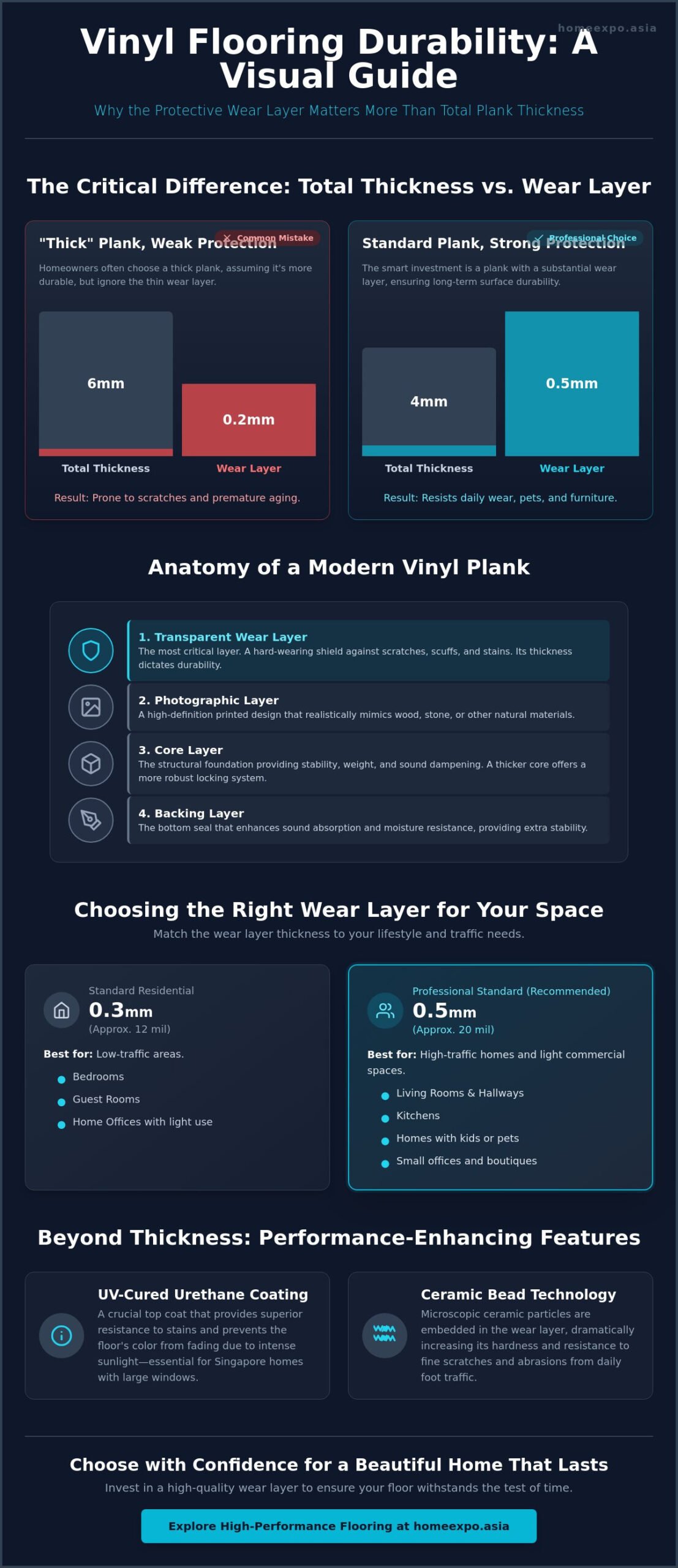
Durability in modern renovation often gets confused with physical weight or bulk. This wear layer thickness vinyl flooring guide helps you identify that the top transparent coating is actually your primary defense. While the total thickness of a plank provides structural stability and weight, the wear layer is what prevents high-heeled shoes, pet claws, and shifting furniture from ruining the aesthetic. Without a high-quality wear layer, even the thickest plank will show signs of aging within months.
Unlike traditional Vinyl composition tile (VCT) which required consistent waxing to stay protected, modern vinyl uses a permanent, multi-layered system. In 2026, industry standards have shifted toward sophisticated, factory-applied coatings to ensure longevity. A common mistake is buying a “thick” 6mm plank assuming it is tough, only to realize it has a paper-thin wear layer. That is a recipe for premature failure. You end up with a floor that feels solid but looks battered and scratched almost immediately.
What is the Wear Layer Made Of?
The wear layer is a high-grade clear PVC film topped with specialized protective coatings. Most premium options now feature UV-cured urethane. This is crucial for Singapore homes where intense sunlight through floor-to-ceiling windows can cause fading. This coating acts as a shield for your floor. It maintains the vibrant color of the photographic layer underneath while providing superior stain resistance against spills. It ensures that the beautiful wood or stone pattern you chose doesn’t vanish under a haze of micro-scratches.
Total Thickness: More Than Just a Number
Total thickness, usually ranging from 3mm to 6mm, dictates the “feel” of your floor and its acoustic properties. For those living in HDB flats, a thicker core provides better sound dampening. This helps keep peace with neighbors downstairs by reducing the “click-clack” sound of footsteps. It also allows for a deeper, more robust locking mechanism. A stronger click system prevents planks from shifting or gapping over time.
Finding the right balance is essential for flooring singapore projects. You need enough total thickness for structural integrity and a substantial wear layer for surface protection. A well-constructed floor typically consists of these layers:
- Transparent Wear Layer: The hard-wearing shield against abrasions.
- Photographic Layer: The high-definition design that mimics natural materials.
- Core Layer: The structural foundation that provides stability.
- Backing Layer: The bottom seal that assists with sound absorption and moisture resistance.
By focusing on both specifications, you ensure your floor can handle the humidity and heavy usage typical of a busy Singaporean household.
Decoding the Measurements: Mil vs. Millimeter (mm) in Vinyl Flooring
Understanding the numbers on a product spec sheet can be frustrating. Many international brands use “mils” to describe protection levels. This is a US customary unit representing one-thousandth of an inch. In Singapore, however, we use the metric system. Confusing these two units is a common error that leads to poor purchasing decisions. This wear layer thickness vinyl flooring guide ensures you compare products accurately across different brands and regions.
The ASTM F1303 standard provides a clear framework for these classifications. It defines the minimum requirements for residential, light commercial, and heavy commercial grades. If a salesperson only highlights the total thickness of a plank, ask for the wear layer specification specifically. Don’t be fooled by bulk. A 6mm plank with a 0.2mm wear layer will show scratches and wear much faster than a 4mm plank with a 0.5mm wear layer. The “sweet spot” for modern durability in 2026 is finding a high wear layer regardless of the plank’s total height.
To keep your comparison simple, remember these approximate conversions:
- 12 mil is approximately 0.3mm (Standard Residential)
- 20 mil is approximately 0.5mm (Commercial Grade)
- 28 mil is approximately 0.7mm (Heavy Commercial)
The 0.3mm (12 mil) Standard for Residential Use
A 0.3mm wear layer serves as the baseline for residential protection. It’s a reliable choice for bedrooms or study rooms where foot traffic is relatively light. In a typical Singaporean home, quality vinyl with this specification can last between 15 and 25 years. It represents an excellent cost-benefit balance for budget-conscious renovations where you don’t expect extreme daily abuse to the floor surface.
The 0.5mm (20 mil) Commercial Grade Powerhouse
For high-traffic zones like the living room, dining area, and kitchen, 0.5mm is the professional recommendation. This thickness provides a powerhouse shield against the daily grind of dragging dining chairs and the impact of dropped utensils. If you have active pets or young children, this specification is essential for surface longevity. It’s also the minimum requirement for commercial offices to ensure a 10 to 15-year lifespan. You can browse our range of 0.5mm vinyl designs to find a style that matches your vision while meeting these high-performance standards. This choice offers long-term peace of mind for property investors who want their floors to survive multiple tenant cycles without replacement.
Choosing the Right Wear Layer for Singaporean Homes and Commercial Spaces
Selecting the perfect protection level depends entirely on your floor’s daily “battlefield.” In a standard HDB 4-room or 5-room flat, the traffic isn’t uniform. The hallway leading from the main door to the kitchen sees ten times more action than the corner of a master bedroom. This wear layer thickness vinyl flooring guide helps you allocate your budget where it matters most. For a “forever home,” investing in higher specs ensures you won’t need a mid-life renovation. Conversely, for rental properties, a durable 0.5mm layer protects your ROI against unpredictable tenant usage and frequent move-ins.
When exploring vinyl flooring singapore options, you must consider the 2026 standards for safety and longevity. Modern homeowners are moving away from “one-size-fits-all” approaches. They now prefer tailored specifications that match the specific utility of each room, ensuring they don’t overspend on low-traffic areas while under-protecting the heart of the home.
Room-by-Room Specification Guide
- Bedrooms: A 0.3mm wear layer is usually sufficient here. Foot traffic is typically barefoot or in soft slippers, and furniture stays stationary for years.
- Living and Dining Areas: These are high-impact zones. We recommend 0.5mm to handle heavy sofas, such as those from RitzHouzz, the constant sliding of dining chairs, and social gatherings.
- Kitchens: Thickness is only half the story. Kitchen floors need a wear layer with high chemical resistance to withstand grease, spices, and frequent cleaning with household detergents.
Commercial and High-Traffic Requirements
Commercial units in the CBD or local heartlands face extreme pressure. For retail boutiques and F&B outlets, a 0.7mm wear layer is the industry standard to prevent the floor from looking “walked out” within a few short years. According to the Resilient Floor Covering Institute, the manufacturing quality of these high-performance layers is what separates professional-grade materials from generic alternatives. It ensures the floor maintains its slip resistance and visual appeal even under heavy public use.
Office environments present a unique challenge: rolling chairs. The constant friction from caster wheels can delaminate a thin wear layer, leading to unsightly bubbling. A minimum of 0.5mm is required to maintain a professional appearance. Also, commercial projects must adhere to strict safety standards. The BCA Code on Accessibility 2025 mandates a minimum R10 slip-resistance rating for staircases in major renovations. Choosing a product that combines a thick wear layer with these safety certifications is the only way to ensure your commercial space remains compliant and safe for the public.
Beyond the Numbers: Factors That Influence Wear Layer Performance
While this wear layer thickness vinyl flooring guide has established the importance of measurements, the material chemistry and structural support are equally vital. A 0.5mm wear layer on a soft core behaves differently than one on a rigid core. For instance, Stone Plastic Composite (SPC) flooring provides a dense, limestone-based foundation that prevents the wear layer from “giving” under heavy pressure. This rigidity protects the surface from indentations caused by high heels or heavy furniture. In contrast, traditional Luxury Vinyl Tile (LVT) is more flexible, which can sometimes lead to localized stretching of the wear layer if the subfloor isn’t perfectly stable.
Advanced manufacturing in 2026 has introduced “Ceramic Bead” technology into the top coating. This involves infusing the urethane layer with microscopic ceramic particles. These beads act as a secondary shield, significantly increasing the floor’s resistance to micro-scratches. It’s the difference between a standard screen protector and tempered glass on a smartphone. To achieve the best results, you must ensure your floor is laid on a cement screed foundation. A flat base prevents “high spots” where the wear layer would otherwise take disproportionate friction and erode prematurely.
The Role of UV Coatings and Scratch Resistance
Singapore’s intense tropical sun can be a floor’s worst enemy. Modern vinyl uses UV-cured urethane coatings to prevent the photographic layer from yellowing or fading over time. You should distinguish between scratch resistance and impact resistance. While a thick wear layer stops scratches, the core material handles the impact. To keep your floor in pristine condition for over 20 years, avoid using abrasive cleaning tools. Simple, pH-neutral cleaners are all you need to maintain the integrity of the protective shield.
Why Subfloor Flatness is Non-Negotiable
Even the highest quality wear layer can’t compensate for a bumpy subfloor. This issue, known as “telegraphing,” occurs when imperfections in the concrete show through the vinyl. High spots on an uneven floor become friction points. Every time someone walks over that spot, the wear layer is ground down faster than the rest of the floor. This is why hiring a professional carpenter singapore or flooring specialist is critical. They perform a site assessment to ensure the substrate level doesn’t vary by more than 2mm over a 2m span. You can consult our installation experts to verify your subfloor condition before making a purchase. Professional leveling is the most effective way to protect your investment from localized erosion and edge wear.
Why Home Expo Asia is Singapore’s Trusted Expert for High-Performance Vinyl
Home Expo Asia understands that your floor is the foundation of your daily life. We’ve built our reputation on providing materials that exceed standard expectations for durability and style. While many retailers offer 0.3mm options as their primary stock, we provide over 200 designs with premium 0.5mm wear layers as our standard. This commitment ensures that every home we renovate is equipped for maximum longevity. Our in-house installation teams are trained to handle technical challenges that others might avoid. Whether you are looking for a classic plank or a sophisticated herringbone flooring layout, we provide the precision required for a flawless finish.
We believe in total transparency. Our after-sales support and clear warranty terms are designed to give Singaporean homeowners absolute peace of mind. We don’t use external sub-contractors for our core services. By maintaining an in-house team, we ensure that the high standards mentioned in this wear layer thickness vinyl flooring guide are met during every single installation. This hands-on approach is why we are consistently recognized as a reliable leader in the local renovation industry.
Our Quality Assurance Process
- Rigorous Testing: Every product batch undergoes strict testing for wear, stain, and water resistance to ensure it survives the Singaporean climate.
- Direct Sourcing: We source our materials directly to ensure affordability. This allows us to offer commercial-grade wear layers at residential price points.
- Free Site Assessments: Our experts provide complimentary on-site checks. We measure your subfloor evenness and offer personalized recommendations for the ideal thickness for your specific layout.
Comprehensive Renovation Solutions
Choosing us means gaining access to a complete renovation ecosystem. We aren’t just flooring specialists; we are a one-stop shop for HDB and condo transformations. Our services extend from vinyl installation to professional carpentry and essential cement works. This integrated model ensures that your carpentry fits perfectly over your new floors and that your subfloor is prepared correctly from the start. It eliminates the stress of coordinating multiple contractors and ensures a cohesive result for your entire home.
We invite you to visit our showroom for a hands-on experience. You can perform your own “scratch test” on our samples to see how our premium coatings hold up against daily abuse. Our consultants are ready to guide you through our extensive collection and provide the technical documentation you need to make an informed choice. Build your forever home with the confidence that only an experienced expert can provide.
Secure Your Singapore Home with Professional Flooring Standards
Your journey through this wear layer thickness vinyl flooring guide has highlighted that true durability lies in the technical details rather than just the bulk of the plank. You now know that the top protective coating is what preserves your floor’s aesthetic against the daily grind of Singaporean life. By selecting the correct specification for each room and ensuring a perfectly level subfloor, you are protecting your investment for decades to come. Don’t settle for total thickness when surface protection is what actually prevents scratches and bubbling.
We are here to help you turn these professional insights into a beautiful, lasting reality for your flat or office. With over 200+ designs available and our dedicated professional in-house installation teams, we ensure every project meets the highest quality standards. Our comprehensive warranty on all 2026 collections provides the long-term security and peace of mind your family deserves. Take the first step toward a flawless renovation and Get Your Free Site Assessment and Vinyl Quote Today. Your dream home is just one expert decision away, and we look forward to building it with you.
Frequently Asked Questions
Is a 20 mil wear layer overkill for a residential bedroom?
No, choosing a 20 mil (0.5mm) wear layer is not overkill, though it exceeds the standard 12 mil requirement for low-traffic areas. While 0.3mm is usually sufficient for bedrooms, a 0.5mm layer provides superior protection if you frequently move furniture or have pets. It ensures the surface remains in pristine condition for a much longer period, offering better long-term value for your renovation budget.
Does a thicker wear layer make the vinyl flooring waterproof?
No, the thickness of the wear layer doesn’t determine whether the floor is waterproof. Most modern vinyl products are inherently waterproof due to their PVC or SPC core materials. The wear layer’s specific job is to protect against surface scratches, scuffs, and stains. Water resistance actually depends on the core composition and the precision of the locking system that prevents moisture from seeping between planks.
Can I sand or refinish the wear layer if it gets scratched?
How long does a 0.5mm wear layer typically last in a Singaporean home?
A 0.5mm wear layer typically lasts between 15 and 25 years in a residential setting. In a busy Singaporean household with children or active pets, this thickness provides the necessary durability to resist daily abrasion and heavy foot traffic. Its expected lifespan is significantly longer than thinner 0.3mm options, making it the professional choice for homeowners who want a permanent flooring solution.
What is the difference between a wear layer and a top coat?
The wear layer is a clear PVC film that provides the primary thickness and physical durability of the floor’s surface. The top coat, usually a UV-cured urethane, is a thinner liquid application applied over the wear layer. While the wear layer handles heavy friction, the top coat provides essential stain resistance and prevents the design from fading under Singapore’s intense sunlight through windows.
Is wear layer thickness the same as the total plank thickness?
No, these are two entirely different measurements that serve different purposes. Total plank thickness refers to the entire height of the vinyl, including the core and backing, which impacts structural stability and sound dampening. Wear layer thickness only measures the top protective film. It’s possible to find a thick plank with a thin wear layer, which would result in a floor that feels solid but scratches easily.
Will a thick wear layer protect against heavy furniture dents?
No, protection against dents is provided by the core material rather than the wear layer. Rigid cores like SPC are specifically designed to resist heavy impact and static pressure from furniture. The wear layer’s primary function is to prevent surface level damage like scratches and scuffs. Even with a premium wear layer, you should always use felt pads under heavy furniture to protect the floor’s structural integrity.
How do I identify the wear layer thickness on a product sample?
You can usually find this information on the technical specification label located on the back of the sample. It will be listed in either “mm” or “mils.” If the label is missing, always ask your flooring consultant for the official product data sheet. Using a wear layer thickness vinyl flooring guide helps you understand these numbers so you can verify the quality of the material before making a purchase.