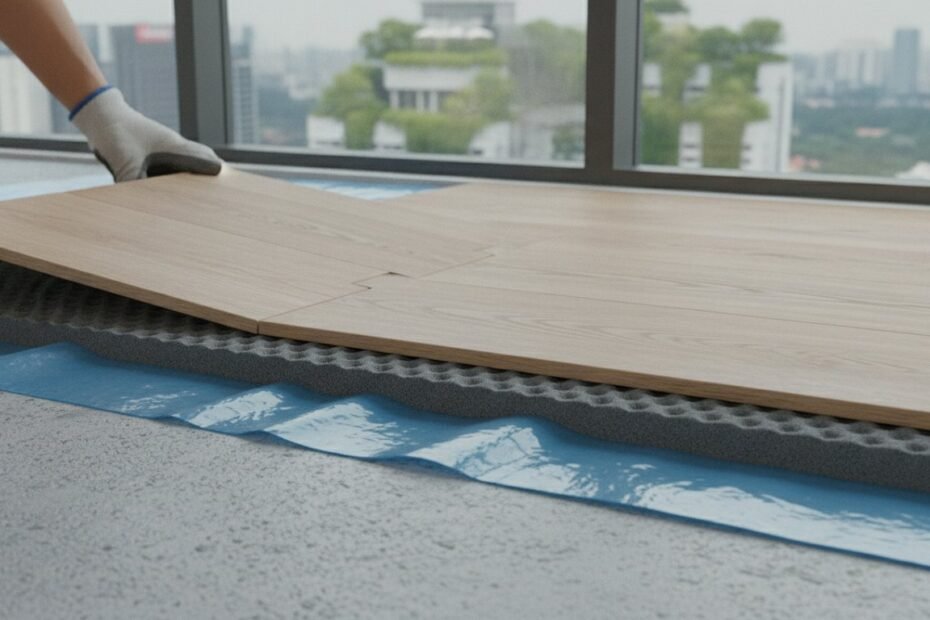
What if your brand-new vinyl floor is silently trapping moisture and growing mold right beneath your feet? In Singapore’s intense humidity, laying vinyl directly onto a concrete subfloor without the right protection is a risk that leads to costly repairs. You want a home that feels solid and quiet. However, the fear of clicking sounds from uneven slabs or noise complaints from your downstairs HDB neighbors can make the renovation process feel overwhelming.
We understand that a floor is a long-term investment in your family’s comfort and safety. Finding the best underlayment for vinyl flooring on concrete is about more than just a soft feel underfoot. It is about technical compliance and structural integrity. This 2026 guide will show you how to choose an underlayment that meets HDB’s mandatory 8 dB sound insulation requirement while providing a robust moisture barrier against porous concrete.
You will learn about the critical differences between attached and separate underlayments. We also cover how to stay within the 50mm total thickness regulation and the professional standards required to keep your floors beautiful and stable for decades.
Key Takeaways
- Learn why the porous nature of concrete subfloors makes a dedicated moisture barrier essential for preventing mold growth in Singapore’s humid climate.
- Identify the best underlayment for vinyl flooring on concrete by comparing the acoustic benefits of cork with the moisture-blocking properties of specialized foam.
- Ensure your installation meets HDB’s strict soundproofing and thickness regulations to avoid future compliance issues or neighbor complaints.
- Discover the hidden risks of the “double underlayment” trap and how to properly handle vinyl planks that already feature pre-attached padding.
- Understand why a professional site assessment is critical for identifying uneven concrete and moisture levels before your renovation begins.
Why Concrete Subfloors Require Specific Underlayment for Vinyl
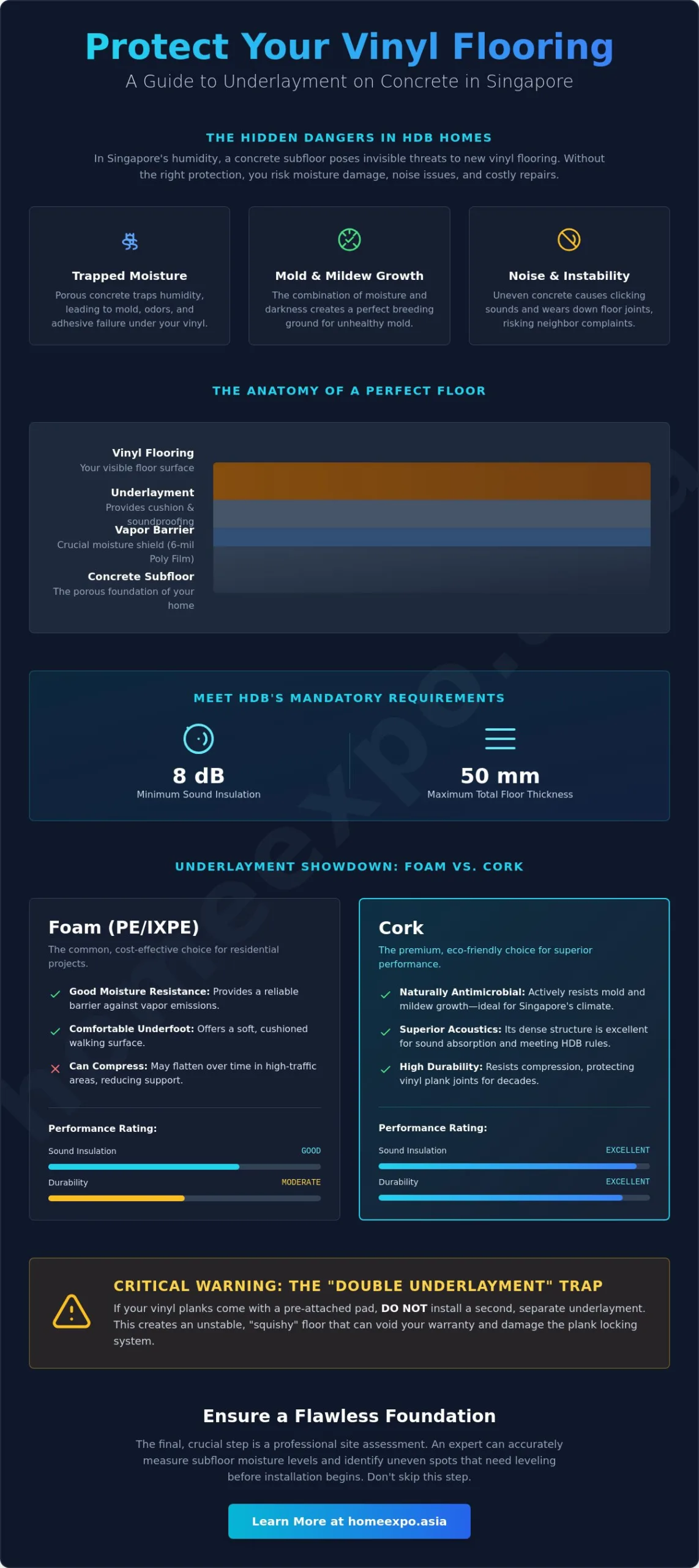
Concrete is the standard subfloor for HDB flats and condominiums across Singapore. While it feels indestructible, it’s actually a porous material that behaves like a hard sponge. Choosing the best underlayment for vinyl flooring on concrete is the most critical step in your renovation because it handles the invisible challenges concrete presents. Without this protective layer, your flooring faces a constant battle against moisture, temperature shifts, and structural friction. A professional installation ensures your floor remains stable, quiet, and healthy for years to come.
Concrete presents four primary risks to vinyl flooring:
- Moisture migration: Porous concrete allows ground water to rise to the surface.
- Thermal transfer: Bare concrete stays cold, making the floor uncomfortable in air-conditioned rooms.
- Subfloor imperfections: Rough cement surfaces can telegraph through thin vinyl or cause “hollow” spots.
- Joint friction: Constant contact between vinyl and concrete wears down the locking mechanisms of the planks.
The Role of Moisture Protection on Concrete
Even fully cured concrete releases vapor emissions. This is essentially ground moisture traveling through the slab and exiting at the surface. If you lay vinyl directly on top, this moisture gets trapped between the non-porous vinyl and the concrete. This leads to mold growth, adhesive failure, and a sour smell that’s impossible to remove without tearing up the floor. In Singapore’s tropical climate, where humidity levels are high, this risk is amplified. The industry standard for safety is a 6-mil poly film vapor barrier. This thin but powerful layer acts as a shield, ensuring your vinyl stays dry and bonded for its entire lifespan. Understanding underlayment materials and functions is the first step in mitigating these environmental risks.
Leveling and Structural Support
No concrete slab is perfectly flat. Small pits, ridges, or high spots are common in HDB screeds. When you walk across vinyl laid on bare concrete, these imperfections cause the planks to shift or flex. This often results in annoying clicking sounds or a hollow feeling underfoot. A high-quality underlayment bridges these small gaps, providing a forgiving foundation. It’s essential for protecting the delicate locking mechanisms of your planks. Without support, the friction between the vinyl and the rough cement eventually snaps the joints, leading to gaps between your floorboards. By selecting the best underlayment for vinyl flooring on concrete, you provide the density needed to prevent joint stress while maintaining enough cushion for comfort.
Top Underlayment Materials: Foam, Cork, and Vapor Barriers
Selecting the right material is the foundation of a successful flooring project. In Singapore’s unique environment, the best underlayment for vinyl flooring on concrete must balance moisture protection with long-term durability. Each material offers distinct advantages depending on your building type and lifestyle needs. Choosing the wrong one can lead to “squishy” floors or, worse, mold growth that ruins your investment.
Foam is the most common choice for many residential projects. High-density polyethylene (PE) or Cross-linked polyethylene (IXPE) foams provide reliable moisture resistance and a comfortable walking surface. While budget-friendly, basic foam can compress over time in high-traffic areas like corridors. Felt underlayment is another robust option. It’s much denser than foam, offering superior cushion and heavy-duty sound absorption for those who want a more “solid” feel underfoot. It doesn’t compress as easily as foam, which helps maintain the integrity of your vinyl’s locking system.
Cork stands out as a premium choice for HDB owners. It’s naturally antimicrobial, which is vital for resisting mold in our tropical humidity. Its cellular structure acts as a natural acoustic buffer, making it an excellent material for meeting strict noise regulations. Because cork is a sustainable, eco-friendly material, it’s also a top pick for homeowners focusing on green living.
Foam vs. Cork: Which Wins on Concrete?
Foam is lightweight and easy to handle, making it a cost-effective solution. However, it lacks the structural memory of cork. Cork doesn’t compress easily, meaning your vinyl floor joints remain protected for decades. If you live in a high-traffic HDB unit, cork is often the superior choice for sound dampening. Use foam if budget is your primary concern, but opt for cork if you prioritize longevity and a quiet home environment. For those seeking a professional flooring installation service, an expert assessment can help determine which material suits your specific subfloor condition.
The Importance of Vapor Barrier Layers
On concrete subfloors, a simple pad is rarely enough. Ground-floor units and newer HDB blocks often have higher vapor emission rates. This is where 2-in-1 underlayments become essential. These products feature an integrated vapor barrier layer, usually a thin film attached to the foam or cork.
An integrated barrier ensures a continuous moisture seal across the entire room. During installation, it’s vital to use specialized tape to seal the seams between underlayment rolls. This prevents moisture from “leaking” through the gaps, which is a common cause of floor failure on concrete. When evaluating the best underlayment for vinyl flooring on concrete, always verify that the product includes a 6-mil vapor barrier or is compatible with a separate poly film.
The Attached Underlayment Debate: Is It Enough for Concrete?
Many premium vinyl products in 2026 feature pre-attached IXPE or EVA foam padding. While this built-in layer simplifies the installation process, it creates a common dilemma for homeowners dealing with concrete subfloors. You might think that adding another layer of cushion will make your floor feel even better. However, the “double underlayment” trap is a leading cause of floor failure in Singapore. The best underlayment for vinyl flooring on concrete is often the one that provides the most stability, not the most cushion.
The primary role of pre-attached padding is to provide basic sound dampening and a slight “give” for comfort. It is not designed to act as a moisture barrier. On a porous concrete slab, relying solely on this attached pad is risky. Without an additional vapor barrier, moisture can still seep into the core of your vinyl planks. If you add a second soft underlayment, you create too much vertical movement. This excessive “bounce” causes the locking mechanisms to flex beyond their limit. Eventually, the delicate tongues and grooves will snap, leading to permanent gaps and a floor that feels unstable.
Understanding Manufacturer Warranties
Protecting your investment means following the manufacturer’s strict guidelines. Most warranties for vinyl flooring singapore are voided the moment you install an unapproved second layer of padding. Manufacturers engineer their locking systems to withstand specific pressure levels. When you over-pad the floor, you introduce structural instability that the product wasn’t built to handle. Vertical movement leads to joint failure, which is almost never covered by a warranty if the underlayment setup is incorrect. To remain warranty-safe, any separate underlayment used should typically not exceed 1.5mm in thickness unless the manufacturer explicitly states otherwise.
When a 6-mil Poly Film is Mandatory
If your chosen vinyl planks already have attached padding, your focus should shift entirely to moisture protection. In this scenario, a 6-mil poly film is the mandatory solution for concrete subfloors. This thin plastic sheet provides a professional-grade vapor barrier without adding any extra bulk or sponginess to the floor. It is the best underlayment for vinyl flooring on concrete when you need to block moisture while maintaining a rock-solid foundation.
- Overlap the seams: Ensure the poly film sheets overlap by at least six inches.
- Tape securely: Use moisture-resistant tape to seal every seam for a continuous barrier.
- Run it up the wall: Extend the film slightly up the walls behind your skirting boards for total protection.
This method is highly cost-effective and ensures your floor stays dry without risking the integrity of the plank joints. It provides the long-term security you need in Singapore’s humid climate while keeping your installation within professional standards.
Selecting Underlayment for Singapore’s Tropical Climate and HDBs
Living in Singapore means your home faces environmental challenges that don’t exist in cooler regions. High humidity and heavy rainfall put constant pressure on porous concrete subfloors. Choosing the best underlayment for vinyl flooring on concrete requires a localized approach to ensure your renovation lasts. You need materials that meet strict flooring singapore standards while providing a healthy indoor environment. Standard underlayments designed for temperate climates often fail here because they can’t handle the persistent moisture levels found in our tropical air.
One critical feature for our climate is antimicrobial treatment. In the tropics, even a tiny amount of trapped moisture leads to rapid fungal growth. High-quality underlayments are pre-treated to resist mold and mildew. This protection is non-negotiable for HDB flats where ventilation might be limited in certain rooms. By selecting a treated material, you ensure that the air quality in your home remains safe for your family. It’s a professional standard that prevents the “musty” smell often associated with older flooring installations.
Managing Humidity and Condensation
Air-conditioning is a staple in Singaporean homes, but it can lead to the “sweating floor” phenomenon. When you cool your room, the temperature difference between the vinyl surface and the warm concrete subfloor causes condensation. If your underlayment has an open-cell structure, it will absorb this moisture like a sponge. To prevent this, the best underlayment for vinyl flooring on concrete utilizes a closed-cell structure. These materials don’t allow water to penetrate. This keeps the area between your vinyl and the screed bone-dry even during the monsoon season. This structural choice is vital for maintaining the floor loading limit of 150kg per square meter, as water-logged materials can add unnecessary weight and instability.
HDB Soundproofing and Neighbor Courtesy
In high-density HDB living, sound travels easily through concrete slabs. Impact noise, such as footsteps or moving furniture, is the primary source of neighbor disputes. HDB regulations require new flooring installations to provide a minimum sound insulation of 8 dB. To achieve this, you must evaluate the Impact Insulation Class (IIC) rating of your underlayment. A higher IIC rating means better noise reduction for the unit below you.
The right choice provides enough density to meet these standards without exceeding the 50mm total thickness limit for floor finishes and screed. For those laying over existing tiles, the new flooring and underlayment together must not exceed 13mm. If you’re planning a renovation, contact our team for a professional flooring installation service that guarantees compliance with all local housing regulations and soundproofing requirements.
Professional Vinyl Installation: Ensuring a Flawless Foundation
Even the best underlayment for vinyl flooring on concrete cannot compensate for a poorly prepared base. A flawless finish starts long before the first roll of foam or cork is laid. It begins with a meticulous site assessment that identifies the unique quirks of your concrete subfloor. Professional installation isn’t just about speed. It’s about risk mitigation and structural security. Our team ensures that every square inch of your home is ready to support your new flooring, protecting your investment from day one. We focus on creating a foundation that is clean, dry, and perfectly level.
A professional approach removes the guesswork from your renovation. By evaluating the concrete slab’s integrity, we prevent common issues like bubbling, shifting, and premature wear. This stage is where technical expertise meets practical experience. We don’t just lay materials; we build a system designed to withstand Singapore’s environmental pressures and the daily footfall of a busy household.
This commitment to structural integrity is just as vital for industrial spaces; for example, you can explore Warehouse Floor Striping to see how StripeGuys Warhouse Line Striping ensures safety and organization on large concrete surfaces.
The Importance of Subfloor Preparation
A common mistake in DIY projects is underestimating the condition of the cement screed. If the screed is dusty, crumbling, or damp, your underlayment won’t perform its job correctly. While DIY moisture tests provide a rough idea, they lack the precision of professional-grade hygrometers. We use advanced testing to measure Relative Humidity (RH) levels deep within the concrete. If the subfloor is uneven, our team employs specialized leveling techniques to create a flat surface. This prevents the clicking sounds and joint stress discussed in earlier sections, ensuring your floor feels solid underfoot. Professional standards, such as those maintained by Inspire Concrete, ensure that every concrete project begins with a perfectly prepared and durable foundation.
Why Choose Home Expo Asia for Your Renovation?
Choosing Home Expo Asia means partnering with a team that prioritizes safety and quality. We provide access to over 200 high-quality designs, each paired with the best underlayment for vinyl flooring on concrete tailored to your home’s specific needs. Our approach is transparent and methodical. We back our flooring installation service with comprehensive warranties and official documentation, giving you financial clarity and peace of mind. You don’t have to guess which moisture barrier or soundproofing layer is right for your HDB flat. We provide the technical expertise to ensure your home meets all local standards while reflecting your personal style.
Ready to transform your space with confidence? Book your free site assessment with Home Expo Asia today and let our experienced experts guide you toward a durable, beautiful floor that stands the test of time.
Build a Foundation for a Lifetime of Comfort
Finding the best underlayment for vinyl flooring on concrete is the single most important decision you’ll make for your home’s longevity. You now understand that moisture protection and HDB-compliant soundproofing are the pillars of a successful Singapore renovation. By avoiding the common “double underlayment” trap and prioritizing high-density materials like cork or specialized foam, you protect your planks from breakage and your family from mold growth.
Don’t leave your investment to chance with generic DIY solutions that might void your warranty. Our team of trusted Singapore experts offers over 200 premium designs and provides a professional site assessment to ensure your concrete subfloor is perfectly prepared. We stand behind every project with comprehensive warranties on both materials and installation, giving you total security for years to come. It’s time to enjoy the peace of mind that comes with a floor built to last.
Get a Risk-Free Quote for Your Vinyl Flooring Installation today. Your journey toward a quiet, beautiful, and durable home starts with a foundation you can trust.
Frequently Asked Questions
Do I really need underlayment for vinyl flooring on concrete?
Yes, you definitely need it. Concrete acts as a sponge that releases moisture over time. Without underlayment, you risk mold growth and adhesive failure. It also provides the thermal break needed to keep your floors from feeling cold in air-conditioned rooms. For HDB owners, it is the only way to ensure your floor meets local soundproofing standards while providing a comfortable walking surface.
What is the best underlayment for vinyl plank flooring on a concrete slab?
The best underlayment for vinyl flooring on concrete is a high-density IXPE foam or natural cork equipped with a built-in vapor barrier. These materials are specifically engineered to resist the high humidity levels found in Singapore. They provide superior structural support for your planks while effectively blocking ground moisture. This combination ensures your floor remains stable and quiet for its entire lifespan.
Can I use two layers of underlayment to make my floor softer?
No, you should never use two layers of underlayment. While it might seem like it would add comfort, double layering creates a “trampoline effect” that puts too much stress on the vinyl joints. This vertical movement eventually causes the locking systems to snap, leading to permanent gaps. Additionally, most manufacturers will void your warranty if they find that multiple layers of underlayment were used during installation.
How do I know if my concrete subfloor is too moist for vinyl?
You can identify moisture issues through professional testing or visible signals. We recommend using a digital hygrometer to measure the Relative Humidity (RH) of the concrete slab. If you see white powdery deposits known as efflorescence or notice a persistent damp smell, your subfloor likely has high vapor emissions. Addressing these levels with a 6-mil vapor barrier is critical before laying your final floor finish.
Does underlayment help with noise in HDB apartments?
Yes, underlayment is a critical component for noise reduction in HDB living. It helps you comply with the mandatory 8 dB sound insulation requirement by absorbing impact noise from footsteps or falling objects. High-quality underlayments with a strong Impact Insulation Class (IIC) rating significantly reduce the sound transmitted to neighbors below. This ensures a peaceful living environment and prevents potential disputes over noise complaints in high-density blocks.
Should I use a vapor barrier if my vinyl has an attached pad?
Yes, a separate vapor barrier is mandatory on concrete even if your vinyl has an attached pad. The pre-attached padding is designed for comfort and basic sound dampening, but it does not provide a continuous moisture seal. Using a 6-mil poly film underneath ensures that rising dampness cannot reach the vinyl core. This inexpensive step is the most effective way to prevent long-term moisture damage and mold growth.
What thickness of underlayment is best for vinyl flooring?
The ideal thickness for separate underlayment is typically between 1mm and 1.5mm. While it is tempting to go thicker for more cushion, anything over 3mm often creates too much flexibility in the floor. This instability can cause the locking mechanisms of your vinyl planks to fail under pressure. Maintaining a slim but dense profile is the most reliable way to ensure a solid and durable foundation.
Can underlayment fix an uneven concrete floor?
No, underlayment is not a substitute for proper floor leveling. While it can bridge very minor pits or rough patches in the cement, it cannot fix significant dips or humps in the subfloor. Laying underlayment over an unlevel surface will still result in “hollow” sounds and potential plank breakage. For a professional finish, any concrete irregularities should be corrected with a self-leveling compound before the underlayment is laid.