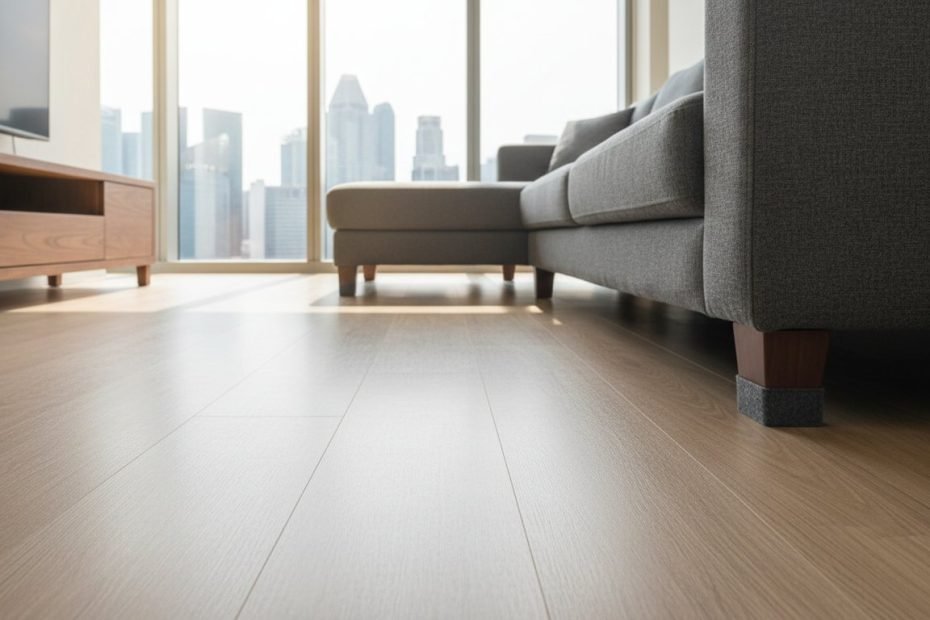
Weight isn’t the primary enemy of your floor; it’s the concentrated pressure and restricted movement that cause the most damage. Many Singaporean homeowners ask: can vinyl flooring withstand heavy furniture like solid teak wardrobes or oversized sectional sofas? The answer is a resounding yes, provided you understand the science of weight distribution and choose the right installation method for your HDB flat or condo.
It’s natural to feel anxious about seeing permanent dents on an expensive renovation just weeks after moving in. You’ve likely heard conflicting advice about click-lock versus glue-down durability or worried about meeting HDB’s strict flooring regulations. We’re here to provide the professional clarity you need. This guide will show you exactly how to safely place heavy items on your vinyl floors without causing permanent indentations or accidentally voiding your material warranty.
We’ll break down technical standards like ASTM F970 static load limits and share practical, professional-grade methods to distribute weight effectively, giving you total confidence in your flooring choice for years to come.
Key Takeaways
- Understand how industry-standard PSI ratings like ASTM F970 ensure your flooring recovers from heavy static loads without permanent damage.
- Compare the mechanics of click-lock and glue-down systems to determine which installation method best supports heavy tropical hardwood furniture.
- Learn the professional secret to weight distribution and finally answer: can vinyl flooring withstand heavy furniture without compromising your warranty?
- Discover essential protection techniques, including the “Plywood Path” for moving items and choosing high-quality felt or rubber protectors.
- Recognize why expert subfloor preparation and cement screed levelling are vital to prevent air pockets and joint failure under high-pressure loads.
Understanding Vinyl Flooring Load Capacity and PSI
When evaluating whether your new floor can handle a heavy designer sideboard or a solid wood bed frame, the most important metric to understand is PSI, or Pounds per Square Inch. This is a measurement of pressure that determines how much force a specific area of your flooring can withstand before it suffers permanent deformation. In the context of Singaporean homes, where heavy tropical hardwoods are popular, knowing your floor’s PSI rating is the difference between a pristine finish and a room full of unsightly divots.
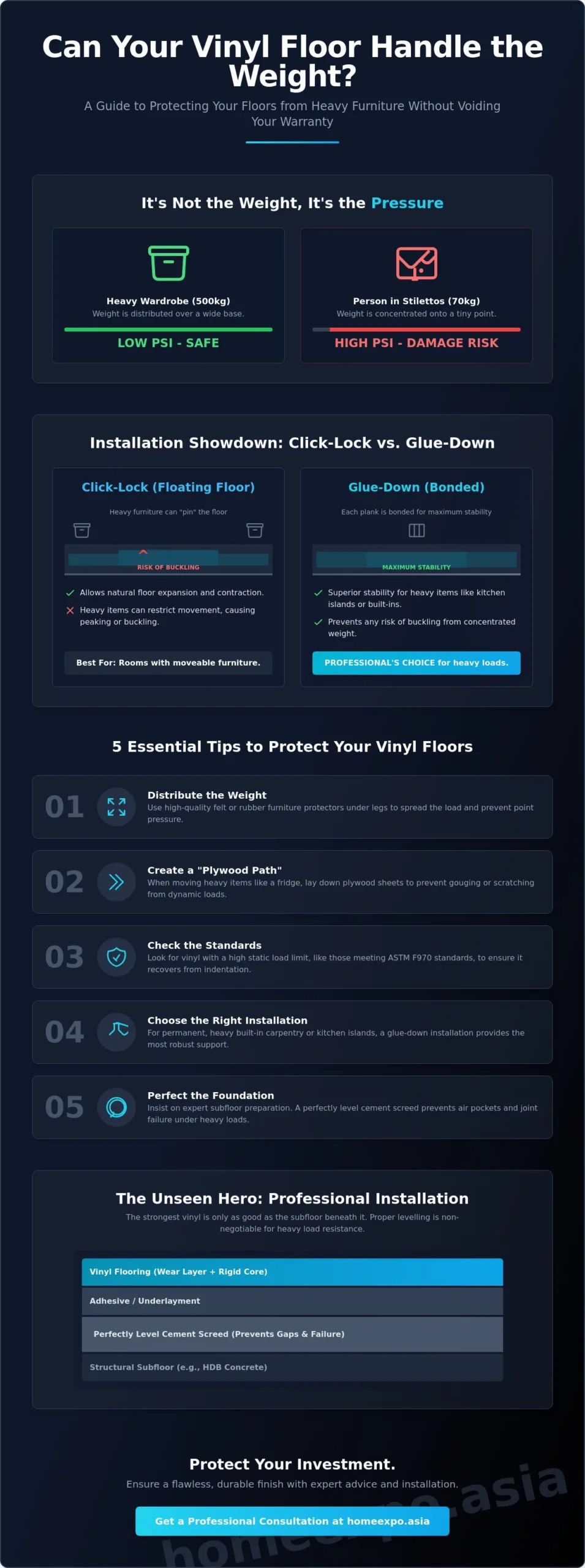
You might be surprised to learn that a 500kg wardrobe is often safer for your floor than a 70kg person walking in stilettos. This is because the wardrobe typically distributes its weight across four broad legs or a flat base, whereas the person in high heels concentrates their entire body weight onto two tiny points. Modern high-quality vinyl is designed to handle high PSI, but its performance depends heavily on the core material. Rigid cores, often found in luxury options and similar to the durability standards of a Vinyl composition tile, use limestone-composite materials to provide superior compressive strength. This solid foundation prevents the planks from crushing under the heavy loads common in local HDB flats.
While the core provides structural support, the wear layer acts as your first line of defense. A thick wear layer, ideally 0.5mm or higher for living areas, prevents surface-level crushing and scratches. When homeowners ask can vinyl flooring withstand heavy furniture, they are usually worried about the core collapsing, but a robust wear layer is what keeps the texture and pattern looking new even after years of supporting heavy items.
Total Weight vs. Point Pressure
Physics plays a significant role in how your floor survives your decor choices. Furniture legs concentrate force on a tiny surface area, creating “point-loading.” Sharp metal feet are the biggest offenders, as they exert massive pressure on a single spot. Broad wooden bases or flat-bottomed legs are much safer because they spread the weight across more square inches of the vinyl. It is not the weight of the furniture that damages vinyl, but the concentration of that weight on a single point.
Static vs. Dynamic Loads
It’s vital to distinguish between static and dynamic loads. A static load is a heavy cabinet that sits in one place for years. The risk here is long-term indentation, where the vinyl loses its ability to “bounce back” after the pressure is finally removed. Dynamic loads occur when you move a heavy fridge or roll an office chair. These create a higher risk of surface tearing or joint separation. High-performance vinyl is engineered with “elastic memory,” allowing the material to recover its shape after the pressure is gone, provided the PSI limit hasn’t been exceeded for too long. Understanding these forces helps you decide where to place your heaviest items and how to protect the floor during a move.
Click-Lock vs. Glue-Down: Which Handles Heavy Weight Better?
The method used to secure your planks to the subfloor is just as critical as the material itself. While we’ve established that the core’s PSI rating determines indentation resistance, the installation type dictates how the entire floor surface reacts to the weight of your home’s contents. Homeowners often ask can vinyl flooring withstand heavy furniture when it’s installed as a floating system, and the answer depends on how you distribute that weight across the room.
Click-lock vinyl is a “floating floor” system. It isn’t attached to the subfloor; instead, the planks lock together and rest on an underlayment. This design allows the floor to expand and contract naturally as Singapore’s humidity and temperature fluctuate. However, heavy furniture can interfere with this necessary movement. If you place a heavy wardrobe on one side of a room and a massive bookshelf on the opposite wall, you effectively “pin” the floor. When the vinyl tries to expand due to the afternoon sun, it can’t move under the furniture’s weight. This often leads to buckling or “peaking” at the joints in the center of the room.
Glue-down vinyl offers a different set of advantages. Because each plank is bonded directly to the cement screed, the floor doesn’t need to move as a single unit. This makes glue-down options the preferred choice for commercial spaces or residential areas with heavy-duty equipment. If you’re planning a full home renovation that includes heavy built-in carpentry or a kitchen island, glue-down provides superior stability against lateral pressure.
The Floating Floor Expansion Dilemma
Buckling is a primary concern for floating floors in our tropical climate. When heavy items exceed a certain weight threshold, usually around 200kg for a single piece, they act as anchors. To prevent issues, you must leave generous expansion gaps of at least 8mm to 10mm around the perimeter of the room. If you’re installing built-in wardrobes, it’s best to install the carpentry first and lay the vinyl around it, rather than placing the heavy cabinet on top of a floating floor.
Glue-Down Stability for Heavy Loads
Adhesive prevents individual planks from shifting or separating under the stress of heavy furniture. In Singapore, it’s vital to use high-quality, heat-resistant adhesives that won’t soften during hot spells. This method is particularly effective in high-traffic kitchens or dining areas where heavy dining tables and fridges are common. It ensures the floor remains a solid, immovable surface that doesn’t “telegraph” movement or create air pockets over time. While the installation process is more labor-intensive, the long-term structural integrity under heavy loads is often worth the extra effort.
Common Heavy Items in Singapore Homes and Their Impact
Every home in Singapore has its own unique set of heavy-duty requirements. From the massive teak dining tables favored in traditional households to the sleek, oversized refrigerators in modern condos, the load on your floor is constant. When homeowners ask can vinyl flooring withstand heavy furniture, they are often thinking of specific, high-value items that define their living space. Understanding how these pieces interact with your floor is the first step toward long-term protection.
Beyond traditional furniture, many modern homes now feature advanced tech setups. For example, high-performance AI computing and server solutions from Viperatech represent a significant static load that requires the same level of floor protection as a solid wood cabinet.
Solid tropical hardwoods like teak, mahogany, and Suar wood are incredibly dense and heavy. A single solid wood console can easily weigh over 80kg. Because these pieces are often heirloom quality, they tend to stay in one place for decades. This creates a permanent static load. To manage this, we advocate for the “Carpentry First” rule during a full home renovation. Heavy built-in wardrobes and kitchen islands should be installed directly onto the cement screed subfloor. Your flooring specialists will then lay the vinyl around the base of the carpentry. This prevents the heavy cabinets from pinning the floor, allowing the rest of the planks to expand and contract naturally.
Pianos and Musical Instruments
Pianos are perhaps the most challenging items for any resilient flooring. A standard upright piano typically weighs between 180kg and 360kg, while a grand piano can exceed 500kg. The real danger lies in the small metal casters. These tiny wheels concentrate hundreds of kilograms of pressure onto a few square millimeters, which can create permanent “tracks” or deep indentations. To safeguard your floor, always use dedicated piano caster cups. These accessories are designed to distribute the massive weight across a much larger surface area, often spanning multiple planks to prevent core compression.
Large Appliances and Kitchen Gear
Kitchens and laundry yards face a combination of weight and movement. A large refrigerator is a significant static load, but the risk of damage usually occurs during maintenance or cleaning. Dragging a 100kg fridge across vinyl can gouge the wear layer or snap the delicate click-lock joints. We recommend using transition strips to separate the kitchen zone from the living room. This creates a “break” in the floor, ensuring that the vibrations from a high-speed washing machine spin cycle don’t ripple through the rest of your home’s flooring. For moving these appliances, always use protective sheets to ensure the weight doesn’t catch on the edges of the planks.
5 Essential Tips to Protect Your Vinyl Floors from Dents
Modern engineering has made resilient flooring more durable than ever. However, the question isn’t just can vinyl flooring withstand heavy furniture, but how you can assist the material in maintaining its original profile for decades. Implementing a few professional protection strategies will ensure your home remains a high-value asset without the eyesore of permanent indentations.
Choosing the Right Furniture Cups
Wide-diameter furniture cups are vastly superior to the standard stick-on felt pads found in hardware stores. For heavy static loads like sofas or dining tables, you need a hard plastic or wooden cup that spans at least 5cm in diameter. This spreads the weight across multiple planks, significantly reducing the PSI on any single point. While soft felt is excellent for dining chairs that slide frequently, it’s too compressible for heavy wardrobes. Avoid any protectors with black rubber backings. Over time, the antioxidants in rubber can chemically react with the vinyl’s wear layer, leading to permanent yellow staining that no cleaning agent can remove.
Moving Heavy Items Safely
Never “walk” a heavy cabinet across your floor by tilting it from side to side. This creates extreme pressure on the corners and can easily snap the delicate click-lock joints of a floating floor. Instead, use the “Plywood Path” technique. Lay down 1/4 inch plywood sheets across your transit route to provide a rigid, flat surface that distributes the weight during the move. If you use furniture sliders, follow this professional sequence:
- Clear the path of all debris to prevent trapped grit from scratching the wear layer.
- Tilt the furniture piece slightly and place a slider firmly under each leg.
- Push the item from the lowest possible point to keep the center of gravity stable.
- Move slowly and steadily, ensuring the sliders don’t slip out from under the weight.
If you’re ready to upgrade your space, consult with experts during your full home renovation to ensure your subfloor is perfectly prepped for these heavy loads.
Why Professional Installation is Key to Heavy Load Resistance
Even the highest PSI-rated floor will fail if the foundation beneath it is flawed. While we’ve discussed material density and protection tips, the ultimate answer to whether can vinyl flooring withstand heavy furniture depends on the quality of the installation. A plank is only as strong as the subfloor supporting it. Without a perfectly flat base, the weight of your furniture creates uneven stress points that the material wasn’t designed to handle alone.
Professional installation mitigates the risk of “telegraphing” and joint failure. When a heavy object is placed on a floor with underlying gaps, the vinyl is forced to bridge that empty space. Over time, this leads to structural fatigue. By choosing expert installers, you ensure that every square inch of your flooring is in direct contact with a stable surface, allowing the core to absorb and distribute weight as intended.
The Importance of a Level Subfloor
In many Singaporean homes, the raw concrete slab often contains minor dips or “hollow” spots. A professional application of cement screed is the most critical step in preventing these imperfections. If a heavy furniture leg sits directly over a subfloor dip, the vinyl plank will flex downward every time weight is applied. This repeated movement eventually leads to joint snapping, especially in click-lock systems. Our professionals use high-precision grinding and self-levelling compounds to ensure the subfloor meets strict tolerance standards. This eliminates air pockets and provides the rock-solid foundation necessary for heavy tropical hardwood pieces.
Home Expo Asia’s Professional Approach
We believe that a durable floor starts with a meticulous site assessment. Our team identifies potential weight-loading issues before the renovation begins, ensuring your layout is optimized for your heaviest items. We take pride in our vinyl flooring Singapore installation standards, which are designed to withstand the unique challenges of the local climate and HDB regulations.
- Free Site Assessment: We evaluate subfloor moisture and levelness to prevent future warping under heavy loads.
- Durability Testing: Our 200+ designs undergo rigorous testing to ensure they meet international standards for indentation resistance.
- Comprehensive Warranty: We provide official documentation and long-term support, giving you total peace of mind in your investment.
- Expert Craftsmanship: Our installers are trained in specific weight-distribution techniques for built-in carpentry and large appliances.
Don’t leave the safety of your new home to chance. By prioritizing professional subfloor preparation and expert installation, you can enjoy your heavy designer furniture without fear of damaging your floors. We’re committed to delivering quality, safety, and reliability in every project we undertake.
Ready to transform your space with confidence? Get a risk-free quote for your heavy-duty vinyl flooring and let our experts guide you to the perfect choice for your home.
Secure Your Perfect Floor Today
You now have the professional knowledge to ensure your home’s aesthetic remains flawless for decades. We’ve explored how high-density cores and strategic weight distribution answer the question: can vinyl flooring withstand heavy furniture in your specific living space. By focusing on PSI ratings and choosing the right installation method, you’re protecting your HDB or condo investment. Remember that a level subfloor and the correct furniture protectors are your best allies against permanent indentations.
Home Expo Asia is here to provide the expertise your project deserves. We offer over 200+ vinyl designs specifically tested for Singapore’s unique climate. Our professional installation service includes comprehensive warranties and specialized subfloor preparation to handle even the heaviest tropical hardwoods. Don’t leave your renovation to chance. Book a Free Site Assessment for Your Vinyl Flooring Today and move your heavy furniture with absolute peace of mind. Your dream home is built on a foundation of quality and long-term security.
Frequently Asked Questions
Can I put a heavy pool table on vinyl plank flooring?
Yes, you can place a pool table on vinyl, but you must use large furniture cups to distribute the weight. A standard slate pool table can weigh over 400kg, which creates immense pressure on four small points. Using wide coasters ensures the weight spans multiple planks, preventing the legs from pinning a floating floor or crushing the core material.
Will a heavy refrigerator dent my vinyl floor?
A stationary refrigerator is unlikely to dent high-quality vinyl, as most residential products are rated for at least 250 PSI. The primary risk occurs during movement for cleaning or maintenance. To prevent gouging the wear layer, always use a “Plywood Path” or protective sheets when sliding the appliance to ensure the weight doesn’t catch on plank edges.
Do I need to put something under my heavy bed on a vinyl floor?
Placing wide-diameter furniture coasters under bed legs is a vital step for long-term floor protection. Beds carry significant static weight, especially when occupied, which can lead to deep impressions over several years. Coasters prevent the legs from creating permanent divots in the vinyl core, ensuring your floor maintains its flat, professional profile regardless of the furniture layout.
How do I fix a dent in my vinyl floor from heavy furniture?
Minor indentations often recover on their own within 24 to 48 hours thanks to the material’s elastic memory. However, if the core has been permanently crushed, the only reliable fix is to replace the damaged plank. This is why we always provide extra planks during our professional installations, allowing for seamless repairs without needing to redo the entire room.
Is glue-down or click-lock better for a home gym with weights?
Glue-down vinyl is the superior choice for home gyms because it remains completely stable under lateral force. Click-lock systems are floating floors that can shift or “bounce” when you drop weights or perform high-intensity exercises. Bonding the planks directly to the cement screed ensures the floor doesn’t buckle or separate at the joints during your workout routine.
Can I install vinyl flooring under my heavy kitchen cabinets?
We recommend installing heavy kitchen cabinets directly onto the subfloor rather than on top of a floating click-lock system. If you are wondering can vinyl flooring withstand heavy furniture like a full row of base cabinets, the answer is that the weight will pin the floor and cause buckling. For a seamless look under cabinets, a glue-down installation is the safer professional alternative.
What is the maximum weight vinyl flooring can hold per square inch?
Standard residential vinyl is typically tested to withstand 250 PSI according to the ASTM F970 standard. High-performance commercial-grade options can handle significantly more, with some top-tier products exceeding 3,000 PSI. These ratings indicate the floor’s ability to recover from a load, ensuring the material “bounces back” once the heavy furniture is moved to a new location.
Should I use furniture sliders or felt pads for my heavy sofa?
Use wide-diameter furniture cups for static support and reserved sliders only for active transit. While felt pads are excellent for preventing surface scratches on dining chairs, they are often too thin to prevent indentation from a heavy sofa. A wide-base cup made of hard plastic or wood is necessary to spread the concentrated weight across a larger surface area of the vinyl.