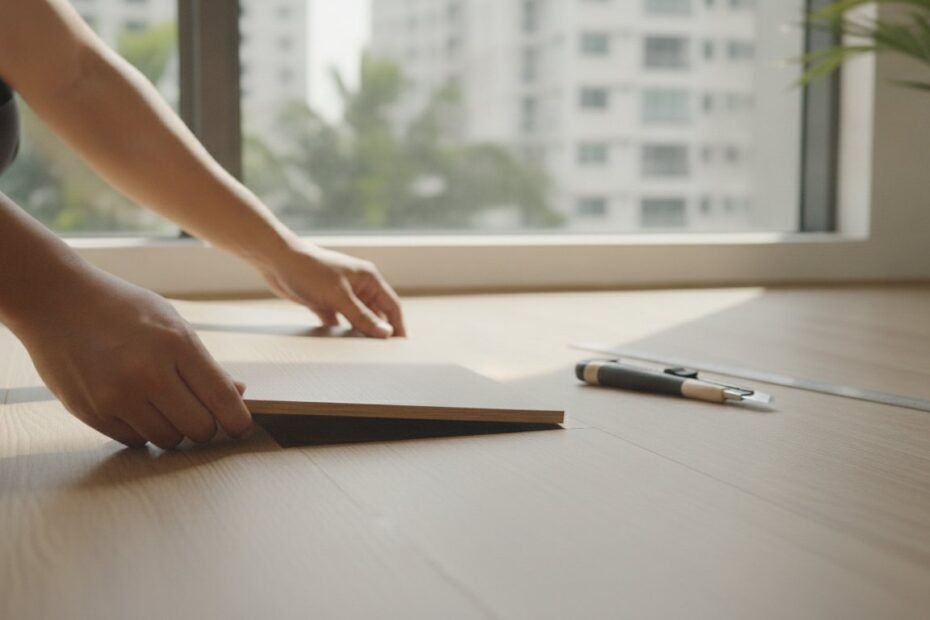
That deep gouge in the middle of your kitchen floor doesn’t mean your entire renovation was a waste of money. Most homeowners assume a single damaged board requires dismantling the floor back to the nearest wall, but that simply isn’t the case. You can fix the problem right where it sits with the right technique.
For prices, options and installation details, see our guide to vinyl flooring services in Singapore.
It’s completely normal to feel anxious about the cost of professional repairs or the risk of snapping those fragile locking tabs. You want a floor that looks seamless and stays waterproof without the headache of a full room tear-out. We understand that your home is a major investment, and maintaining its quality and safety is your top priority.
This guide provides the expert steps you need for replacing a single vinyl plank with surgical precision. You’ll learn how to remove the damage and click in a new piece without disturbing the rest of your installation. We will cover the essential tools, the specific cutting patterns required for a clean extraction, and the professional secrets to ensuring your repair remains invisible and fully protected against moisture.
Key Takeaways
- Learn how to restore your floor’s beauty without a full renovation by identifying the specific repair method required for click-lock or glue-down vinyl.
- Master the precise extraction technique for replacing a single vinyl plank using a utility knife and the essential 1-inch border rule.
- Discover the “Closet Swap” secret to achieve a perfect color match, even if your original flooring batch is no longer available.
- Understand how to maintain the waterproof integrity of your floor and protect your long-term material warranty during the repair process.
- Identify the critical warning signs that indicate a subfloor issue and when professional assistance is necessary to ensure a safe, lasting result.
Can You Replace Just One Vinyl Plank?
Yes, it is entirely possible to replace a single plank without a total teardown. Many homeowners fear that a single deep scratch or a stubborn stain means the end of their beautiful floor. It doesn’t. Modern flooring is designed for modularity. Whether you have a click-lock system or a glue-down installation, you can isolate the damage and fix it. This process is much faster than a full room renovation and saves significant costs. You don’t need to be a professional to achieve a clean result, but you do need patience and the right strategy.
Speed is your best friend when dealing with floor damage. Replacing a plank early prevents moisture from seeping into the subfloor through cracks or deep gouges. If water gets under the vinyl, it can lead to mold growth or cause the surrounding planks to lift and peel. Historically, the development of Vinyl composition tile and modern luxury vinyl has prioritized this ease of maintenance. You just need a matching plank from your original installation batch to ensure the texture and color remain consistent. Successful replacing a single vinyl plank depends heavily on this color match, as different production runs often have slight shade variations.
The method you use depends on your specific floor type. Click-lock floors are “floating,” meaning they aren’t attached to the subfloor. Glue-down planks are bonded directly to the surface below. While the extraction process differs, the goal remains the same: a seamless finish that looks like the damage never happened.
The “Surgical” Approach to Floor Repair
Think of this as a surgical procedure rather than a demolition project. You should never try to “pry” a plank up from the edge. Doing so will almost certainly snap the delicate locking mechanisms of the healthy planks surrounding it. Instead, we use a “center-out” cutting technique. We cut into the damaged board itself, remove the middle section, and then carefully pull the remaining strips away from the tongues and grooves of the good boards. This preserves the structural integrity of your entire floor. It’s a precise way to handle replacing a single vinyl plank without causing collateral damage.
Assessing the Damage: Repair vs. Replacement
Not every mark requires a full swap. Minor surface scratches can often be handled with a vinyl floor repair kit using specialized wax or filler markers. However, deep gouges that penetrate the wear layer or structural cracks mandate a replacement. These issues compromise the floor’s waterproof nature. In our experience, vinyl flooring Singapore standards emphasize durability; if the core is exposed, it’s time for a replacement.
- Use a repair kit if: The scratch is shallow and doesn’t catch your fingernail.
- Replace the plank if: There are holes, deep burns, or if the edges are curling.
- Consult a pro if: You see signs of water damage or “popping” across multiple boards.
Tools and Preparation for a Seamless Repair
Preparation is the foundation of any successful floor restoration. You cannot rush this stage. When you are replacing a single vinyl plank, your toolkit determines whether the final result is invisible or an eyesore. Professional results require more than just a spare board; they require a set of precision instruments designed to protect the surrounding floor. You need a heavy duty utility knife with fresh blades, a metal straight edge for exact cuts, and a high strength vinyl adhesive specifically rated for your floor type.
Every professional knows that safety is paramount. Wear cut resistant gloves to protect your hands during the extraction process. To safeguard your existing flooring Singapore investment, apply painter’s tape around the perimeter of the damaged plank. This simple step prevents your utility knife or pry bar from accidentally scratching the healthy boards nearby. A pull bar or a small crowbar is also essential for seating the new plank into its locking mechanism without damaging the edges.
Your vacuum cleaner is actually your most critical bonding tool. Even a single grain of dust or a tiny shard of old vinyl can prevent the new plank from sitting flush. This creates a “telegraphing” effect where a small bump eventually wears through the new surface. This DIY vinyl floor repair strategy emphasizes that a surgically clean subfloor is non negotiable for a long lasting bond.
The Importance of the Heat Gun
Controlled heat is the secret to a stress free repair. A heat gun softens the rigid core of the vinyl, making it pliable and easier to cut without splintering. In Singapore, where relative humidity often exceeds 80%, moisture can sometimes linger in the subfloor. Using a heat gun on a low setting helps ensure the area is perfectly dry before you apply new adhesive. Be careful to keep the nozzle moving. Holding it in one spot for too long can scorch the wear layer of adjacent planks, turning a small repair into a larger problem.
Preparing the Replacement Plank
Before you make your first cut, you must prepare the new material. Acclimatize the replacement plank in the room where it will be installed for at least 24 hours. This allows the material to expand or contract to match the room’s specific climate. Double check the grain direction and pattern flow. If the task of matching patterns and handling high temperature tools feels overwhelming, our expert flooring installation service team can ensure a perfect, warrantied finish for your home.
Step-by-Step Guide: Replacing Click-Lock vs. Glue-Down
Executing a flawless repair requires a methodical approach. You aren’t just swapping a board; you’re performing a precise extraction to save the rest of your floor. The process begins with isolating the damage to ensure you don’t compromise the surrounding area. Follow these five essential steps for a professional result:
- Step 1: Use a straight edge and a pencil to mark a rectangle inside the damaged plank. Stay exactly 1-inch away from all four edges to protect the locking mechanisms of the healthy boards.
- Step 2: Cut through the center of the rectangle with your utility knife. Carefully lift out the middle section. Once the center is removed, pull the remaining 1-inch strips inward toward the gap to release them from the surrounding tongues and grooves.
- Step 3: Prepare your replacement plank by trimming off the locking “tongues” on the long and short sides. This allows the new piece to drop directly into the opening without needing to slide it under existing boards.
- Step 4: Apply a thin, even layer of specialized vinyl adhesive to the grooves of the surrounding floor and the subfloor area.
- Step 5: Place the new plank into the opening and press firmly. Weight it down with a heavy object, like a stack of books or a toolbox, for at least 24 hours to ensure a flat, permanent bond.
This systematic method ensures that replacing a single vinyl plank doesn’t lead to a chain reaction of loose boards. By focusing on the “center-out” extraction, you maintain the structural integrity of your entire room.
Modifying Click-Lock Planks for In-Place Fitting
The “tongue-trimming” secret is what separates amateurs from experts. Since you can’t tilt and click a plank into the middle of a finished floor, you must remove the protruding locking lips. Use a sharp chisel or your utility knife to shave these down until the plank sits flush. In Singapore’s humid climate, we recommend using a high-strength liquid adhesive rather than double-sided tape. This creates a superior moisture barrier. It ensures the “short end” joints remain tight and waterproof, preventing future lifting.
Glue-Down Specifics: Managing the Adhesive
If your floor is glued directly to a cement screed, the challenge is residue management. You must scrape away every bit of stubborn old glue until the surface is perfectly smooth. Any leftover bumps will “telegraph” through the new vinyl, creating an uneven finish. Use a moisture-resistant pressure-sensitive adhesive (PSA) for the best results. Always follow the “wait-to-tack” rule. Wait until the adhesive turns from white to clear and feels tacky to the touch before you lay the plank. This guarantees an instant, secure bond that won’t shift.

Common Pitfalls and How to Avoid a “Patchy” Look
Achieving a seamless finish is the ultimate goal when replacing a single vinyl plank. The biggest hurdle homeowners face is batch variance. Even if you find the exact same model name, a plank manufactured in 2026 may have slight color or texture differences compared to your 2024 installation. This happens because production runs often involve different dye lots or embossing plates. If you use a brand-new plank in the center of your living room, the color shift might be noticeable under bright light.
The “Closet Swap” trick is our favorite professional secret for a perfect match. If you don’t have spare planks from your original installation, find an invisible area of your home, such as the back of a walk-in closet or the space under a heavy refrigerator. Carefully extract a “seasoned” plank from that hidden spot and use it for your visible repair. You can then use your new, slightly different plank to fill the hidden gap. This ensures the most visible parts of your floor remain consistent in color and wear level.
Cleaning the surrounding area is also vital for a successful blend. Dirt and grime build up in the textures of your existing floor over time. Before you install the new piece, deep clean the surrounding boards. This prevents the new, pristine plank from standing out against a “grayer” or duller background. A clean surface also ensures the adhesive bonds perfectly without interference from household oils or dust.
Sourcing Matching Planks in Singapore
Your first step should always be contacting your original vinyl flooring supplier Singapore. They often keep records of your specific batch numbers and might have “attic stock” available. If your specific design is discontinued, don’t panic. You can often find a close match by comparing samples in different lighting conditions. If a perfect match is impossible, consider using decorative rugs or strategically placing furniture to mask the repair area. For complex sourcing or matching issues, our flooring installation service team can provide expert guidance to ensure your repair remains invisible.
The “Lip” Issue: Preventing Tripping Hazards
New planks are often slightly thicker than old ones because they haven’t been subjected to years of foot traffic. This creates a tiny “lip” at the edge of the repair. Even a fraction of a millimeter can become a tripping hazard or a point where your vacuum gets stuck. Use a rubber mallet to gently tap the edges of the new plank into place. This helps compress the adhesive and seats the board firmly against the subfloor. To verify your work, perform the “socks test.” Walk over the area in thin socks. Your feet will detect even the smallest uneven edge that your eyes might miss. If you feel a snag, continue to weight the plank down until it sits perfectly flush.
When to Call the Professionals at Home Expo Asia
While replacing a single vinyl plank is a manageable weekend project for many, some situations demand a higher level of technical expertise. If you notice multiple damaged planks in one area, it’s rarely just a coincidence. Often, this signals a failing subfloor or issues like popping tiles beneath your vinyl layer. Attempting to patch a floor that has structural movement will only lead to the new plank lifting within weeks. Professional assessment is the only way to ensure your floor remains safe and level.
You should also consider the long term protection of your investment. Many premium flooring brands have strict installation requirements. Undertaking DIY modifications can sometimes void your material warranty if the method doesn’t meet precise manufacturer specifications. Our team at Home Expo Asia provides the security of professional certification. We ensure every repair is documented and performed to industry standards, which gives you total peace of mind and maintains your warranty coverage.
Complex Repairs: Beyond the Single Plank
Professional intervention is essential when damage extends deep into the cement screed. If moisture has been trapped under the floor for an extended period, the subfloor may need specialized treatment to prevent mold and structural rot. We use industrial tools that aren’t available at local hardware stores, such as high powered moisture meters and industrial heat vacs. These tools allow us to dry the subfloor completely and prep the surface for a bond that will last for decades. It’s a level of precision that guarantees a healthy home environment.
Home Expo Asia: Your Flooring Partner
Choosing a professional partner means accessing a wealth of historical experience and a massive inventory of materials. We maintain a library of over 200 designs, which makes it much easier to find an elusive match for a discontinued floor. Our carpenter Singapore experts bring surgical precision to every cut. We don’t just fix the surface; we provide a comprehensive assessment of your home’s flooring health to prevent future issues.
Our commitment to quality includes dedicated after sales support and transparent service terms. You won’t have to worry about hidden fees or a messy cleanup. We handle the entire process from the initial extraction to the final “socks test.” Don’t risk your floor’s integrity with a “good enough” DIY fix. Contact Home Expo Asia for a professional repair quote today and let our reliable specialists restore your home to its original beauty.
Restore Your Floor’s Flawless Finish Today
If the damage is widespread or signals deeper subfloor issues, don’t risk your investment with a DIY mistake. Our professional Singapore-based installation team offers over 200 vinyl designs and a comprehensive warranty for your peace of mind. We provide the expert after-sales support you need to keep your home looking its best. Get a professional assessment from Home Expo Asia to ensure your repair is handled with industry-leading precision. Your floor is the foundation of your home’s comfort; let us help you keep it perfect.
Frequently Asked Questions
Can I replace a vinyl plank without a spare piece?
You can replace a plank without a spare by harvesting one from a hidden location like a closet. This “Closet Swap” ensures a perfect color match that matches the wear of your existing floor. Once you’ve taken the seasoned plank, use a new, similar board to fill the hidden gap where the slight color difference won’t be seen.
How long does it take to replace a single vinyl plank?
The physical process of replacing a single vinyl plank typically takes between 45 and 90 minutes. This includes time for the precision extraction and preparing the subfloor. However, you must factor in a 24-hour curing period where the plank should be weighted down and kept free of foot traffic to ensure a permanent bond.
Do I need to remove the baseboards to replace a plank in the middle of the room?
No, you don’t need to touch your baseboards for a repair in the middle of the room. The “surgical” center-out cutting technique allows you to remove a damaged board without disturbing the surrounding planks or the perimeter of the room. This saves you the hassle of removing and re-installing delicate trim or molding.
What is the best adhesive for a vinyl plank repair in Singapore?
A high-quality, moisture-resistant pressure-sensitive adhesive (PSA) is the best choice for Singapore’s humid environment. These adhesives are designed to handle the expansion and contraction caused by local temperature swings. Always ensure the adhesive is specifically rated for luxury vinyl to prevent the edges from curling over time.
Will replacing one plank void my flooring warranty?
It’s possible that a DIY repair could void your material warranty if the installation doesn’t meet the manufacturer’s specific guidelines. Most warranties require professional installation to remain valid. If you are concerned about long-term protection, hiring a professional service ensures the repair is documented and performed to the required industry standards.
How do I remove the glue from the subfloor before putting a new plank down?
You can remove old glue by gently heating it with a heat gun and scraping it away with a putty knife. If you’re working on a cement screed subfloor, you may need a light sanding to ensure the surface is perfectly smooth. A clean, bump-free base is essential for the new adhesive to create a reliable and level bond.
Can I walk on the new plank immediately after replacing it?
You shouldn’t walk on the new plank for at least 24 hours. The adhesive needs this time to reach its full bonding strength without being shifted by the weight of foot traffic. Keep the area weighted down with heavy objects during this window to prevent the edges from lifting while the glue sets.
What if the new plank is slightly thicker than the old ones?
If the new plank is slightly thicker, you can often seat it flush by using a rubber mallet to firmly tap it into the adhesive. This helps compress the glue layer and ensures the board sits as low as possible. If the height difference is significant, it usually indicates a batch variance that might require a professional assessment to fix safely.