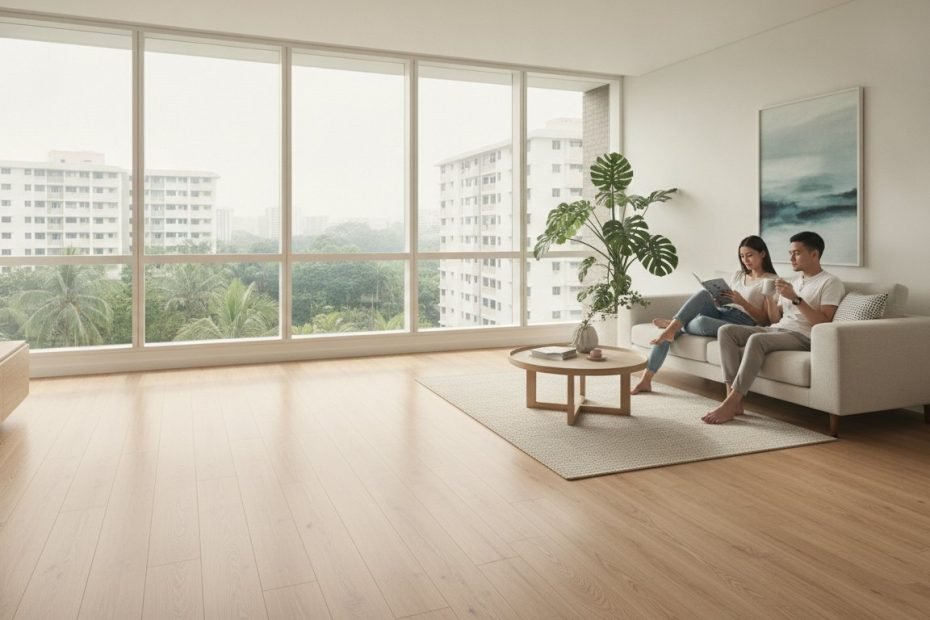
In Singapore’s 80% relative humidity, your flooring choice isn’t just about aesthetics; it’s a critical decision to prevent structural failure in your home. Choosing the best flooring for Singapore’s humid climate requires more than just picking a pretty pattern. It demands a moisture-impermeable system designed to withstand intense tropical conditions without compromising on safety or quality.
We understand the deep anxiety that comes with home ownership. You might worry about expensive parquet floors warping or the dreaded sound of HDB tiles popping up in the middle of the night. These aren’t just minor inconveniences; they are signs of environmental stress that can lead to mould growth and costly repairs. It’s natural to feel confused by the technical jargon surrounding different vinyl types and installation methods.
This guide promises to clear that confusion and restore your peace of mind. You’ll discover the most durable, moisture-resistant vinyl flooring options that stay flat and beautiful for years. We provide a clear preview of HDB regulations, including the 50mm thickness limit, and the latest 2026 installation standards. By the end, you’ll have the expert knowledge needed to secure a home that’s as resilient as it is stylish.
Key Takeaways
- Understand how Singapore’s high humidity causes natural materials to warp and why traditional tiles are prone to “popping” in HDB flats.
- Learn why premium vinyl is the best flooring for Singapore’s humid climate because of its 100% waterproof properties and exceptional dimensional stability.
- Identify critical HDB renovation guidelines, including the 50mm floor thickness limit and the necessity of pre-packed screed.
- Gain expert insights into subfloor preparation and why professional installation is the key to preventing long-term structural issues.
- Discover a range of over 200 moisture-resistant designs that offer the beauty of natural timber without the risk of moisture damage.
Why Singapore’s Tropical Humidity is the Ultimate Test for Your Flooring
Singapore’s environment is notoriously harsh on interior finishes. With an average relative humidity of 84%, the air is constantly saturated with water vapour. This level of moisture creates a relentless environment where porous materials act like sponges. Why Singapore’s Tropical Humidity is the Ultimate Test for your home boils down to how these materials react to invisible moisture. When natural timber or parquet absorbs this vapour, it expands. This often results in ‘cupping’, where the edges of the planks rise higher than the centre, or ‘crowning’, where the centre bulges upward. These aren’t just cosmetic flaws; they indicate deep structural stress that can ruin your investment within a few years.
Traditional laminate flooring often struggles even more. In local conditions, many homeowners find their laminate floors failing within just 3 to 5 years. The core of laminate is usually made of compressed wood fibres that swell uncontrollably when exposed to our tropical air. If you’re searching for the best flooring for Singapore’s humid climate, you need a material that ignores moisture entirely. Temperature fluctuations also play a massive role. The cycle of hot afternoons and cool, air-conditioned evenings causes materials to expand and contract rapidly, leading to gaps or buckling in less stable products.
The Science of Moisture and Material Expansion
Many common building materials are hygroscopic, meaning they actively attract and hold water molecules from the surrounding air. In new BTO or Condo units, this is particularly risky as the building itself is still “curing” and releasing moisture. When you trap this moisture under a non-breathable floor, it leads to mould growth and that unmistakable musty smell. The problem worsens with our love for air-conditioning. The temperature difference between a chilled room and the humid exterior creates a dew point on your floors. This condensation is the silent killer of inferior flooring types, leading to rot and adhesive failure over time.
Common Flooring Failures in Local HDBs and Condos
One of the most distressing issues for HDB dwellers is the “popping tile” phenomenon. This happens when the concrete subfloor and the tiles expand at different rates due to heat and humidity. Without enough “breathing room” or proper adhesive, the pressure builds until the tiles literally explode off the floor. Similarly, cheap glue-down vinyl often suffers from delamination. High heat near balconies or windows can weaken the adhesive, causing edges to peel and curl. By 2026, homeowners are moving away from these high-maintenance risks. They’re choosing advanced solutions that offer total peace of mind. Finding the best flooring for Singapore’s humid climate is about choosing stability over constant repair.
Comparing Popular Flooring Types for Moisture Resistance and Durability
Choosing the right material is a balance between style and long-term performance. When Comparing Popular Flooring Types, you must look beyond the showroom floor. Each material reacts differently to the relentless moisture levels found in Singaporean homes. While some prioritize luxury, others offer the resilience needed for a hassle-free lifestyle. Understanding these trade-offs is the first step toward finding the best flooring for Singapore’s humid climate.
Natural Timber and Parquet: The Warping Risk
Solid wood remains a high-status choice, but it’s arguably the most temperamental. Because timber is naturally porous, it requires constant dehumidification to remain stable. Without 24/7 climate control, these floors are prone to significant movement. Water-damaged parquet is notoriously expensive to refinish; it often requires the replacement of entire sections rather than simple repairs. While engineered wood offers better stability through its layered construction, it remains vulnerable to top-layer delamination in extreme humidity.
Ceramic and Homogeneous Tiles: Addressing the Popping Problem
Tiles are 100% waterproof, making them a default choice for many. However, they aren’t without risks. Many HDB residents face the “popping” phenomenon during rare “cold” spells in Singapore. When temperatures drop, the concrete subfloor and tiles contract at different rates. If the installation was too rigid, the resulting pressure causes tiles to buckle or shatter. Fixing this is a major headache. Hacking up old tiles is a dusty, loud, and expensive process. If you’re dealing with existing damage, professional tiling and cement works can restore your home’s safety, though many now prefer overlaying with more flexible materials.
Laminate flooring serves as a budget-friendly alternative, but it’s highly susceptible to edge-swelling. Even routine mopping can cause water to seep into the seams, leading to permanent “pillowing” of the edges. By contrast, vinyl flooring has emerged as the 2026 gold standard for tropical environments. It offers the perfect blend of 100% waterproofing and thermal stability. It doesn’t pop like tiles or warp like wood. For homeowners seeking the best flooring for Singapore’s humid climate, vinyl provides a high-quality, low-risk solution. If you’re unsure which path to take, exploring professional vinyl installation can save you years of maintenance stress.
Why Vinyl Flooring is the Best Choice for Singapore’s Humid Climate in 2026
Vinyl has evolved from a simple alternative into the best flooring for Singapore’s humid climate. Unlike natural materials that swell or ceramic tiles that can buckle, modern vinyl is engineered to be 100% waterproof. This means the planks remain dimensionally stable even during the most intense monsoon seasons. When you choose vinyl, you’re investing in a floor that won’t gap, warp, or trap moisture beneath the surface. It’s the ultimate risk-mitigation strategy for your home renovation.
Understanding the Essential Factors to Consider regarding humidity is vital for any homeowner. High-quality vinyl provides a non-porous barrier that actively resists mould and bacterial growth. In Singapore’s allergy-prone climate, this is a significant health benefit. You don’t have to worry about the musty smells or microscopic spores that often plague older parquet or carpeted floors. It’s a clean, safe, and reliable foundation for your family.
Understanding SPC vs. LVT for Maximum Stability
Choosing between Stone Plastic Composite (SPC) and Luxury Vinyl Tile (LVT) depends on your specific room conditions. SPC features a rigid core made of limestone and stabilisers, offering superior heat resistance. This makes it perfect for areas with high sunlight, such as balconies or living rooms with floor-to-ceiling windows. LVT is slightly more flexible and can be more forgiving on minor subfloor imperfections. However, for most 2026 Singaporean homes, SPC’s rigidity provides the best protection against the “cupping” issues seen in traditional wood.
Comfort and Safety Underfoot
Safety is a priority for every household. High-grade vinyl comes with slip-resistance ratings ranging from R9 to R11, providing essential grip for children and the elderly. Beyond safety, vinyl’s multi-layered construction offers excellent sound-dampening properties. This is a huge advantage for high-rise living, as it reduces the “click-clack” noise of footsteps that can disturb your neighbours. If you want this durability without sacrificing style, you can opt for herringbone flooring. This classic pattern delivers a premium, wood-like aesthetic while maintaining all the moisture-resistant benefits of modern vinyl technology.
By opting for vinyl, you’re choosing a material that balances beauty with uncompromising performance. It’s the most practical way to achieve a high-end look without the high-end maintenance. You get the warmth of wood and the resilience of stone, all in one package designed specifically for our tropical environment.

Essential Factors to Consider Before Your Flooring Renovation
Preparation is the foundation of every successful home transformation. Even the best flooring for Singapore’s humid climate will fail if the subfloor isn’t properly prepared. We’ve seen many DIY projects struggle because the homeowner skipped a professional site assessment. A specialist identifies hidden dampness or structural movement that can ruin your new floor. This step is critical for ensuring your investment stays beautiful and functional for decades.
HDB regulations play a major role in your renovation planning. The total thickness of your floor finish and screed must stay under 50mm. This is a non-negotiable safety standard to prevent overloading the building’s structure. For dry areas, using pre-packed screed is now the industry standard to ensure a consistent, high-quality finish. If you’re moving into a new BTO flat, your unit usually comes with a pre-screed base, making it ideal for a direct vinyl overlay.
You also need to choose the right installation system. Click-lock vinyl is popular because it “floats” over the subfloor. This allows the material to breathe as temperatures shift between hot afternoons and air-conditioned nights. Glue-down systems offer a more permanent feel but require a perfectly primed base to avoid peeling. Both systems have their merits, but the choice depends heavily on your specific subfloor condition and usage needs.
HDB Screeding and Subfloor Preparation
A level subfloor is the single most important factor in vinyl longevity. When the base is uneven, the joints of your flooring are under constant stress, leading to cracks or gaps. Using professional-grade cement screed is the best way to create a flawless, flat base for your home. For all new BTO units, the pre-screed requirement ensures that every home starts with a standardized, level foundation ready for immediate flooring works.
Selecting the Right Design for Your Space
Design isn’t just about colour; it’s about how the floor interacts with Singapore’s natural light. Lighter shades can make a compact HDB feel airy and bright, while darker wood tones add a sense of luxury to larger condo units. Large-format vinyl planks are a top trend for 2026. They create a seamless look that makes rooms appear more spacious. However, complex layouts require a steady hand. Professional installation is non-negotiable for intricate patterns to ensure perfect alignment and minimal wastage.
Ready to start your renovation journey? Contact our expert team for a detailed site assessment and discover how we can transform your space with precision and care.
Transforming Your Home with Home Expo Asia’s Premium Vinyl Solutions
Home Expo Asia understands that your home is your sanctuary. We provide access to over 200 premium designs that cater to every local interior style, from Japandi to Modern Industrial. Selecting the best flooring for Singapore’s humid climate shouldn’t mean sacrificing beauty for durability. Our extensive collection ensures you get both. We offer transparent pricing packages tailored specifically for HDB BTO and resale flats. This allows you to plan your renovation budget with total financial clarity and no hidden costs.
Our team consists of experienced local specialists who understand the unique challenges of our tropical environment. We don’t just sell materials; we provide a complete service designed to give you long-term peace of mind. By focusing on quality and reliability, we’ve established ourselves as a trusted partner for thousands of Singaporean homeowners. We prioritize your safety and satisfaction through every step of the process. Our goal is to build your confidence by delivering a floor that stands the test of time.
Our Professional Installation Process
We start every project with a free site assessment and precise measurement service. This allows our experts to identify potential subfloor issues before they become expensive problems later. For families already living in their homes during a renovation, we use a specialized ‘dust-free’ installation approach. This minimizes disruption and keeps your living environment clean and healthy. Beyond flooring, our team can assist with high-quality carpentry services. This ensures your new floors perfectly complement your built-in cabinets and wardrobes for a cohesive home makeover.
Risk-Free Renovation with Industry-Leading Warranties
Our commitment to your home’s safety is backed by rigorous third-party certifications. We only use materials that meet the highest industry standards for durability and moisture resistance. Because we know the best flooring for Singapore’s humid climate must perform year after year, we offer comprehensive warranties. These cover both material integrity and installation quality. If your floor needs a humidity-related adjustment after its first monsoon season, our responsive after-sales support team is ready to help. This risk-mitigation promise is our final guarantee of security for your investment.
Don’t leave your home’s foundation to chance. Visit our showroom today to feel the quality of our premium vinyl for yourself. Our knowledgeable guides are ready to provide a personalized quote and help you build a home that’s ready for anything the Singaporean weather brings. Contact us now to secure your consultation.
Secure Your Home’s Future with Moisture-Resistant Flooring
Choosing the right foundation for your home is a decision that impacts your daily comfort and long-term property value. We’ve explored why premium vinyl stands out as the best flooring for Singapore’s humid climate, offering 100% waterproofing that natural timber simply can’t match. A successful renovation relies on more than just high-quality materials; it requires strict adherence to HDB guidelines and a perfectly levelled subfloor to prevent future warping or popping.
At Home Expo Asia, we make this transformation seamless. With over 200+ designs available, you’ll find the perfect aesthetic for your interior style. Our professional local installation team has earned 5-star customer testimonials for delivering moisture-resistant solutions that truly last. We take the risk out of your renovation by providing transparent packages and expert site assessments that ensure a flawless finish every time.
Get Your Risk-Free Vinyl Flooring Quote Today and invest in a home that stays beautiful regardless of the weather outside. Your dream living space is just a consultation away, and our team is ready to guide you toward the ultimate peace of mind.
Frequently Asked Questions
Is vinyl flooring really 100% waterproof for Singapore bathrooms?
How does humidity affect the glue used in vinyl flooring?
Excessive moisture trapped in the subfloor can cause standard adhesives to lose their bonding strength over time. This often leads to edges curling or planks shifting. To mitigate this risk, we perform professional site assessments to check moisture levels before any work begins. Using premium grade, moisture-resistant adhesives or opting for click-lock systems ensures your floor remains dimensionally stable even during Singapore’s most humid months.
Can I install vinyl flooring over my existing HDB tiles?
You can definitely install vinyl over existing tiles as long as they are firm, level, and free of cracks. This overlay method is highly popular because it avoids the dust and cost of hacking. However, if your current tiles are hollow or popping, they must be addressed first. Our team ensures the surface is primed and levelled to create a flawless foundation for the best flooring for Singapore’s humid climate.
Will vinyl flooring expand and buckle in Singapore’s heat?
Vinyl flooring handles tropical temperatures well, but it does undergo minor thermal movement. Professional installers prevent buckling by leaving small expansion gaps around the perimeter, which are neatly hidden by skirting. Without these gaps, the floor has no room to breathe and may lift. Choosing rigid core options provides even greater resistance to heat-related movement compared to traditional flexible vinyl types, keeping your floors perfectly flat.
How long does vinyl flooring typically last in a humid climate?
High-quality vinyl flooring typically lasts between 10 to 20 years in Singapore’s climate when installed by specialists. Its longevity depends on the wear layer thickness and the quality of the initial subfloor preparation. Unlike parquet which requires sanding and varnishing, vinyl maintains its integrity without intensive maintenance. Regular cleaning and avoiding standing water in the seams will ensure your floor remains a beautiful, worry-free part of your home for decades.
Is SPC flooring better than parquet for a BTO flat?
SPC is generally superior for new BTO flats due to its 100% waterproofing and high impact resistance. While parquet offers a natural luxury, it’s highly susceptible to the warping and mould issues common in new buildings. SPC provides the best flooring for Singapore’s humid climate because it handles the building’s initial moisture release better than wood. It’s a practical solution that gives you the wood aesthetic without the constant maintenance.
How do I clean vinyl floors to prevent mould in Singapore?
Cleaning vinyl is straightforward and helps prevent mould spores from settling in your home. Use a microfiber mop that’s damp, not dripping wet, along with a pH-neutral cleaner. Avoid using harsh chemicals or steam mops, as extreme heat can damage the protective wear layer. Keeping your home well-ventilated during the monsoon season further ensures that moisture doesn’t linger on the surface, keeping your living environment healthy and fresh.
What should I do if my tiles are already popping?
If your tiles are popping, you should contact a specialist for tiling and cement works immediately to assess the structural safety. Popping tiles are a trip hazard and indicate significant pressure build-up. Once the damaged area is stabilized and levelled, many homeowners choose to overlay the space with vinyl. This provides a flexible, moisture-resistant finish that prevents the same pressure-related popping from occurring again in the future.