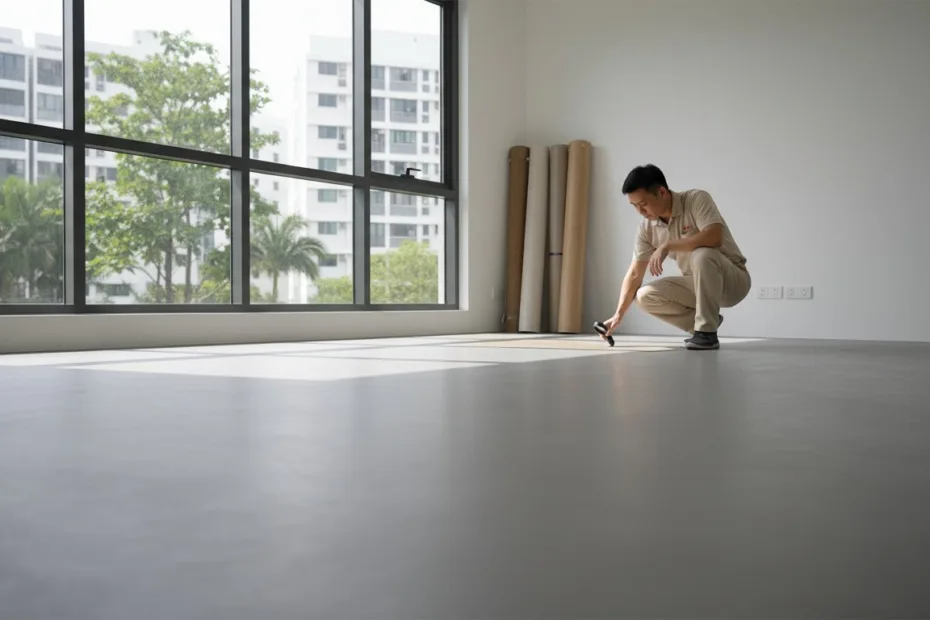
What if the most expensive mistake in your renovation isn’t the designer furniture, but the hidden layer of cement screed you barely thought about? In 2024, over 65% of flooring failures in local BTO flats were caused by poor subfloor preparation rather than the surface material itself. It’s natural to feel overwhelmed by HDB’s strict rules on pre-packed materials or the anxiety of uneven floors ruining your new S$4,500 vinyl installation. You’re right to want a foundation that’s both durable and legally compliant without any hidden fees.
You deserve a home built on quality and safety. This 2026 guide will help you master the technical and aesthetic essentials of screeding to ensure a level, durable, and HDB-compliant foundation for your space. We’ll break down the latest HDB permit requirements, current S$ per square foot market rates, and professional secrets to preventing hairline cracks. You’re about to learn exactly how to secure a flawless, risk free floor that stands the test of time.
Key Takeaways
- Understand how a professional cement screed application creates the essential level foundation required for both modern aesthetics and durable vinyl flooring.
- Navigate HDB’s strict 50mm thickness regulations and mandatory pre-packed material requirements to ensure your renovation stays fully compliant.
- Learn to manage the natural characteristics of cement, including how to turn potential hairline cracks into a unique, seamless design feature.
- Discover the precision of laser-leveling and professional surface preparation techniques that prevent future flooring failures and costly repairs.
- Gain peace of mind with Home Expo Asia’s risk-free approach to subfloor assessment, ensuring your home meets the highest Singaporean quality standards.
What is Cement Screed and Why is it Essential for Singapore Homes?
Homeowners in Singapore encounter this material most often during BTO renovations or resale hacking works. Most BTO units are handed over with a raw, uneven concrete base that isn’t ready for immediate flooring installation. For resale units, hacking away old 600mm x 600mm tiles often leaves the ground pockmarked and jagged. A fresh layer of screed creates the flat canvas needed for a professional finish. It’s the secret to a floor that looks good and stays durable for decades.
The Functional Necessity of a Level Floor
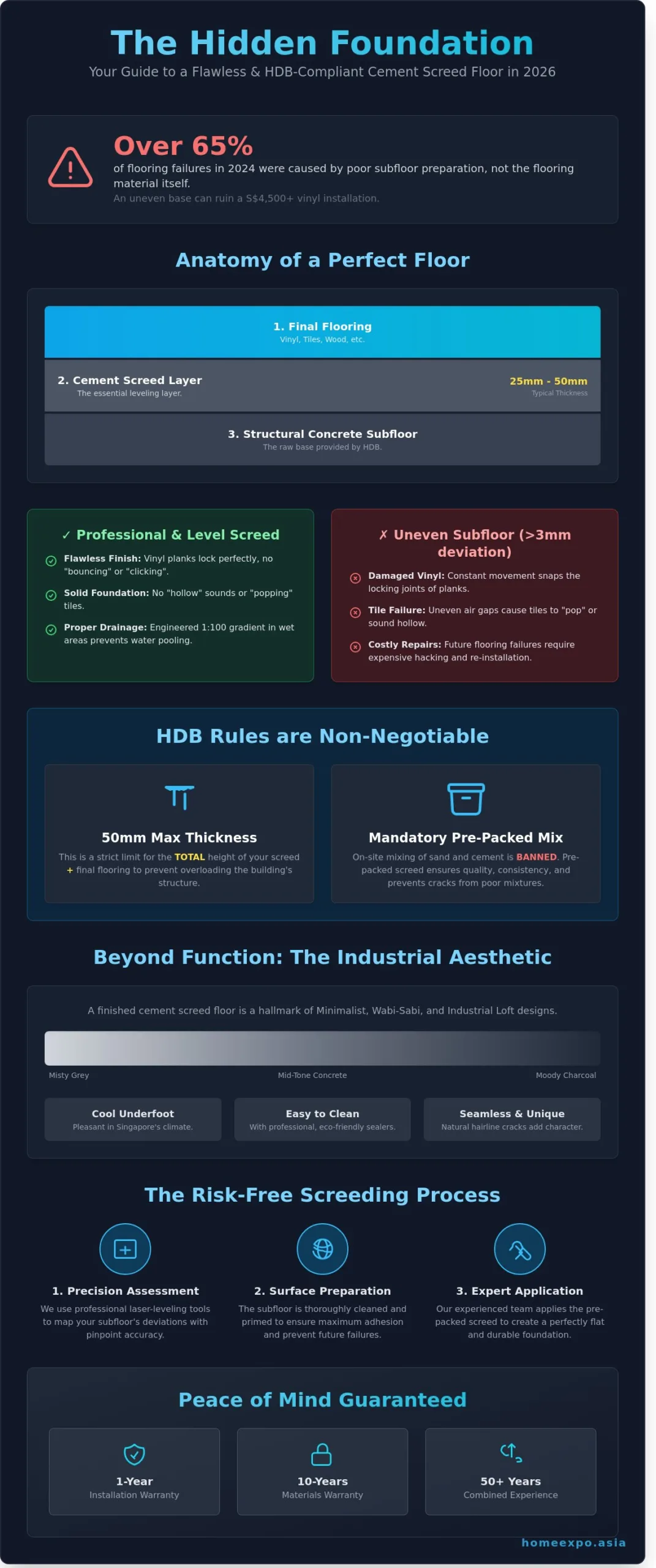
Precision is everything for a long-lasting floor. If your subfloor has a deviation of more than 3mm over a 2-meter span, vinyl planks will “bounce” or “click” when you walk on them. This constant movement eventually snaps the locking joints of the planks. Our team uses professional leveling tools to ensure your floor is perfectly flat before any adhesive is applied. In wet areas like kitchens or balconies, we carefully engineer a 1:100 gradient. This ensures water flows directly toward the floor trap, preventing stagnant pools and potential seepage issues that could damage your neighbor’s ceiling below.
- ✓ Prevents “hollow” sounds under ceramic or porcelain tiles.
- ✓ Eliminates “popping” tiles caused by uneven air gaps in the mortar.
- ✓ Provides a 100% smooth surface for high-strength vinyl adhesives.
- ✓ Corrects height differences between different rooms for a seamless transition.
Cement Screed as a Design Choice
Beyond its role as a functional base, many homeowners now choose a finished cement screed for its raw, industrial aesthetic. It’s a hallmark of the minimalist “Wabi-sabi” or loft-style designs popular in Tiong Bahru and Queenstown apartments. You aren’t limited to a single dull look. We can customize the finish from a pale, misty grey to a deep, moody charcoal. This versatility allows it to match various interior themes, from Scandi-industrial to modern chic.
The tactile experience of a screed floor is unique. It feels cooler underfoot than wood but smoother than traditional unpolished stone. To ensure it’s practical for daily life, we apply specialized, eco-friendly sealers. These protective coatings make the surface non-porous and easy to clean with a simple damp mop. You get the rugged beauty of concrete without the dust or staining risks common in untreated floors. It’s a professional, durable, and safe choice for families who want a standout home without the high maintenance of natural stone.
At Home Expo Asia, we back our work with a 1-year installation warranty and 10 years of materials warranty. It’s risk-free! Our team has more than 50 years of combined experience in the Singapore flooring industry, ensuring your home gets the professional treatment it deserves. Don’t settle for uneven floors; choose a quality finish that lasts.
Understanding HDB Regulations and Screed Types
Renovating your flat requires strict adherence to local building codes to ensure safety and longevity. HDB implemented a mandatory rule requiring pre-packed cement screed for all internal dry areas to maintain structural integrity and site cleanliness. You can’t mix raw sand and cement on your floor anymore. This shift happened because site-mixed batches often lacked consistency, which led to hollow tiles or surface cracks within just 2 to 3 years of installation.
Before your contractor begins work, it’s vital to review the HDB Regulations for Cement Screed to avoid heavy penalties. One critical rule is the 50mm thickness limit. This 50mm restriction includes the screed layer and your final floor finish, such as vinyl or tiles. Exceeding this height adds excessive weight to the building slab, which is a serious safety violation in Singapore’s high-rise environment.
While most homeowners focus on the finish, the system used underneath is just as important. There are three primary systems used in Singaporean homes:
- Bonded Screed: This is applied directly to the concrete slab using a specialized bonding agent to ensure it sticks firmly.
- Unbonded Screed: This system is separated from the main slab by a damp-proof membrane, which is ideal if there’s a risk of rising moisture.
- Floating Screed: This is laid over a layer of thermal or acoustic insulation, often used in premium developments to reduce noise transmission.
You don’t always need a formal renovation permit for simple screeding in dry areas. However, a permit is mandatory if you’re changing the floor finish in wet areas or if the total thickness will significantly alter the floor level. Starting work without an approved HDB permit can lead to a S$5,000 fine and a legal order to reinstate the floor to its original condition at your own expense.
Pre-packed vs. Traditional Site-Mixed Screed
Since 2015, HDB has banned traditional site-mixing for internal works to reduce dust and ensure quality control. Pre-packed materials come in bags with factory-calibrated ratios of cement and graded sand. This ensures every square meter of your floor reaches a consistent 20 to 30 MPa compressive strength. Professional contractors in Singapore rely on certified brands like Laticrete or Davco. These materials offer better adhesion, less shrinkage, and a much faster curing time than old-fashioned methods.
Waterproofing and Screeding in Wet Areas
Wet areas like bathrooms and service yards follow strict protocols to prevent leaks. You must apply a certified waterproofing membrane before the cement screed process begins. HDB guidelines require a mandatory 7-day curing period for the screed before a 24-hour water ponding test is conducted. This process is essential to prevent S$3,000 to S$6,000 in potential water damage repairs for your neighbors downstairs. Our team provides reliable flooring advice to help you choose the right materials that comply with these safety standards.
✓ Quality Is Our #1 Priority
✓ Certified and Tested Materials
✓ No Hidden Fees
The Reality of Cement Screed: Pros, Cons, and Pitfalls
Choosing a floor finish is a major decision for any Singapore homeowner. Most people gravitate toward a cement screed finish for its raw, industrial aesthetic. The primary advantage is the seamless look. Because there are no grout lines, your floor appears as one continuous surface. This eliminates the common headache of scrubbing moldy grout joints in humid weather. It creates a clean, expansive feeling in HDB flats where space is at a premium.
You must understand the “cracking” reality before committing. In the flooring industry, we say hairline cracks are a feature, not a bug. Cement naturally shrinks as it cures over a 28-day period. In Singapore’s 80% average humidity, this movement is inevitable. These tiny cracks don’t signal structural failure. Instead, they provide that authentic, weathered look many designers crave. If you want a surface that remains perfectly uniform forever, traditional cement might not be your best match.
Safety and regulations are also vital. When planning your layout, you must follow the HDB renovation guidelines which mandate the use of pre-packed screed. This material is factory-mixed for better consistency and bonding. It also limits the thickness of your floor finish to 50mm to ensure the structural integrity of the building is never compromised. We prioritize these standards to ensure your home remains safe for decades.
Cost is another factor that has shifted recently. In 2026, cement screed is no longer the “budget” option it once was. While raw materials remain affordable, the specialized labor for a smooth finish and high-quality sealing has increased. You can expect to pay between S$15 and S$22 per square foot for a professional job. This puts it in the same price bracket as high-quality porcelain tiles. However, the thermal properties offer a unique benefit. Cement stays 2 to 3 degrees cooler than the surrounding air, providing a refreshing chill underfoot during a tropical afternoon.
Managing the Maintenance Challenge
Raw cement screed is naturally porous. If you leave it unsealed, it acts like a sponge for liquids. Spilled coffee or red wine will leave a permanent mark in less than 10 minutes. This is why professional sealing is non-negotiable for a long-lasting floor.
- ✓ Apply a high-grade polyurethane sealer immediately after curing.
- ✓ Reseal the surface every 3 to 5 years to maintain water resistance.
- ✓ Use only pH-neutral cleaners to prevent eroding the protective coating.
- ✓ Place felt pads under furniture to prevent deep scratches in the finish.
Microcement vs. Traditional Cement Screed
Microcement is rapidly becoming the preferred choice for homeowners who want the industrial look without the cracking risks. It’s a polymer-modified coating that is applied in thin, flexible layers. While traditional cement screed requires a thick application, microcement is only 2mm to 3mm thick. This flexibility allows it to resist the shrinkage cracks that plague standard cement. It’s also much more durable for high-traffic living rooms and commercial spaces. The trade-off is the price. Microcement typically costs between S$28 and S$38 per square foot. It’s a premium investment for those who demand a flawless, crack-free aesthetic and superior stain resistance.
Our team ensures every installation meets rigorous quality checks. We provide an official invoice and clear warranties because your peace of mind is our priority. It’s risk-free when you work with experienced professionals who understand the science of cement.
The Professional Screeding Process: Step-by-Step
Achieving a flawless floor requires more than just pouring wet concrete. It’s a precise science that demands technical expertise and the right equipment. At Home Expo Asia, we follow a rigorous protocol to ensure every cement screed installation meets our high standards for durability and aesthetics. We don’t take shortcuts because your home’s foundation deserves a professional touch. Our process is designed to eliminate common issues like cracking or unevenness before they even start.
- ✓ Thorough Surface Assessment: We inspect every square inch of the subfloor.
- ✓ Digital Leveling: We use high-precision laser tools for 100% accuracy.
- ✓ Certified Materials: We only use HDB-approved pre-packed screed.
- ✓ Dust Control: We keep your site clean and protect your existing fixtures.
The entire workflow begins with a clean slate. We remove all traces of dust, oil, and loose debris that could interfere with adhesion. If the subfloor isn’t perfectly prepared, the new layer won’t bond correctly. This leads to “hollow” sounds when you walk on it later. We use industrial-grade vacuums and scrapers to ensure the surface is pristine. Once cleaned, we apply a high-quality bonding agent. This primer acts as the glue between the old slab and your new floor. It’s a critical step that many budget contractors skip to save costs, but it’s essential for a long-lasting result.
Preparation and Priming
Our experts perform a “tap test” to identify hollow spots in your existing subfloor. In older Singaporean flats, we often find that 12% to 18% of the floor area requires localized hacking before we begin. We then apply a specialized primer to prevent the subfloor from absorbing moisture too quickly. This prevents the cement screed from drying out prematurely and cracking. We also wrap your S$3,500 kitchen cabinets and skirting boards in protective plastic to prevent any splashing during the wet phase.
Setting the levels is where the real skill comes in. We don’t rely on eyesight or simple spirit levels. Our team sets up 360-degree laser levels that project a perfectly horizontal beam across the entire room. We then establish “screed rails” or dots at 1.5-meter intervals. This ensures that the final surface has a flatness tolerance of less than 3mm over a 3-meter distance. This level of precision is vital if you’re planning to install large-format tiles or luxury vinyl flooring later.
Levelling and Finishing
The “trowel finish” is a signature of our craftsmanship. For a standard base, we aim for a smooth, closed-surface finish. If you need an ultra-thin application for a minor correction, we use self-levelling compounds that flow into every low point. These specialized mixes are often just 3mm to 5mm thick but provide a glass-like surface. Our final inspection involves a 2-meter straight edge to verify the levelness before we sign off on the work.
The final stage is the curing period, which is the most difficult part for homeowners. You cannot walk on the floor for at least 24 to 48 hours. During this window, the chemical reaction between the cement and water is at its peak. Stepping on it too early will leave permanent footprints and structural weaknesses. For the best results, we recommend waiting a full 7 days before heavy furniture is moved in. This patience ensures your floor remains “Risk Free” and durable for decades to come.
Book a professional floor consultation with Home Expo Asia today and enjoy our 1-year installation warranty.
Why Home Expo Asia Prioritizes Expert Cement Works for Vinyl Success
A stunning vinyl floor is only as durable as the surface beneath it. At Home Expo Asia, we’ve seen how a poor foundation ruins even the highest quality materials. That’s why we treat cement screed preparation as the most critical step in your renovation. When the subfloor is perfectly level, your vinyl planks click together seamlessly. This prevents the “popping” sounds and “hollow” feelings that often plague DIY or poorly managed projects. A flat surface ensures the locking mechanism of your vinyl remains intact for decades.
Our team brings over 50 years of combined industry experience to every HDB and private residential unit. We’ve completed thousands of successful installations across Singapore. This deep expertise allows us to identify potential moisture issues or structural irregularities before they become expensive problems. We don’t just lay floors; we engineer a stable environment for your home. By choosing an expert team, you avoid the common mistake of laying new flooring over an uneven cement screed, which leads to floor buckling and joint separation.
To give you complete peace of mind, we provide a “Risk-Free” promise. Our comprehensive coverage includes:
- ✓ 10-year material warranty against manufacturing defects
- ✓ 1-year Home Expo Asia installation warranty
- ✓ Official invoice provided for every job
- ✓ Certified and tested materials (SGS, FloorScore, and Green Label Singapore)
We believe quality is our #1 priority. We use professional-grade bonding agents and leveling compounds that meet Singapore’s strict building standards. This commitment to excellence is why we maintain a 5.0/5.0 rating on Google from hundreds of satisfied homeowners. We don’t take shortcuts because your safety and satisfaction are our primary goals.
Our Integrated Flooring Solutions
Most homeowners face frustration when a masonry contractor blames the vinyl installer for unevenness, while the installer blames the mason for a bad floor finish. We eliminate this “finger-pointing” by handling the entire workflow. Our one-stop service ensures the team preparing your floor knows exactly what the installation team needs. Our pricing is 100% transparent. You’ll see every cost for floor preparation upfront with S$0 hidden fees. This integrated approach saves you time and ensures a higher standard of quality control.
Book Your Free Site Assessment
During our site visit, we conduct a professional subfloor evaluation. We check for levelness, moisture levels, and HDB regulation compliance. You’ll receive an official invoice and expert advice tailored to your specific unit’s layout. We’ve handled everything from 3-room BTOs to expansive landed properties. It’s the safest way to ensure your renovation stays on track and within your budget. Don’t leave your home’s foundation to chance. Get a Risk-Free Quote for Your Flooring Today and experience the Home Expo Asia difference.
Take the First Step Toward a Flawless Singapore Home
Achieving a level floor isn’t just about aesthetics; it’s about structural integrity. From meeting strict HDB technical requirements to ensuring your vinyl planks don’t warp, a professional cement screed application is the most critical stage of your 2026 renovation. Skipping the details now often leads to S$5,000 repair bills down the road. Our team at Home Expo Asia eliminates that risk by focusing on precision from day one. You’ll benefit from over 50 years of combined experience and a transparent process that leaves no room for error. We provide an official invoice and a full warranty on every job, so you know your investment is protected. It’s time to stop worrying about uneven surfaces and start enjoying a home that feels solid underfoot.
✓ 50+ Years Combined Experience
✓ No Hidden Fees
✓ Official Invoice & Warranty Provided
Get a Risk-Free Quote for Your Dream Flooring Today
Your journey to a beautiful, lasting home starts with a foundation you can trust.
Frequently Asked Questions
How much does cement screed flooring cost in Singapore for 2026?
In 2026, you can expect to pay between S$15 and S$25 per square foot for decorative cement screed flooring in Singapore. For basic floor leveling before installing vinyl, prices usually range from S$5 to S$9 per square foot. These rates include material costs and professional labor, which have risen by 15% since 2023 due to increased logistics and raw material expenses.
Can I do cement screed for my HDB BTO floor without a permit?
You must obtain a renovation permit from HDB before starting any cement screed work in your BTO flat. HDB regulations require this to ensure the structural integrity of the building isn’t compromised by excessive floor weight. Your HDB-registered contractor will typically handle the application process, which usually takes 7 to 14 working days for approval.
Is cement screed flooring prone to cracking?
Cement screed is naturally prone to hairline cracks because the material shrinks as it cures and reacts to temperature changes. About 90% of screed floors will develop these fine lines over time, which many homeowners appreciate as part of the industrial aesthetic. We use high-quality bonding agents and proper curing techniques to minimize larger structural cracks.
How long does it take for cement screed to dry before I can lay vinyl?
You should wait at least 7 to 14 days for the cement screed to dry completely before laying vinyl flooring. If the moisture content is above 5%, the trapped dampness can cause your vinyl planks to warp or grow mold. We use moisture meters to confirm the floor is ready, ensuring your 10 year material warranty remains valid. For comprehensive guidance on choosing the right materials and installation techniques, our flooring Singapore guide covers everything from HDB-approved options to moisture management strategies.
What is the difference between cement screed and microcement?
The main difference is thickness; traditional cement screed is applied at 30mm to 50mm for floor leveling, while microcement is a decorative coating only 2mm to 3mm thick. Microcement is more flexible and resistant to cracking compared to standard screed. It’s an excellent premium choice for those who want the industrial look without the high maintenance of traditional cement.
Can I have cement screed in my bathroom?
We don’t recommend using traditional cement screed in the wet areas of your bathroom because it’s a porous material. Even with high-grade sealants, constant exposure to water can lead to seepage and efflorescence, which are white salty deposits. For a consistent look, most Singaporean homeowners choose cement-look tiles that offer 100% waterproof protection and better slip resistance.
How do I maintain an exposed cement screed floor?
Maintaining an exposed cement screed floor requires regular sweeping and mopping with a pH-neutral cleaner to protect the sealant. You should avoid harsh chemicals like bleach or vinegar, as these will strip the protective wax or epoxy coating. We suggest reapplying a fresh layer of sealant every 2 to 3 years to keep the surface water-resistant and scratch-free.
Why is pre-packed screed required by HDB?
HDB requires pre-packed screed because it’s factory-mixed to ensure a consistent ratio of cement and sand, which reduces the risk of floor failure. Since 2015, this rule has helped maintain cleaner work sites and higher construction standards across all HDB estates. Using these pre-packed bags ensures your renovation meets the ISO 9001 quality standards we uphold for every project.