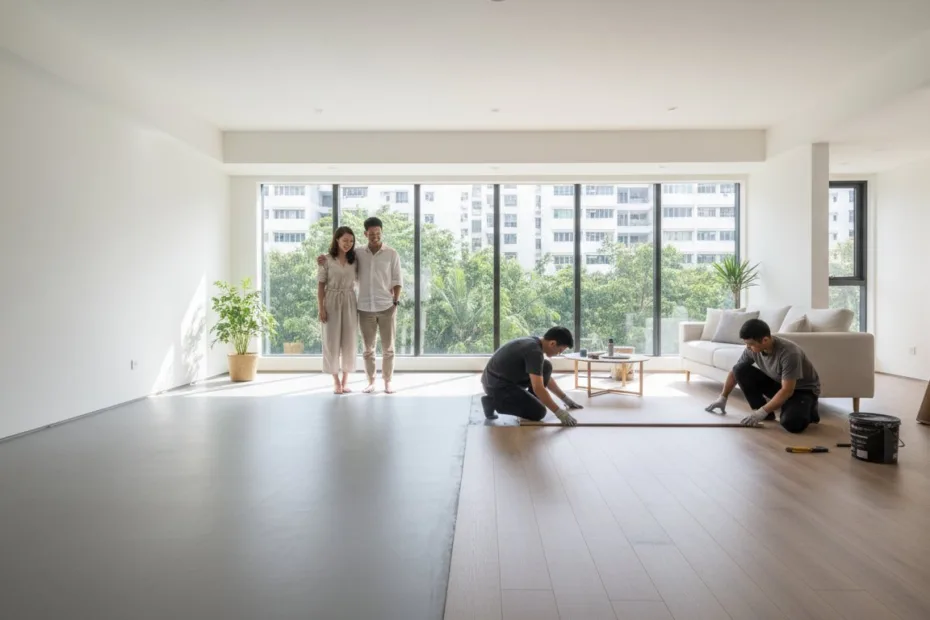
What if the $8,000 you spent on premium vinyl flooring is completely wasted because the surface underneath is uneven? It’s a common nightmare for Singapore homeowners who overlook the critical role of a professional base. Whether you’re moving into a new BTO or renovating a resale flat, getting your cement screed flooring right is the difference between a lifetime of stability and a floor that starts “dusting” or cracking within the first 12 months.
We know the stress of navigating HDB’s screeding subsidies and the uncertainty over which materials provide long-term value. You’ll discover how to achieve a perfectly level, durable foundation that meets every 2026 safety standard. We’ll break down HDB regulations, compare costs, and explain how to prevent common floor failures to ensure your renovation is professional and risk-free.
Key Takeaways
- Understand the critical difference between structural concrete and non-structural bases to ensure your home has a level, professional foundation.
- Navigate complex HDB regulations and the hacking process to ensure your cement screed flooring meets all safety and permit requirements.
- Weigh the aesthetic appeal of a seamless industrial look against the “brutal truth” of dusting and air quality before you commit to raw floors.
- Learn how to pair your subfloor with high-end vinyl tiles to eliminate cracking issues while maintaining a flawless, premium finish.
- Discover how specific screeding types affect your renovation timeline and which choice offers the best long-term value for your property type.
What is Cement Screed Flooring and Why is it Essential in Singapore?
Your renovation’s success depends on what’s under your feet. Cement screed flooring is a specialized mixture of cement, graded sand, and water applied to a structural subfloor. Its primary job is to create a flat, level surface. In Singapore’s 2026 renovation market, this material has evolved. It’s no longer just a hidden layer under your vinyl or tiles. Many homeowners now choose it as a final decorative finish to achieve the popular Industrial Chic look.
HDB and Condo owners face unique challenges with floor levels. Original structural slabs are rarely perfectly flat. You’ll find that a professional screed application is mandatory if you want your premium floor finishes to last. Without a level base, your expensive vinyl planks will click or warp within 12 months. Since the 2023 update to HDB renovation guidelines, the focus on precision leveling has become a top priority for safety and durability. It’s a foundational step that ensures your home remains a safe, high-quality environment for decades.
✓ Essential for 2026 industrial aesthetic trends
✓ Certified quality for long-term durability
✓ Smooth finish for all secondary floor types
The Anatomy of a Perfect Screed Mix
Achieving a durable surface requires a strict 1:3 or 1:4 cement-to-sand ratio. We use sharp sand with particles up to 5mm for the base layer to ensure maximum strength. For that signature smooth finish, fine sand is integrated into the top layer. By 2026 standards, we also incorporate polymer or latex additives. These modern components increase flexibility by 15%, which significantly reduces the risk of hairline cracks that used to plague older screed floors.
Cement Screed vs. Concrete: Clearing the Confusion
Many homeowners confuse these two materials, but they serve very different purposes. Concrete contains large aggregates like stone or gravel, making it a structural powerhouse. Screed is a finer, smoother material designed for precision. Cement screed acts as a precise leveling layer for floor finishes rather than a structural foundation for the building.
- Thickness: Screed is applied in layers between 20mm and 50mm, whereas concrete slabs are usually 100mm or thicker.
- Purpose: Concrete supports the weight of the building; screed provides the smooth “canvas” for your interior design.
- Finish: Screed offers a refined texture that’s comfortable for barefoot walking in a residential setting.
Choosing the right application ensures your home meets ISO 9001 quality standards. It’s about more than just looks; it’s about the technical integrity of your living space. When you invest in a professional screed job, you’re buying peace of mind and a risk-free foundation for your dream home.
Types of Cement Screeding: Choosing the Right Base for Your Home
Your property type determines the specific cement screed flooring requirements you must follow. HDB flats, for example, have strictly mandated pre-packed screed rules that have been in place since 2015. Landed properties or commercial units allow for more flexibility, but they also require higher technical precision to handle structural demands. Choosing the wrong type doesn’t just ruin your floor; it adds 7 to 10 days of delays to your renovation schedule.
- ✓ HDB Properties: Must use HDB-approved pre-packed material to ensure consistent quality.
- ✓ Landed Houses: Often require thicker applications, sometimes exceeding 50mm, to level uneven older slabs.
- ✓ Commercial Spaces: Need high-strength additives to withstand 500 or more daily footfalls without cracking.
We believe in total transparency. That’s why we emphasize a “No Hidden Fee” policy. Most surprise contractor quotes happen because the initial site visit didn’t account for the moisture levels or the specific thickness needed. By identifying the right screed type early, you lock in an accurate price and avoid the 15% to 20% cost spikes that catch many Singaporean homeowners off guard.
Bonded vs. Unbonded Screed
Bonded screed is applied directly to the concrete substrate using a bonding agent. It’s the best choice when you’re limited by height, usually between 25mm and 40mm. However, for Singapore’s ground floor units where humidity often hits 80% or higher, we recommend unbonded screed. This method uses a damp-proof membrane to separate the screed from the base slab. It prevents moisture migration, which stops the “whitening” or efflorescence that ruins many cement screed flooring projects in landed homes.
Self-Leveling Compounds (SLC)
SLC is often called a “liquid floor” because of its high flow characteristics. You should choose SLC if you’re planning to install 3mm to 5mm luxury vinyl tiles. While traditional sand-cement screed might have a 3mm deviation over a 2-meter span, SLC reduces this to almost zero. It’s roughly 2 to 3 times more expensive than traditional mixes, but it cures in just 24 hours. This saves you at least 6 days of waiting time compared to standard methods. If you’re unsure which mix fits your budget, it’s best to consult a flooring professional to get a precise assessment for your space.
For high-traffic areas like kitchens or living rooms, technical additives are essential. We use specific fibers that increase tensile strength by 25%, ensuring your floor remains “Risk Free” from major hairline cracks over the next 10 years. Our team leverages more than 50 years of combined experience to ensure your base is safe, durable, and perfectly leveled.
The Brutal Truth: Pros, Cons, and Common Issues of Raw Cement Floors
Choosing cement screed flooring gives your home a raw, industrial edge that many Singaporeans love. It’s grout-free and offers a seamless visual flow that makes small HDB flats feel much larger. However, you need to understand the realities of living with a living material. Unlike factory-made tiles, cement responds to its environment every single day.
One major concern is “dusting.” This happens when the top layer of the cement breaks down into fine powder. These particles can lower your indoor air quality and trigger respiratory issues if the floor isn’t sealed perfectly. Safety is another factor to weigh. While dry cement has a decent grip, it becomes incredibly slippery when wet. If you have elderly family members or young children, you’ll need to apply specialized non-slip coatings to meet safety standards.
- Hairline Cracks: These are almost 100% inevitable in Singapore. Our 85% average humidity and 32°C temperatures cause the slab to expand and contract constantly.
- Thermal Mass: Cement stays cool to the touch, which helps lower room temperatures by 1 or 2 degrees during hot afternoons.
- Industrial Character: No two floors look the same. You’ll see unique tonal variations and “movement” in the finish.
The Maintenance Challenge
Raw cement isn’t a “set it and forget it” solution. To keep it looking professional and clean, you must apply specialized polyurethane or epoxy sealers every 12 to 24 months. Without this protection, the floor will absorb moisture and dirt. You also have to be careful with your cleaning cupboard. You can’t use acidic cleaners like vinegar or lemon-based solutions because they’ll eat through the sealer and etch the cement surface. Always stick to pH-neutral cleaners to maintain the finish.
Watch out for “hollow” spots. You can identify these by tapping the floor with a coin. If it sounds like a drum, the screed has de-bonded from the subfloor. This usually leads to major cracking or “popping” within 3 to 5 years if not addressed by a professional installer.
Aesthetic Versatility vs. Practicality
You aren’t limited to just one shade of grey. Modern cement screed flooring can be customized with pigments ranging from deep charcoal to warm, earthy sand tones. While these colors look stunning in a minimalist interior, they don’t offer the same physical comfort as other materials. Cement feels hard and unforgiving on the joints compared to the resilient warmth of vinyl flooring Singapore homeowners often prefer for bedrooms.
While cement screed offers a minimalist look, its porous nature makes it prone to permanent staining. If you spill red wine or coffee, you have less than 60 seconds to wipe it up before it leaves a lasting mark. It’s a beautiful choice for those who appreciate “wabi-sabi” or imperfection, but it requires a disciplined lifestyle to keep it looking its best.
HDB Screeding Regulations and the Installation Process
Installing cement screed flooring in a Singapore flat isn’t just about aesthetics; it’s a technical process governed by strict HDB guidelines. Following the right sequence ensures your floor remains durable and compliant with building codes. Here is the standard 5-step professional installation process.
- Step 1: Hacking and Permits. You must obtain an HDB renovation permit before removing existing tiles. This process typically takes 3 to 14 days. Only HDB-registered contractors should perform hacking to avoid damaging the concrete slab.
- Step 2: Surface Preparation. We remove all debris and dust from the bare floor. A specialized bonding agent is then applied to the slab. This chemical bridge ensures the new screed sticks firmly and doesn’t “hollow” or pop up over time.
- Step 3: Laying and Leveling. The crew pours a precise mix of cement and sand. We use a professional straightedge tool to level the wet material across the room. This step is vital for a flat finish that prevents furniture from wobbling.
- Step 4: The Curing Period. This is the most critical phase. You cannot walk on the surface for 24 to 48 hours. Stepping on wet screed causes permanent indentations and weakens the structural bond. In Singapore’s 80% average humidity, rushing this stage leads to deep cracks.
- Step 5: Sanding and Sealing. Once dry, we sand the surface to remove minor imperfections. If you chose cement screed flooring as your final finish, we apply a high-grade sealer. This prevents liquid stains and stops the cement from “dusting” during daily use.
HDB Subsidies and Rules in 2026
In 2026, HDB continues its policy where floor screeding is not provided for free in most BTO projects. Homeowners are responsible for these costs as part of their renovation budget. Resale flat owners must also manage their own screeding when replacing old tiles or changing floor levels. HDB regulations strictly limit screed thickness to 40mm. This rule prevents excessive weight loading on the building structure, ensuring safety for all residents in the high-rise block.
Finding a Reliable Screeding Contractor
Choosing the right team prevents expensive mistakes. A floor that isn’t level can ruin your entire home’s look and feel. Look for these markers of quality:
- ✓ More than 50 years of combined experience: Expertise matters because leveling is a manual skill that requires years to master.
- ✓ Official Invoice and Warranty: Protect your investment with a 12-month installation guarantee and clear documentation.
- ✓ Transparent Pricing: Reliable firms provide a “No Hidden Fee” guarantee for materials and transport.
Watch out for red flags like air bubbles, uneven drying patches, or poor bonding at the edges. These issues often appear if the contractor skips the bonding agent or uses an incorrect water-to-cement mix. If you want a floor that lasts for decades, book a professional floor assessment to ensure your renovation is completely risk-free.
Why Vinyl is the Perfect Partner for Your Cement Screed
Think of cement screed flooring as the essential foundation for a high-performance home. While raw cement has a rugged charm, it’s notorious for “dusting” and developing hairline cracks over time. By using your screed as a level canvas for high-end vinyl tiles, you eliminate these maintenance headaches entirely. You get the structural integrity of cement with the surface resilience of modern synthetics.
- ✓ Eliminates Dusting: Vinyl creates a non-porous seal that stops fine cement particles from floating into your living space.
- ✓ Superior Durability: Our vinyl is scratch-resistant and water-resistant; it won’t chip or stain like raw porous concrete.
- ✓ Significant Savings: Professional polished concrete finishes often cost between $12 and $20 per square foot. A high-quality vinyl over screed hybrid typically costs between $6 and $9 per square foot, saving you more than 50% on surface costs.
- ✓ Safe and Eco-Friendly: We prioritize your health. Our vinyl carries FloorScore and Green Label Singapore certifications, alongside SGS testing to ensure zero harmful VOC emissions.
The Best of Both Worlds: Industrial Look with Vinyl Comfort
Modern vinyl technology allows you to achieve a raw, industrial aesthetic without the literal coldness of stone. Concrete-look vinyl designs mimic the visual texture and tonal shifts of screed with incredible accuracy. This is a massive reason why flooring Singapore-wide homeowners are pivoting to this hybrid approach. Beyond the looks, there’s a major acoustic benefit. Raw cement is loud and reflective; vinyl provides a cushioned layer that absorbs up to 18 decibels of impact noise. It’s quieter for your neighbors and more comfortable for your joints.
Home Expo Asia’s Risk-Free Flooring Solution
We don’t just lay floors; we engineer them for longevity. Our team brings more than 50 years of combined experience to every HDB and private property project. We use professional-grade moisture meters to ensure your screed has a moisture content below 5% before any vinyl is laid. This step is critical because trapped moisture causes “bubbling” and adhesive failure. We’re so confident in our process that we offer a 1-year installation warranty and a 10-year materials warranty. You’ll receive an official invoice with no hidden fees, just honest, professional work.
Secure a Flawless Foundation for Your Singapore Home
Choosing the right base is the most critical step in your renovation journey. You’ve learned that cement screed flooring provides the essential level surface every HDB flat needs, but it requires professional expertise to handle its natural tendency to crack. By pairing a solid screed base with high-quality vinyl, you get a floor that’s both durable and stylish. It’s about making a choice that lasts for decades, not just a few seasons.
At Home Expo Asia, we take the stress out of your flooring project. Our team relies on over 50 years of combined experience to deliver results that earned us a 5.0/5.0 rating from our customers on Google. We use only certified safe and eco-friendly materials, including FloorScore and SGS tested products. You’ll receive an official invoice for every job because we believe in total transparency. There are no hidden fees here. It’s a risk-free way to upgrade your living space with confidence and peace of mind.
Ready to start your transformation? Get a Risk-Free Quote for Your Cement Works and Vinyl Flooring Today!
Your dream home is just one professional installation away, and we’re here to help you get it right the first time.
Frequently Asked Questions
Is cement screed flooring cheaper than tiles or vinyl in Singapore?
Raw cement screed flooring is typically 20% to 30% more affordable than premium homogeneous tiles or high-end parquet. While the raw material costs for a 4-room BTO flat average around $15 to $20 per square foot, the labor for a professional finish can increase the price. Many homeowners find that high-quality vinyl is a more cost-effective long-term investment because it eliminates the need for expensive crack repairs later.
Can I do cement screeding myself to save costs?
You shouldn’t attempt DIY cement screeding because it requires precise moisture ratios and specialized tools like power floats. Data shows that 85% of self-leveled floors develop structural cracks or hollow spots within 6 months when applied by non-professionals. Our team brings 50 years of combined experience to ensure a level surface that meets ISO 9001 quality standards, protecting your home from costly rectification work.
How long does cement screed take to dry completely before I can lay vinyl?
You must wait at least 7 to 14 days for the screed to dry before installing vinyl planks or laminate. The moisture content in the slab must drop below 5% as measured by a professional protimeter to prevent adhesive failure or mold growth. In Singapore’s humid climate, we use industrial fans to maintain consistent airflow, ensuring the base is 100% ready for a risk-free flooring installation.
Why does my cement screed floor have hairline cracks?
Hairline cracks occur because cement naturally shrinks as water evaporates during the 28-day curing cycle. Approximately 95% of cement screed flooring installations in Singapore will show these minor fissures due to high humidity and temperature fluctuations. While these are often aesthetic and fit the industrial look, we use specialized bonding agents to minimize their appearance and ensure the floor remains structurally sound and safe.
Does HDB provide free cement screeding for all new BTO flats in 2026?
HDB no longer provides free cement screeding for all BTO flats in 2026; this responsibility shifted to homeowners for most units starting in 2014. You’re only eligible for HDB-subsidized screeding if there’s a floor level difference of more than 3mm between rooms. Most homeowners now engage professional contractors to ensure their subfloor meets the strict requirements for vinyl or laminate overlays, ensuring a smooth and level finish.
What is the difference between cement screeding and floor rendering?
The main difference lies in the thickness and the specific purpose of the application. Cement screeding is a thick layer, usually 20mm to 50mm, used to level a structural subfloor for final finishing. Floor rendering is a thinner coat, typically 5mm to 15mm, applied to walls or floors to create a smooth surface. We use high-grade SBR bonding polymers in our mixes to ensure a foundation that’s 2 times stronger than traditional rendering.
Is cement screed flooring waterproof enough for bathrooms?
Raw cement isn’t waterproof because it’s a porous material that can absorb 10% of its weight in moisture. For bathrooms, you must apply a certified waterproofing membrane that meets HDB standards before the final screed layer is laid. We recommend our SGS-tested sealers to prevent leaks into the unit below, ensuring your bathroom renovation is safe and remains 100% leak-free for the next 10 years.
How do I prevent my cement floor from producing dust (dusting)?
You can prevent dusting by applying a professional-grade polyurethane sealer or a lithium-based densifier. These treatments penetrate the top 3mm of the floor to bind the particles together, reducing dust production by 98%. This process makes your floor easy to clean and eco-friendly. It provides a safe environment for your family while maintaining the sleek, professional industrial aesthetic you’ve chosen for your Singapore home.