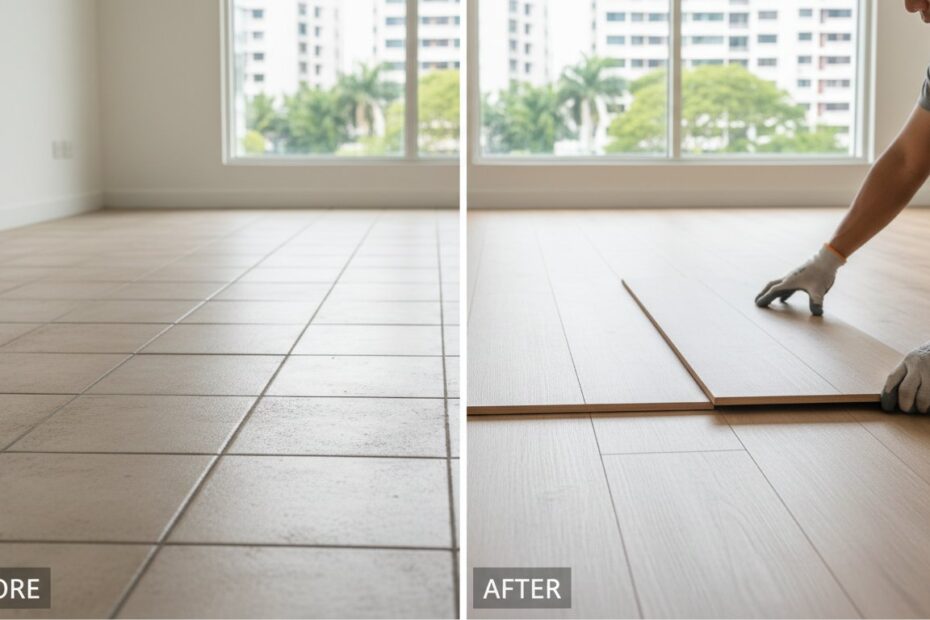
What if you could skip the S$2,000 hacking fee and the weeks of construction dust currently standing between you and your dream home? Most Singaporean homeowners dread the noise and mess of a traditional floor renovation. You want a fresh look, but the thought of jackhammers echoing through your HDB block is enough to put any project on hold. One of the most common questions we hear from clients is, “can you install vinyl over ceramic tiles” without the floor looking uneven or failing within a year?
For prices, options and installation details for living rooms, bedrooms and kitchens, see our guide to vinyl flooring Singapore.
The answer is yes, but the secret to a professional result lies in the preparation of your subfloor. We’ve completed over 3,500 successful overlays across Singapore, and we know exactly what it takes to prevent grout lines from showing through. This guide will walk you through the essential suitability checks for your existing tiles. You’ll also learn the specific techniques our installers use to ensure a long-lasting, water-resistant finish that looks exactly like a brand-new floor.
Key Takeaways
- Learn exactly when can you install vinyl over ceramic tiles to avoid a messy hack-out and save significantly on your Singapore home renovation costs.
- Discover why Rigid Core SPC technology is the essential choice to prevent grout line ghosting and ensure your new floor remains perfectly level over time.
- Identify how to manage Singapore-specific flooring risks, such as “popping tiles,” while benefiting from a faster and more eco-friendly installation process.
- Master the professional preparation workflow, from deep degreasing to grout filling, to ensure your overlay stays secure for years to come.
- Understand how expert underlayment selection and a professional warranty can eliminate “hollow” sounds and provide a truly Risk-Free flooring transformation.
Can You Install Vinyl Over Ceramic Tiles? The “Yes, But” Criteria
The short answer is yes; can you install vinyl over ceramic tiles? Absolutely. In fact, the overlay method has become the preferred renovation standard for Singaporean homes in 2026. It saves time, reduces dust, and significantly lowers labor costs. However, your existing floor must meet specific safety and stability standards before we proceed. Many homeowners ask, can you install vinyl over ceramic tiles without losing significant ceiling height? Yes, provided the substrate is level and secure.
Substrate stability is the most critical factor in preventing floor failure. If the underlying ceramic tiles are loose, the new vinyl layer will eventually shift or crack. Understanding the material properties of a Vinyl composition tile helps explain why a flat surface is non-negotiable. Vinyl is flexible; it mirrors the texture and imperfections of whatever sits beneath it. If your tiles are “hollow” or uneven, those defects will telegraph through the surface, ruining the aesthetic and structural integrity of your new floor. Quality is our #1 priority, and that starts with a solid foundation.
When an Overlay is the Perfect Choice
Overlaying is a high-quality, professional solution when your original flooring is structurally sound. It’s a reliable way to achieve a premium look without the mess of heavy construction. It’s particularly effective in these scenarios:
- ✓ HDB BTO and Resale Flats: If your original tiles are sound, overlaying is the fastest way to modernize your space.
- ✓ Cost Management: Choose an overlay when hacking and disposal costs exceed 30% of your total flooring budget. This keeps your renovation affordable and efficient.
- ✓ Rental and Commercial Spaces: It’s perfect for quick aesthetic refreshes where you need a durable, water-resistant surface without weeks of downtime.
Red Flags: When You Must Hack Your Tiles Instead
Sometimes, safety dictates that hacking is the only responsible path. We prioritize your long-term peace of mind, so we look for these specific warning signs during our site inspection:
- Popping or Buckled Tiles: This indicates structural movement or moisture trapped beneath the ceramic. Overlaying won’t fix this; it’ll only hide a growing problem.
- Extreme Height Variance: If the surface is uneven by more than 3mm over a 2-meter distance, the vinyl planks won’t lock correctly. This leads to gaps and “springy” spots.
- Loose or Cracked Tiles: If more than 10% of your floor sounds “hollow” when tapped, the bond between the tile and the concrete slab has failed. In these cases, we recommend a full hack to ensure a safe, certified installation.
Our experienced team ensures every installation is risk-free. We don’t just cover up problems; we solve them. By identifying these red flags early, we ensure your 2026 home renovation stands the test of time.
The Science of Substrates: Preventing Telegraphing and Grout Line Ghosting
Telegraphing is a common issue where the texture of your old floor shows through your new one. It usually appears as “ghost” lines exactly where your ceramic grout used to be. When homeowners ask, can you install vinyl over ceramic tiles, they often worry about these visible shadows. This happens because vinyl is a resilient material that eventually settles into any gaps or uneven spots beneath it.
To ensure a professional finish, you must understand the relationship between the tile surface and the vinyl plank. A flat substrate is mandatory for a long-lasting floor. Without proper preparation, the pressure from heavy furniture and daily foot traffic will force the vinyl to mirror the tile pattern below, ruining the aesthetic of your renovation.
Managing Grout Lines and Surface Texture
Deep grout lines are the biggest enemy of a smooth vinyl finish. If your existing tiles have wide gaps, these depressions create “valleys” that the vinyl will eventually sink into. Professionals use a specific process to neutralize these risks:
- ✓ Skim Coating: We apply a high-quality floor patch compound over the entire surface to fill grout lines.
- ✓ The 5mm Rule: If your grout lines are wider than 5mm, a direct floating installation without filler will almost certainly fail.
- ✓ Self-leveling Compounds: For ceramic floors with significant height variations or lippage, a self-leveling pour creates a perfectly flat plane.
Testing your floor is simple. Lay a straight edge across your tiles; if you see gaps larger than 3mm, your substrate needs professional leveling before you proceed.
Rigid Core (SPC) vs. Flexible LVT Over Tiles
The type of vinyl you choose determines how much preparation your tiles need. Flexible Luxury Vinyl Tiles (LVT) are thin and pliable, making them highly prone to showing tile patterns. In contrast, Stone Plastic Composite (SPC) is the industry standard for overlays in Singapore due to its structural integrity.
SPC’s limestone core prevents indentation from tile edges by providing a heavy duty, non-flexible foundation that resists pressure. This rigid core allows the planks to “bridge” minor imperfections in your ceramic tiles without sagging into the grout lines. It is a much more forgiving material for HDB and condo renovations where the original tiling might not be perfectly level.
Proper underlayment is also essential. In Singapore, we prioritize high-density IXPE foam underlayment. This material provides the necessary structural support to prevent the vinyl click-system from breaking while meeting HDB standards for sound dampening. Using the right underlayment ensures your floor feels solid rather than hollow. To get the best results, you can book a professional site assessment to check your current tile condition.
Our team relies on FloorScore certified materials to ensure your home remains safe and eco-friendly. By choosing SPC over flexible options, you eliminate the risk of ghosting and ensure a durable, professional result that lasts for decades. It’s a risk-free way to upgrade your home without the mess of hacking.
Pros, Cons, and the Singapore “Popping Tile” Risk
Deciding to overlay your floor is a major step in any home renovation. When homeowners ask “can you install vinyl over ceramic tiles”, they’re usually looking for a balance between aesthetics and budget. This method offers several distinct advantages, but it also comes with specific trade-offs that you need to understand before the first plank is laid.
- ✓ Significant cost savings: You avoid the S$500 to S$2,000 cost associated with hacking and disposing of old ceramic tiles.
- ✓ Faster installation: A standard 4-room HDB flat can often be completed in just 2 days since there’s no need for floor drying or extensive prep work.
- ✓ Reduced construction waste: Overlaying is an eco-friendly choice that keeps old materials out of Singapore’s landfills.
While the answer is yes, you can install vinyl over ceramic tiles, the success of the project depends on the stability of the existing base. If the installation is rushed or the subfloor is uneven, you might experience a “hollow” acoustic feel when walking. This occurs when there are tiny air gaps between the vinyl and the ceramic surface. Using high-quality, certified underlayment is the best way to dampen this sound and ensure a premium feel underfoot.
The “Popping Tile” Phenomenon in Local Homes
Singapore’s tropical climate is characterized by high humidity and temperatures that fluctuate between 25°C and 33°C. This environment causes ceramic tiles to expand and contract constantly. In older HDB flats, the bond between the tile and the cement screed can weaken over 10 to 15 years. This leads to “popping tiles,” where the flooring suddenly lifts or cracks due to internal pressure.
Overlaying vinyl on top of tiles that are already under stress is a recipe for disaster. If the base tiles pop, your new vinyl floor will buckle and warp. Professional installers at Home Expo Asia assess tile bond strength using percussion tools to identify hollow areas. We ensure the foundation is 100% stable before proceeding. It’s part of our commitment to providing a safe and risk-free experience for every homeowner.
Managing Floor Height and Door Clearance
You must calculate the total stack-up height to avoid legal and functional issues. A typical ceramic tile is 8mm to 10mm thick. When you add 5mm vinyl and a 1.5mm underlayment, your floor rises by roughly 6.5mm. HDB renovation guidelines specify that the total thickness of the floor finish must not exceed 50mm. Overlaying easily stays within these legal limits, but it does impact your doors.
If your bedroom doors or main entrance doors have a tight gap, they will scrape against the new floor. We solve this by professionally trimming the bottom of timber doors by 3mm to 5mm. Additionally, we use transition strips between different room types. These strips manage the height difference between the new vinyl in the living room and the original tiles in the kitchen or bathroom, preventing trip hazards and ensuring a clean, professional finish.

How to Install Vinyl Over Tile: The Professional Workflow
Achieving a flawless floor requires more than just laying planks. When homeowners ask can you install vinyl over ceramic tiles, the answer is a definitive yes, provided you follow a rigorous, four-step professional workflow. This process ensures your new floor remains stable, quiet, and looks premium for years to come.
- Step 1: Intensive Cleaning. We remove every trace of old wax, grease, and sealant using industrial-grade degreasers. Standard mopping leaves residues that can compromise the stability of the new layer.
- Step 2: Surface Correction. Our team identifies and secures loose tiles. We fill grout lines wider than 3mm with a specialized leveling compound. This prevents “telegraphing,” a common issue where the old tile pattern eventually shows through the vinyl surface.
- Step 3: Underlayment. We lay high-density IXPE or EVA foam. This provides a 100% moisture barrier and superior sound dampening, which is essential for high-rise living.
- Step 4: Precision Clicking. Planks are locked together using a staggered joint pattern. This ensures structural integrity and creates a seamless, natural wood-look finish across the entire room.
Essential Tools and Preparation
Preparation is the most critical phase for a long-lasting result. A simple mop won’t cut it because old ceramic tiles often have decades of floor wax that make surfaces slick. We use specialized solutions to ensure a clean, high-friction base. For ground-floor units in Singapore, we prioritize a dedicated moisture barrier to block rising damp from the concrete slab. We always factor in a 10% wastage rate for material orders. This specific margin accounts for intricate cuts around door frames and built-in cabinetry, ensuring you don’t run out of planks mid-job.
Installation Best Practices for Longevity
Longevity depends on technical precision during the final stages. We leave an 8mm to 10mm expansion gap around the perimeter of every room. Vinyl expands and contracts with Singapore’s fluctuating humidity; without this gap, your floor will eventually buckle or warp. Every plank undergoes a “Tap Test” with a professional rubber mallet. This ensures the click-lock mechanism is 100% engaged to prevent water seepage between joints. Finally, we install matching skirting and apply high-grade silicone sealing. This creates a professional finish that protects your edges from mop water and dust accumulation.
Ready to transform your space with a hassle-free upgrade? Book your professional vinyl installation with our expert team today and enjoy a risk-free experience.
Why Professional Installation is Your Best Warranty
Choosing to upgrade your floors is a major home improvement decision. While many homeowners ask can you install vinyl over ceramic tiles as a DIY project, professional execution is the only way to ensure a flawless finish. At Home Expo Asia, we call this our Risk-Free promise. We don’t just lay planks. We engineer a durable surface that feels solid and premium underfoot.
- Expert Underlayment Selection: We eliminate the annoying hollow sound by selecting high-density underlayment tailored to your existing tile condition. This ensures your new floor feels as solid as the original ceramic.
- Long-Term Peace of Mind: It’s Risk Free! Our comprehensive warranties cover materials for up to 25 years and our expert workmanship for 1 year.
- Premium Design Access: You get access to over 200 designs. These options mimic natural wood grains and marble textures perfectly, giving you the luxury look without the luxury price tag.
- Certified Quality: We use materials that are FloorScore, SGS, and Green Label Singapore certified. This ensures your home remains safe and eco-friendly.
Don’t Listen to Us, Listen to Our Customers
Our reputation in Singapore is built on transparency and real results. We currently maintain a 4.9/5.0 Google review rating from real Singaporean homeowners who value quality. They trust us because we have more than 50 years of combined industry experience. One recent case study involved a 4-room HDB flat transformation. We completed the entire installation in just 48 hours without any hacking. The owners moved their furniture back in immediately. This efficiency is why we are a top choice for busy families. We provide an official invoice for every job. Quality is our #1 priority.
Get Your Professional Site Assessment
Every floor has its own quirks. A free site visit is crucial because it allows our experts to check your ceramic tile stability and grout line depth. We identify potential issues like loose tiles or moisture before they become expensive repairs. After the assessment, we provide customized quotes with no hidden fees. What you see is what you pay. We believe in honest, direct service that respects your budget. Ready to start your home transformation? Book your free site assessment with Home Expo Asia today!
Secure Your Flooring Investment Today
Deciding if can you install vinyl over ceramic tiles depends entirely on the stability of your current floor. You’ll prevent issues like telegraphing and grout line ghosting by ensuring your tiles are level and securely bonded. In Singapore’s humid climate, professional preparation is the only way to avoid the “popping tile” phenomenon that ruins many DIY attempts. It’s about more than just aesthetics; it’s about structural integrity and lasting quality.
Home Expo Asia provides the expertise needed for a flawless finish, backed by over 50 years of combined flooring experience. We prioritize your family’s safety by using FloorScore and Green Label Singapore Certified materials. Our commitment to quality includes an Up to 25-Year Materials Warranty and a 1-Year Workmanship Warranty, making your renovation completely risk-free. You deserve a beautiful home that stands the test of time.
Get a Risk-Free Vinyl Flooring Quote for Your Home
Frequently Asked Questions
Do I need to remove the baseboards before installing vinyl over tile?
It’s highly recommended to remove baseboards before you install vinyl over ceramic tiles to achieve a professional, seamless finish. Removing them lets our installers hide the required 5mm expansion gap behind the skirting rather than using unsightly capping. This ensures your floor remains stable during temperature changes without buckling or warping.
Will the grout lines show through the vinyl over time?
Grout lines can show through thinner vinyl layers over time, a process known as telegraphing. To prevent this, our team uses a self-leveling compound or high-density SPC vinyl with a minimum thickness of 5mm. This rigid core technology bridges the gaps between your existing tiles, keeping the surface perfectly flat for years of use.
How much does it cost to install vinyl over tiles in Singapore?
At Home Expo Asia, laying vinyl over your existing tiles costs from $2.50/sqft with supply and installation included, and most designs are $3.50 to $6.00/sqft. This price usually includes the supply of SPC vinyl and professional installation labor. For an accurate quote, it’s best to book a site measurement to assess your specific floor area and any required leveling work.
Can I install vinyl over tiles in the bathroom or kitchen?
You can install vinyl over tiles in the kitchen, but we don’t recommend it anywhere in a bathroom or toilet, including dry toilets. While our SPC vinyl is 100% waterproof and FloorScore certified, water can seep through the click-lock joints into the old grout below. For kitchens, it’s a safe and durable choice that stands up to daily spills; for bathrooms and toilets, we recommend tiles.
Does vinyl flooring over tile sound hollow when you walk on it?
Vinyl flooring doesn’t sound hollow when installed correctly over a flat, level ceramic base. We use a high-quality 1.5mm to 2mm IXPE underlayment to absorb impact noise and provide a solid feel underfoot. This padding eliminates the clicking sound often associated with thinner materials and ensures your home remains quiet and comfortable.
How much height will a vinyl overlay add to my floor?
A standard vinyl overlay adds approximately 5mm to 7mm of height to your existing floor. This includes the 4mm or 5mm SPC plank and the 1.5mm integrated underlayment. You should check your door clearances; 90% of Singapore HDB doors require a slight trimming of 2mm to 3mm to swing freely after the new floor is laid.
Can I install vinyl over cracked or loose ceramic tiles?
You shouldn’t install vinyl over loose or severely cracked tiles without repairing them first. Any movement in the base layer will eventually cause the vinyl click-joints to snap or fail. Our professionals inspect your floor for hollow sounds; we’ll secure or patch those specific areas before the overlay begins to ensure a risk-free result.
What is the best type of vinyl for an overlay project?
Stone Plastic Composite (SPC) is the best material when you install vinyl over ceramic tiles because of its rigid core and high dimensional stability. Unlike traditional flexible LVP, SPC won’t conform to the texture of the grout lines underneath. It’s also scratch-resistant and eco-friendly, making it the top choice for 2026 Singapore home renovations.